




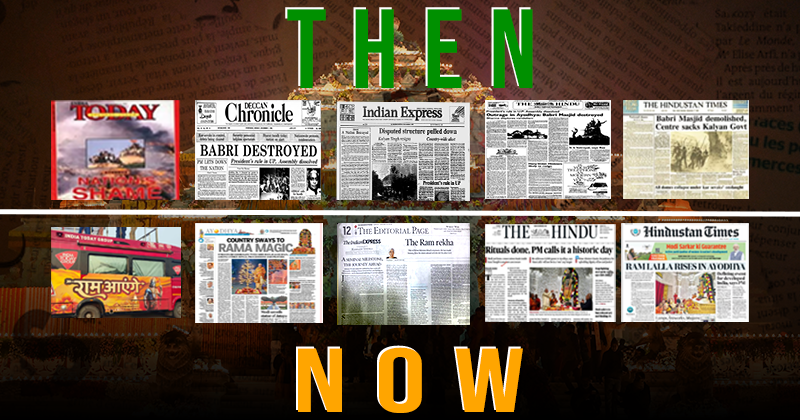
Over the past three decades, Bharat has witnessed a significant transformation in the media’s portrayal of the Ayodhya Ram Janmabhoomi issue and the disputed site. From labelling the demolition of disputed structure as the “Nation’s Shame,” “A Nation Betrayed,” and “Unholy War: Assault on the Secular State” to the recent celebration of the Ram Mandir’s Pran Pratishta, the media’s narrative has undergone a profound shift. Today, we will delve into the changing dynamics of media coverage over the years, exploring the factors contributing to this evolution.
In the aftermath of the demolition of the disputed structure on December 6, 1992, media outlets across the nation unanimously condemned the incident. Publications like India Today carried headlines such as ‘Ayodhya: Nation’s Shame,’ reflecting a sentiment of collective disapproval. The editor, Aroon Poorie, wrote, “There come moments in history when a nation’s soul is seared. For India, that moment came on the afternoon of December 6 when the Babri Masjid-Ram Janmabhoomi-disputed structure, call it what you will, was demolished. It exposed the fragile face of India’s secular democracy. The true character of a person is often unveiled in times of crisis…It is a shame because the largest opposition party of the country thought nothing of reducing this country to a mobocracy by encouraging its followers to take the law into their own hands. It knew very well the catastrophic consequences of such an act.”
Similarly, senior journalist Malini Parthasarthy’s evolving statements reflect a significant shift in her opinion over time and changing circumstances. Initially, as the editor of ‘The Hindu,’ in her editorial titled ‘Unforgiveable’ she strongly condemned the demolition, describing it as “religious fanaticism at its ugliest and expressing deep anguish at the damage caused to the secular and democratic image of India. She wrote, “It was religious fanaticism at its ugliest in Ayodhya yesterday, with the country’s worst fears coming true in the nightmarish spectacle of the brutal destruction of the 450-year-old Babri Masjid by thousands of frenzied kar sevaks. The disputed mosque was razed to the ground with a barbaric savagery reminiscent of the crude traditions of settling scores in medieval history. The demolition of the Masjid has delivered a lethal blow to the image of a secular and democratic India. Yesterday’s catastrophe underlines the validity of the misgivings that a permissive attitude to the kar seva would have disastrous consequences. Sunday was a dark day for India. The Hindu shares the nation’s sense of deep anguish at this painful moment”.
The media’s narrative has evolved from condemnation to embracing the cultural and religious significance attached to the Ram Janmabhoomi
However, with the passage of time and a change in her professional role, Malini Parthasarthy’s stance appears to have totally changed. Now, when she is not the Editor of The Hindu, she, on her X handle, expresses a different sentiment and writes, “As lakhs of devotees wait patiently in queues several kilometres long, I feel blessed & humbled to have had a darshan of the aweinspiring & majestic murti of Balak Ram immediately after the Pran Pratishtha ceremony.”
The change in her statements could be attributed to various factors, including her professional, societal shifts, or a re-evaluation of the situation over time.
For years following the demolition, media narratives consistently portrayed the event as a dark chapter in Bharat’s history. The media consistently criticised the right-wing groups for undermining the rule of law.
But the Ram Mandir has taken centrestage in headlines three decades later. It once again featured on the front pages of newspapers and leading news bulletins. Nevertheless, this comprehensive coverage notably avoids any reference to the disputed structure that previously occupied the disputed site. It was all about celebrating and marking a new era in the Bharatiya history. This contemporary narrative stands in stark contrast to the media coverage observed back in 1992.
In recent years, there has been a noticeable shift in media coverage, coinciding with the increasing prominence of the ‘Hindutva’ ideology championed by the Rashtriya Swayamsevak Sangh (RSS) and Bharatiya Janata Party (BJP). The media’s narrative has evolved from condemnation to embracing the cultural and religious significance attached to the Ram Janmabhoomi.
The transformation in media coverage of Ram Lalla’s Pran Pratishtha is vividly reflected in the evolving headlines of prominent newspapers. The Hindustan Times shifted from called the demolition “National Shame” to a celebratory tone with “Ram Lalla rises in Ayodhya.” Another newspaper Deccan Chronicle shifts its narrative from “Babri Destroyed” to “Country Sways To Rama Magic” on its front page, reflecting a change in perspective.
The Indian Express transformed its narrative from “A National Betrayed” to emphasising the event as “A Seminal Milestone, The Journey Ahead”. The Hindu’s transition from ‘Outrage in Ayodhya: Babri Masjid destroyed’ to ‘Dev to Desh, Ram to Rashtra’ illustrates a significant shift in perspective. Even Amar Ujala, previously marking December 6 as a black day, now proudly said ‘Hamare Ram Aa Gaye’ on its front page. These headlines collectively capture the drastic change in media coverage on this issue.
The shift in media coverage on this issue is primarily due to the awakening of Hindu identity in India. Also, this apparent shift is not a mere change in editorial stance but the impact of larger societal transformation that has forced the media organisations to find connect with the ‘Civilisational Bharat.’
Notably, Rashtriya Swayamsevak Sangh (RSS) and its inspired organisations like Vishva Hindu Parishad (VHP) played a key role in bringing all Hindu sects under one umbrella of Dharma Sansad. Bharatiya Janata Party (BJP) dared to take up the issue on the political plank under the leadership of Shri Lal Krishna Advani and PM Modi took it to the logical conclusion. By highlighting the optimism for a bright future in India through the construction of the Ram Mandir, they have successfully transformed an ideology that was once considered as ‘communal and fascist’. The media’s alignment with this narrative signifies a significant achievement for the right-wing groups in shaping public opinion.
On the other hand, it was the lone voice of the Organiser Weekly that was reverberating loudly and was fighting for the Hindu cause when all the media houses were against Ram Mandir and were crying on the demolition of disputed structure. The Weekly consistently reported the Ram Mandir Movement through its pages and played a constructive role in building the national discourse.
RSS and its inspired organisations like VHP played a key role in bringing all Hindu sects under one umbrella of Dharma Sansad. BJP dared to take up the issue on the political plank under the leadership of Shri Lal Krishna Advani and PM Modi took it to the logical conclusion. By highlighting the optimism for a bright future in India through the construction of the Ram Mandir, they have successfully transformed an ideology that was once considered as ‘communal and fascist’
Organiser, as a nationalist weekly, played a pivotal role in awakening the national consciousness by diligently reporting every aspect of the Ram Janmabhoomi Movement and never changed its stance. Through its coverage, Organiser contributed to the dissemination of information, fostering a deep understanding of the historical and cultural significance of the movement.
The publication’s commitment to reporting on the intricacies of the Ayodhya dispute helped keep the public well-informed, facilitating a broader dialogue on the issues surrounding the Ram Janmabhoomi case.
In conclusion, the shifting media portrayal of the Ayodhya Ram Janmbhoomi issue reflects broader societal changes, with a move from condemnation to celebration. Evolving narratives coincide with the rise of ‘Hindutva’ ideology, transforming public discourse. The BJP and RSS’s role in mainstreaming Hindu values and public opinion contributed to this shift, aligning media perspectives. Noteworthy exceptions, like Organiser Weekly, remained steadfast, highlighting the complexity of the issue.













Comments