






The ancient city of Kashi was first invaded by Mohammad Gori in the 12th century, as described by the 19th century scholar and historian James Prinsep1. Qutubuddin, general of Mohammad Gori was sent to decimate the city. More than 1000 Hindu temples were demolished and vandalised in this invasion, Kashi Vishwanath being the most important temple, could not have been omitted. Carruthers2 further describes the fierce battle in great detail:
“One of these kings, by name Rai Jai-Chand, is mentioned by the above-named historian, and also by Hussein Nizamí, in his ‘Tajulma Asir,’ as having, in A.D. 1194, advanced, ‘with an army countless as the sand,’ to oppose the invading forces of the Emperor Shahab-u-din Ghori, advancing from Ghazni. The opposing armies met near the river Jumna, and after a long and sanguinary contest, in which ‘the carnage of men went on until the earth was weary,’ the brave Rai-Jai Chand fell mortally wounded by an arrow through his heart, and his army, disheartened by the loss of their leader, gave way and fled. The invaders, under their General, by name Kutub-u-din, lost no time in following up their victory, and advancing on Benares, they took and plundered that wealthy city, the seat of the Hindu religion, ‘destroying one thousand temples and erecting mosques on their foundations.’”
This also tells us something about the bravery and valour of Raja Jai Chand, who is often mispresented in Indian history texts. In place of the temple, there was now a Razia’s mosque (1236-1240 CE).
The demolished temple was rebuilt sometime in the 13th century.3 This follows from an inscription which places the earliest date at 1296 CE for observance of the gate of Visvesvara temple and also independently by another historian of the 14th century.
“Before the end of the 13th century the sanctuary of Visvesvara had re-emerged somehow at another location, ‘probably a short distance down the hill in the vicinity of Avimuktesvara Temple, an area it soon came to dominate’
… The resurgence of the Visvesvara temple is confirmed by a Jaina author, Jinaprabha-suri (AD 1332), who distinguished four districts of Varanasi, one of which is that of the Visvanatha temple.”–Bakker, H. (1996)
The temple was again razed down, either by Hussainshah Sharqi (1447-58 CE) or by Sikandar Lodi (1489-1517 CE)4…or, possibly, by both. Bakker (1996) claims that materials from the temple were found at the site of another mosque in Jaunpur.
“The new Avimuktesvara/ Visvesvara temple was destroyed again in the first half of the 15th century, when materials of it of the adjacent complex of Padmesvara were used in the building mosques in the newly founded capital Jaunpur of the Sharqi dynasty.”–Bakker, H. (1996)
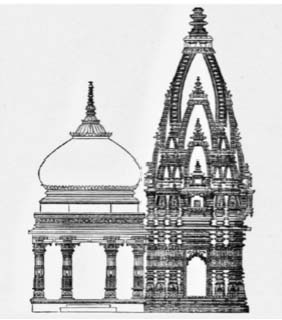
The temple was reconstructed again in the 16th century by Narayana Bhatt in 1585 CE, as described by Diana Eck (2013).5
“The reconstruction of the Vishveshvara Temple, perhaps on the most magnificent scale ever, was undertaken by Narayana Bhatta in 1585…”–Eck (2013)
Some sources say that the temple was rebuilt by Raja Todar Mal, but there seems no final consensus on the matter.
Aurangzeb invaded Benares first in 1664 CE, where his army was fiercely resisted by a group of Hindu warrior ascetics—the Dasanami Naga Sannyasis. These were fearless warriors who were ready to lay down their lives for Visvesvara, rather than see Him defiled. Aurangzeb was defeated and repelled. This is recorded by Lochtefeld (2002).6 “Gyan Vapi, Battle of Battle reportedly fought in Benares by the Naga ascetic warriors of the Mahanirvani Akhara. According to a handwritten book in the akhara’s archives, in 1664 the akhara’s soldiers won a great victory near the Gyan Vapi well.” – Lochtefeld, J. G. (2002)
Owing to this unpalatable defeat, Aurangzeb struck again, in 1669, with full intention to destroy the temple in its entirety and to punish the infidels for their resistance and audacity. He razed the temple and built the Gyan Vapi Masjid atop it.7

“It seems to have been in 1669 that the storm began to gather. In April of that year Aurangzíb was informed that the Bráhmans of Benáres and other Hindú centres were in the habit of teaching their ‘wicked sciences’, not only to their own people but to Muslims. This was more than the orthodox Emperor could tolerate; but the severity of his measures shows that he had been only waiting for a pretext to come down like a thunderbolt upon the unfortunate ‘heathen.’
‘The Director of the Faith,’ we are told, ‘issued orders to all the governors of provinces to destroy with a willing hand the schools and temples of the infidels; and they were strictly enjoined to put an entire stop to the teaching and practising of idolatrous forms of worship.’” – Lane-Poole S (1898)

This destruction of Vishwanath Temple is recorded in the chronicle of the ruler, Maasir-i-Alamgiri.
The temple was again rebuilt. Hindus never gave up their persistence or their love for Visveswara, Avimukteshwara. Rani Ahalyabai Holkar, the daughter-in-law of Malhar Rao Holkar, finally completed the task Malhar Holkar took up several decades ago (he was stopped by the Nawab of Oudh from building the temple during his time). The expense for the gilding of the domes of the temple in gold was borne by Maharajah Ranjit Singh of Lahore.8
“In 1777 the Queen of Indore (Ahalyabai Holkar) sponsored the construction of the present temple.” – Eck, D. L. (2013)
The existence of the Gyan Vapi well and the temple and Nandi complex near it have been clearly mentioned in documents from the 19th century.
“It is stated, moreover, that on occasion of the destruction of the old temple of Bisheshwar, a priest took the idol of the temple and threw it down for safety. The natives visit this well in multitudes, and cast in water or flowers and other offerings as a sacrifice to the deity below.
The well is surrounded by a handsome low-roofed colonnade, the stone pillars of which are in four rows and are upwards of forty in number. The building is small, but bas been designed and executed with considerable taste. It is of very recent date, and was erected in the year 1828 by Sri Maut Baija Bai, widow of Sri Maut Dowlat Rao Sindhia Bahadoor of Gwalior.
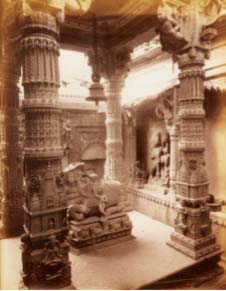
Immediately to the east of this colonnade is the figure of a large bull about seven feet high, cut in stone, dedicated to the god Mahadeo; and a few steps farther east is a temple built in honour of the same deity. The bull is a gift of the Rajah of Nepaul, and the temple of the Ranee of Hyderabad.”
Benares, Past and Present (1865)
Photographs from the 19th century and early 20th century all corroborate the same facts: that a beautiful, exquisitely carved temple and Nandi bull were part of the Gyan Vapi complex, and was regularly visited by Hindus for worship. The legend and significance of the well are also well-documented.

The plans of the temple drawn up by James Prinsep (1831) further validate these findings. The well existed before the destruction of the temple, and before the addition of the Nandi and colonnade around it. As per James Prinsep, part of the rebuilt temple was still occupied by the Gyan Vapi mosque. This was by design, as this was a regular practice of Islamist rulers: deities and construction material from Hindu temples was used to build mosques so as to defile and insult infidel Hindus. It may turn out that this hubris of Islamist rulers may be their own undoing today, much to the chagrin of those who want to deny facts and history.
Verdict on Gyan Vapi Mandir in 2022
The verdict of 2022, to survey the Gyan Vapi mosque is a welcome step to establishing correct history and setting the record straight. Though the proof is visible to the naked eye—the exterior of the Gyan Vapi Mosque has temple construction material in it, which is corroborated from lithographs of 1831 by James Prinsep (so not any recent addition)—any doubting Thomases can be silenced with categorical proof of the existence of a Hindu temple on which the mosque is made. Videography of an ancient monument is neither in violation of Places of Worship Act 1991, nor any other law.

It is ironic that masses still continue to call it “Gyan Vapi” mosque without wondering where the name “Gyan Vapi” comes from! It is a Sanskrit word, which means the “well of knowledge and enlightenment,” and it is called so because of Hindu reverence for the original deity of Visvesvara which still resides in that well. Whether the law will stand on the side of truth and what is right is yet to be seen.
“Republished with author’s permission”














Comments