






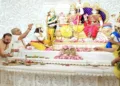
On January 22, 2024, Pran Pratishtha of the Shri Ram Lalla idol will take place in the Shri Ram Janmabhoomi Mandir situated in Ayodhya. Not just the entire Bharat but the whole world is jubilant with the fervour of the festivities of this rare occasion. Even on August 5, 2020, during the ceremony to lay the foundation of the mandir, waves of enthusiasm and festivities ran high through the entire society. People living in Bharat and people of Bharatiya origin across the world witnessed this spectacular event with a sense of contentment. For scores of men and women, it was a dream come true. A sense of achievement was evident as the event was a result of a centuries-long battle. This time too, billions of admirers of Bharat across the world must be rejoicing in the greater bliss and glory of this moment. It is a day of accomplishment for many, but in reality, it is the beginning of a new task. For many people, it was the mere inauguration of the temple construction. However, the Bharatiya view of tradition and philosophy are holistic and integral. Bharat never segregated religion from social life but considered them as complementary pursuits. The Bharatiya view has maintained that every soul is potentially divine. With this view, it sets the goal of manifesting this divinity within, thereby attaining Moksha (to become one with the Supreme being) as the ultimate goal of human life. This process can be pursued by controlling nature, internal and external, by everyone. Bharat accepts and believes that according to the potential, nature and taste of the person there can be various ways and means to accomplish this and all these multiple ways (religions) of manifesting divinity are equal. We are the shining example of this tradition as Bharat Mata is known to have cradled and nourished various religious legacies that continue to shine and thrive here in Bharat. Several other cultures that had a brush with our rich religio-cultural heritage at various points in the past have experienced this truth. While treading the spiritual path, Bharat hasn’t devalued material affluence or prosperity, ever. It is for this reason that Artha (which is related to material wealth) and Kama (which is related to fulfilling desires) find a place alongside Dharma and Moksha in the four broad goals enlisted in Purusharth Chatushtya (which give meaning to human life). Ubuntu, a Zulu-African conceptualisation translates as “I am because we are”. This phrase also resonates with one of the concepts of Dharma in Bharat. Me, my family, village, State, country, humanity, all living creatures and nature are units progressively spiralling out towards a larger whole and thus integral (ekatma). These units are not in conflict but there is harmony amongst them; not in competition but complementary to each other. Human life is a cumulative togetherness of all these forces. We are what we are because these units are what they are. Striking a balance between the myriad units that compose human life is Dharma and to strive for this balance is to establish Dharma. It is unfair to box our view of Dharma under the category of religion; to label it worship is insufficient too. In our meditation on the spiritual goal of human life, material prosperity was neither opposed nor deemed futile. One of the definitions of Dharma is:
यतो अभ्युदय नि:श्रेयस सिद्धि: स धर्म:
“Yato Abhyuday Nihshreyas Siddhih Sa Dharmah”
Here Abhyudaya stands for material prosperity and Nihshreyas stands for Moksha. As per the teachings of Ishavasya Upanishad, the knowledge that enables the creation of wealth is called Avidya and the knowledge that enables the achievement of Moksha is referred to as Vidya. The creators of Upanishads suggested Avidya paves the way for comfortable navigation through this mortal plane (Mrityu Lok) of existence. At the same time, Vidya aids the journey beyond, to the eternal abode of the supreme entity:
विद्याञ्च अविद्याञ्च यस्तद् वेदोरभयम् सह ‘अविद्यया मृत्युम् तीर्त्वा विद्ययारमृतमश्नुते ’
“Vidyaancha Avidyaancha Yastadvedobhayam Sah, Avidyayaa Mrutyum Teertvaa Vidyayaa Amrutmashnute” —Meditating and balancing the pursuits of material prosperity and Moksha is Dharma.
Understanding this concept of Dharma is essential. The Sangh prayer that sprouts from the hearts of millions of RSS Swayamsevaks each day is also a meditation on the balance between elevating one’s material self (samutkarsh) and one’s spiritual self (nihshreyas). In fact, the suffix Asya used to express possessive case in a singular noun (Shashthi Vibhakti, ek vachan) in Sanskrit has been used here, indicating these are two facets of one and the same concept, hence not disparate. This implies that the holistic Bharatiya view of life placed material (physical) and spiritual (meta-physical) progress on the same continuum.
For the longest time, affluence was the hallmark of Bharatiya civilisation. Enamoured by the lore of its material and spiritual glory, seekers of trade and knowledge are known to have set out in search of Bharat from distant lands. Despite its riches, Bharat did not bully other human settlements and countries by waging wars on them. Having traversed long trade routes and engaged in trade with varied people from far-off lands, we never formed colonies. Neither was our behaviour undignified nor did we plunder their wealth. We didn’t attempt to convert them either or push them into cycles of slavery. Instead, Bharatiya people were agents of economic, social and cultural elevation in places where they went. Even today, remnants of that splendid exchange are found in the languages, art and literature, mandirs and cultural practices of many South Asian countries. This civilising barter that enabled and enriched those natives and brought about prosperity on both ends is revered as Mahalakshmi in Bharatiya scriptures. We are no venerators of money, we worship Dhanalakshmi and Mahalakshmi. Therefore, it is fair to conclude that the primogenitor of our pursuit of material wealth and dignity for human life is our concept of Dharma (balance, not religion) and for time immemorial our mandirs have been the seat of meditation over different facets of this all-encompassing Dharma. Given the spirituality-based view of life, the mandirs in Bharat are centres of worship and inner guidance on one hand and precursors of our material and cultural civilisation on the other.
In 1951, while performing Pran Pratishtha pooja at Somnath Mandir, the second President of independent Bharat, Dr Rajendra Prasad, illustrated this point vividly. An excerpt from his speech is enlightening. He said, “On this holy day, we should learn from the Pran Pratishtha of this Somnath Mandir, and all of us should vouch for the re-establishment of the influence of Bharat in terms of prosperity in the world. Our country was an industrial pioneer in ancient times; the products which were made here were exported all over the world. Our exports were higher than our imports, and thus Bharat became a land of wealth. The gold and silver which are stored in the treasury of the developed nations were once stored in the mandirs of Bharat, an example of which is the mandir of Somnath. I think that this Pran Pratishtha will be complete only on the day we reclaim that dominance and do justice to the Somnath Mandir. Moreover, we should also strive to achieve the level of cultural brilliance which we had in ancient times so that when people judge us by today’s culture, they should know that we are still far better than them.”
The struggle for reinstating Ram Mandir on Ram Janmabhoomi was a movement to reinstate the Dharma of Bharat which was being systematically distorted in the name of secularism.
In his address at Ram Mandir Bhoomi Pujan, RSS Sarsanghachalak Dr Mohan Bhagwat mentioned three keywords: आत्मनिर्भर/Aatmanirbhar (self-reliant), आत्मविश्वास/Aatmavishwas (self-confidence) and आत्मभान/Aatmabhaan (self-awareness). Self-reliance was referred to for our knowledge (Bharatiya knowledge—Vidya and Avidya, both) and economy. Self-confidence is in the context of a resolute aim to march towards newer heights with a firm belief in our ancient yet evergreen and eternal spirituality-based integral, holistic and all-encompassing view of life and self-awareness implies demonstrating our Bharatiya worldview in all spheres of one’s life—individual, familial, social, professional and national—to the best of one’s ability and knowledge. Rabindranath Thakur in his essay “Swadeshi Samaj” drew our attention to this fact when he wrote, “We should aim to become who we are. Finding our true self by embracing our identity consciously, deliberately, strongly and completely.”
Re-establishing a deeper connection with our spiritual, cultural and historical roots is the assured path to reclaiming trade dominance and cultural brilliance. In turn, it will allow Bharatiya people to profess once again the civilising values of peaceful communication, solidarity, patience and congeniality to a world plagued by competition, struggle, violence, war, exploitation and torture. By exercising our “dharma” we will be able to shepherd diverse humanity onto a path of peaceful, prosperous and harmonious coexistence. This line from Dr Prasad’s speech holds the key to unlocking that path: “Mandirs were the epicentres of our material and cultural progress. I hope for this temple to be the centre of excellence once again. Until that happens, I will not believe that the reinstatement of the temple is complete.”
This approach is relevant in the context of the Ram Mandir in Ayodhya today. For this reason, the celebration is of both- an end of one long struggle and the beginning of a new journey. Recently, a few other issues of paramount national significance seem to have reached their conclusive ends one after another. Why is it so is another issue that deserves some attention here. In 1987 Ram-Janaki Rath Yatra was underway when one Sangh Swayamsevak quizzed Shri Balasaheb Deoras, then Sarsanghchalak of RSS: “Our pleas to ban cow slaughter and repeal Article 370 from Kashmir seem to have fallen on deaf ears. Nothing seems to move. Will Ram Mandir have a similar fate?” To which Shri Balasaheb Deoras replied, saying, “Let’s work towards awakening people’s consciousness toward this issue. In fact, efforts to stir people’s consciousness to causes of national significance must be consistent and perpetual. At present, the general level of national consciousness of the Hindu Samaj is very low, which is why these problems surround us. The day when the general level of national consciousness of the whole society will get elevated, it will be a time when the resolution to most problems may come about simultaneously.”
In his book, Tipping Point: How Little Things Can Make a Big Difference, Malcolm Gladwell defines “Tipping Point” as “the point at which a series of small changes or incidents become significant enough to cause a larger, more important change.” In hindsight, one is compelled to reflect if Shri Balasaheb Deoras was hinting at this “tipping point” when he talked about the consistent efforts for elevating national consciousness.
Shri Dattopant Thengadi, one of the luminaries and visionaries of Sangh would often remark, “A handful of nationally conscious and active workers cannot bring about lasting social change. But when the common man becomes even slightly more conscious about matters of national significance, then a huge difference comes about. Therefore, unwavering attempts at bringing causes of national consequence to the fore and stirring a discourse over those in the society will gradually boost the general level of national consciousness. As a cumulative effect, small and big issues of national significance will be conclusively addressed. So, it is imperative that some people must dedicate their lives to the task of augmenting the general level of national consciousness.”
It seems the tipping point of Balasaheb Deoras and Dattopant Thengadi’s imagination is nearing. Rabindranath Thakur’s Swadeshi Samaj is coming alive. Several overdue decisions in matters of great national significance are now being made. The world has taken note of the shifts in the defence and foreign policies of the country. We have started our journey towards self-reliance by adopting decentralised, agrarian economic policies. The New Education Policy that will empower young minds to remain true to our roots, our true identity, while spreading their wings far and wide has been recently announced. An atmosphere that is nurturing the entrepreneurial spirit and innovation is emerging. Since all these developments are coinciding with one another after 2014, it is but natural that they are attributed to the change of Government at the Centre. However, I would like to cite a line from the editorial dated May 18, 2014, of The Guardian, published in London, commenting on the election results of May 16, 2014. It read: “It should be obvious that the underlying changes in Indian society have brought us Mr. Modi and not the other way round.” This observation is important. All these changes are a consequence of a boost in the general level of national consciousness and not the other way round. Overthrowing the old regime and electing a new Central Government is one among those changes. Fuelled by its timeless wisdom Bharatvarsha has sought a new ground to fulfil its divinely ordained duties. A senior Sangh pracharak defined RSS as “the evolution of the life mission of this Hindu nation.” Previously impeded essential reforms of national consequence have begun to take shape. It is the time for conscious and careful consolidation of nation-building efforts. This consciousness will inevitably pave the way to the desired self-confidence and self-reliance.
“अरुणोदय हो चुका वीर अब कर्मक्षेत्र में जुट जाएँ, अपने खून-पसीने द्वारा नवयुग
धरती पर लाएँ।”
“Arunoday ho chuka veer ab karmakshetra mein jut jaayen, apne khoon-paseene dwara navyug dharti par laayen.”
As mentioned in one of the Sangh songs, “Colours of the dawn are inviting us to march into the field and usher in a new era by watering the ground with our blood and sweat.”















Comments