Ayodhya Ram Mandir: A journey through time - from 1528 to 2024
December 6, 2025
  • Read Ecopy
  • Circulation
  • Advertise
  • Careers
  • About Us
  • Contact Us
Android AppiPhone AppArattai
Organiser
  • ‌
  • Bharat
    • Assam
    • Bihar
    • Chhattisgarh
    • Jharkhand
    • Maharashtra
    • View All States
  • World
    • Asia
    • Europe
    • North America
    • South America
    • Africa
    • Australia
  • Editorial
  • International
  • Opinion
  • RSS @ 100
  • More
    • Op Sindoor
    • Analysis
    • Sports
    • Defence
    • Politics
    • Business
    • Economy
    • Culture
    • Special Report
    • Sci & Tech
    • Entertainment
    • G20
    • Azadi Ka Amrit Mahotsav
    • Vocal4Local
    • Web Stories
    • Education
    • Employment
    • Books
    • Interviews
    • Travel
    • Law
    • Health
    • Obituary
  • Subscribe
    • Subscribe Print Edition
    • Subscribe Ecopy
    • Read Ecopy
  • ‌
  • Bharat
    • Assam
    • Bihar
    • Chhattisgarh
    • Jharkhand
    • Maharashtra
    • View All States
  • World
    • Asia
    • Europe
    • North America
    • South America
    • Africa
    • Australia
  • Editorial
  • International
  • Opinion
  • RSS @ 100
  • More
    • Op Sindoor
    • Analysis
    • Sports
    • Defence
    • Politics
    • Business
    • Economy
    • Culture
    • Special Report
    • Sci & Tech
    • Entertainment
    • G20
    • Azadi Ka Amrit Mahotsav
    • Vocal4Local
    • Web Stories
    • Education
    • Employment
    • Books
    • Interviews
    • Travel
    • Law
    • Health
    • Obituary
  • Subscribe
    • Subscribe Print Edition
    • Subscribe Ecopy
    • Read Ecopy
Organiser
  • Home
  • Bharat
  • World
  • Operation Sindoor
  • Editorial
  • Analysis
  • Opinion
  • Culture
  • Defence
  • International Edition
  • RSS @ 100
  • Magazine
  • Read Ecopy
Home Bharat

Ayodhya Ram Mandir: A journey through time – from 1528 to 2024

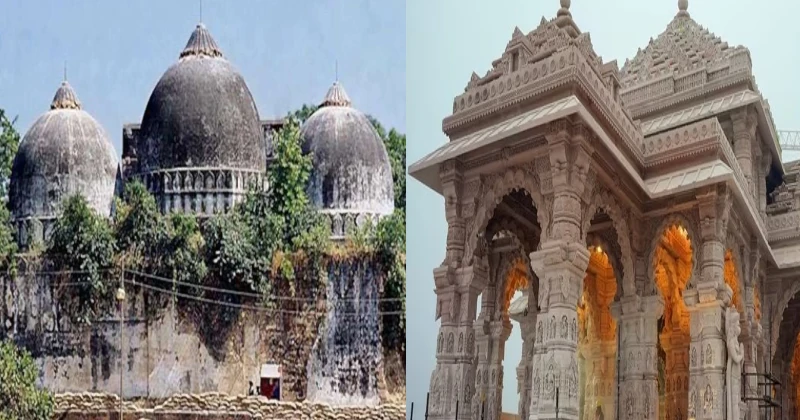
Embarking on a journey spanning centuries, the Ayodhya Ram Mandir unfolds as a poignant tale of faith, legal battles, and political upheavals. From the 1528 construction of Babri Masjid to the imminent pran parathistha in 2024, this timeline encapsulates the intricate layers of a historical saga that has shaped India's socio-religious landscape

WEBDESKWEBDESK
Jan 19, 2024, 12:20 pm IST
in Bharat, Culture
Follow on Google News
Ayodhya Ram Mandir, 1528 to 2024

Ayodhya Ram Mandir, 1528 to 2024

FacebookTwitterWhatsAppTelegramEmail

The roots of the Ayodhya Ram Mandir issue can be traced back to 1853 when religious violence erupted over the site of the Babri Masjid. Constructed in 1528 by Mughal emperor Babar, the site became a focal point of contention as the Nirmohis, a Hindu sect, claimed the existence of a demolished Hindu Mandir during Babur’s era. British intervention in 1859 led to the partitioning of the site, granting Muslims access to the mosque while allocating the outer court for Hindu use. The seeds of discord were sown, setting the stage for decades of legal battles and social unrest.

Ram Lalla Murti inside Babri Mosque (1949)

In 1949, the controversy took a new turn when idols of Sri Ram surfaced inside the Babri Masjid. Legal petitions were filed, with one seeking permission to worship the deity and another advocating for the mosque’s preservation. The government’s response was to lock the site, allowing priests to conduct daily rituals but closing the gates to the public. This marked the beginning of a prolonged legal struggle over the control and fate of the disputed land.

Plea seeks restoration of property to Muslims (1961)

In 1961, a significant development occurred as a petitioner filed a suit pleading for the restoration of the property to Muslims. The Sunni Central Waqf Board joined the legal battle, declaring the Babri Mosque as its property. This legal manoeuvring set the stage for a protracted legal dispute over the rightful ownership of the contested site.

Campaign Launched to Build Ram Mandir (1980s)

The 1980s witnessed the emergence of a committee led by the Vishva Hindu Parishad party (VHP) with the ambitious goal of “liberating” the birthplace of Sri Ram and constructing a Mandir in his honour. This marked the formalisation of efforts to build the Ram Mandir and added a religious and political dimension to the longstanding dispute.

VHP lays the foundation of Ram Mandir (1989)

In 1989, the VHP took a decisive step by initiating the construction of a Ram Mandir on the land adjacent to the Babri Masjid. Legal battles ensued, with a case filed for the relocation of the mosque. The Rath Yatra of 1990, led by LK Advani, galvanised public support for the temple construction, but it also sparked political tensions, ultimately leading to Advani’s arrest.

The Mosque is demolished (1992)

The turning point in the Ayodhya Ram Mandir saga occurred on December 6, 1992, when the Babri Mosque was demolished by karsevaks in the presence of leaders from Shiv Sena, VHP, and BJP. This act of destruction ignited communal riots across the nation, resulting in significant loss of life and widespread condemnation. The event left an indelible mark on India’s socio-political landscape.

ASI conducts survey (2003)

In 2003, the Archaeological Survey of India (ASI) conducted a survey at the disputed site, revealing evidence of a significant Hindu complex beneath the mosque. However, these findings were contested by Muslim organisations, intensifying the debate over the historical interpretation of the site.

Allahabad HC divides the disputed site (2010)

The legal saga reached a milestone in 2010 when the Allahabad High Court delivered its judgement, dividing the disputed land into three parts. One-third was allocated to Ram Lalla, represented by the Hindu Mahasabha, one-third to the Islamic Waqf Board, and the remaining third to the Nirmohi Akhara. This decision prompted further legal challenges, as both the Hindu Mahasabha and the Sunni Waqf Board approached the Supreme Court.

All three sides approach Supreme Court (2011)

In 2011, all three parties—the Nirmohi Akhara, Ram Lalla Virajman, and Sunni Waqf Board—appealed against the Allahabad High Court verdict. The Supreme Court stayed the order, maintaining the status quo and indicating the need for a comprehensive resolution to the long-standing dispute.

Supreme Court orders land transfer (2019)

On November 9, 2019, the Supreme Court issued a historic verdict, ordering the transfer of the disputed 2.77 acres to a trust for the construction of the Ram Janmabhoomi Mandir. Simultaneously, the court directed the government to allocate an alternative five acres of land to the Sunni Waqf Board for the construction of a mosque. This landmark judgement provided a legal foundation for the construction of the Ram Temple.

Foundation stone laying ceremony (2020)

The journey culminated on August 5, 2020, when Prime Minister Narendra Modi laid the foundation stone for the construction of the Ram Temple. This symbolic event marked the beginning of a new chapter, bringing closure to decades of legal battles, political manoeuvring, and social unrest.

The Pran Prathistha ceremony (2024)

As the consecration of Ram Lalla approaches on January 22, 2024, the inauguration of the Ram Mandir in Ayodhya becomes a historic moment. Prime Minister Narendra Modi, along with key dignitaries, will preside over the ceremony, signalling the realisation of a long-cherished dream for millions of devotees.

In the tapestry of India’s history, the Ayodhya Ram Mandir stands as a symbol of faith, legal intricacies, political aspirations, and communal harmony. The journey from 1528 to 2024 reflects the evolving dynamics of a nation grappling with its past, present, and future, and the Ram Mandir emerges as a testament to the resilience of India’s diverse cultural fabric.

Topics: Ram LallaAyodhya Ram MandirRam Mandir Pran PrathisthaAllahabad High CourtVishva Hindu Parishad
Share1TweetSendShareSend
✮ Subscribe Organiser YouTube Channel. ✮
✮ Join Organiser's WhatsApp channel for Nationalist views beyond the news. ✮
Previous News

Assam: Police seize drugs worth Rs 6 crore in Cachar district, 4 held

Next News

Iran-Pakistan Row: US expresses concern over rising tension in the region

Related News

Islamist Moynal Haque who raped 15-year-old Hindu girl

Bilasipara Gang Rape: 15-years-old minor Hindu girl raped by Islamist Moynal Haque and three others in Assam

Representative image

No Scheduled Caste reservation for converts; Allahabad High Court orders strict action against fraudulent claims

Ram Mandir Dhwajarohan: Flag of resolve and realisation

Uttar Pradesh CM Yogi Adityanath

Uttar Pradesh: CM Adityanath’s call to protect Sanatan Dharma; Hoist Sanatan flag, unite against anti-dharma forces

Dharma Dhwaj in Ayodhya: Reverence, resilence, restoration, righteousness

(Left) VHP President Vinod Bansal (Right) Maulana Mahmood Madani, president of Jamiat Ulama-i-Hind

“Instigated, misguided Muslim youth”: Vinod Bansal of VHP slams Jamiat chief Madani over concept of jihad

Load More

Comments

The comments posted here/below/in the given space are not on behalf of Organiser. The person posting the comment will be in sole ownership of its responsibility. According to the central government's IT rules, obscene or offensive statement made against a person, religion, community or nation is a punishable offense, and legal action would be taken against people who indulge in such activities.

Latest News

PM Modi presents Putin with Bhagavad Gita, chess set, and silver horse

Cultural ties strengthened: PM Modi presents Putin with Bhagavad Gita, chess set, and silver horse

Image for representational purpose only, Courtesy Vocal Media

Bihar to get ‘Special Economic Zones’ in Buxar and West Champaran

Thirupparankundram Karthigai Deepam utsav

Andhra Pradesh: AP Dy CM Pawan Kalyan reacts to Thirupparankundram row, flags concern over religious rights of Hindus

23rd India-Russia Annual Summit

India-Russia Summit heralds new chapter in time-tested ties: Inks MoUs in economic, defence, tourism & education

DGCA orders probe into IndiGo flight disruptions; Committee to report in 15 days

BJYM leader Shyamraj with Janaki

Kerala: Widow of BJP worker murdered in 1995 steps into electoral battle after three decades at Valancherry

Russian Sber bank has unveiled access to its retail investors to the Indian stock market by etching its mutual fund to Nifty50

Scripting economic bonhomie: Russian investors gain access to Indian stocks, Sber unveils Nifty50 pegged mutual funds

Petitioner S Vignesh Shishir speaking to the reporters about the Rahul Gandhi UK citizenship case outside the Raebareli court

Rahul Gandhi UK Citizenship Case: Congress supporters create ruckus in court; Foreign visit details shared with judge

(L) Kerala High Court (R) Bouncers in Trippoonithura temple

Kerala: HC slams CPM-controlled Kochi Devaswom Board for deploying bouncers for crowd management during festival

Fact Check: Rahul Gandhi false claim about govt blocking his meet with Russian President Putin exposed; MEA clears air

Load More
  • Privacy
  • Terms
  • Cookie Policy
  • Refund and Cancellation
  • Delivery and Shipping

© Bharat Prakashan (Delhi) Limited.
Tech-enabled by Ananthapuri Technologies

  • Home
  • Search Organiser
  • Bharat
    • Assam
    • Bihar
    • Chhattisgarh
    • Jharkhand
    • Maharashtra
    • View All States
  • World
    • Asia
    • Africa
    • North America
    • South America
    • Europe
    • Australia
  • Editorial
  • Operation Sindoor
  • Opinion
  • Analysis
  • Defence
  • Culture
  • Sports
  • Business
  • RSS @ 100
  • Entertainment
  • More ..
    • Sci & Tech
    • Vocal4Local
    • Special Report
    • Education
    • Employment
    • Books
    • Interviews
    • Travel
    • Health
    • Politics
    • Law
    • Economy
    • Obituary
  • Subscribe Magazine
  • Read Ecopy
  • Advertise
  • Circulation
  • Careers
  • About Us
  • Contact Us
  • Policies & Terms
    • Privacy Policy
    • Cookie Policy
    • Refund and Cancellation
    • Terms of Use

© Bharat Prakashan (Delhi) Limited.
Tech-enabled by Ananthapuri Technologies