The Resonance Of Ram Mandir: Unveiling Ayodhya's cultural, religious, and economic tapestry
December 6, 2025
  • Read Ecopy
  • Circulation
  • Advertise
  • Careers
  • About Us
  • Contact Us
Android AppiPhone AppArattai
Organiser
  • ‌
  • Bharat
    • Assam
    • Bihar
    • Chhattisgarh
    • Jharkhand
    • Maharashtra
    • View All States
  • World
    • Asia
    • Europe
    • North America
    • South America
    • Africa
    • Australia
  • Editorial
  • International
  • Opinion
  • RSS @ 100
  • More
    • Op Sindoor
    • Analysis
    • Sports
    • Defence
    • Politics
    • Business
    • Economy
    • Culture
    • Special Report
    • Sci & Tech
    • Entertainment
    • G20
    • Azadi Ka Amrit Mahotsav
    • Vocal4Local
    • Web Stories
    • Education
    • Employment
    • Books
    • Interviews
    • Travel
    • Law
    • Health
    • Obituary
  • Subscribe
    • Subscribe Print Edition
    • Subscribe Ecopy
    • Read Ecopy
  • ‌
  • Bharat
    • Assam
    • Bihar
    • Chhattisgarh
    • Jharkhand
    • Maharashtra
    • View All States
  • World
    • Asia
    • Europe
    • North America
    • South America
    • Africa
    • Australia
  • Editorial
  • International
  • Opinion
  • RSS @ 100
  • More
    • Op Sindoor
    • Analysis
    • Sports
    • Defence
    • Politics
    • Business
    • Economy
    • Culture
    • Special Report
    • Sci & Tech
    • Entertainment
    • G20
    • Azadi Ka Amrit Mahotsav
    • Vocal4Local
    • Web Stories
    • Education
    • Employment
    • Books
    • Interviews
    • Travel
    • Law
    • Health
    • Obituary
  • Subscribe
    • Subscribe Print Edition
    • Subscribe Ecopy
    • Read Ecopy
Organiser
  • Home
  • Bharat
  • World
  • Operation Sindoor
  • Editorial
  • Analysis
  • Opinion
  • Culture
  • Defence
  • International Edition
  • RSS @ 100
  • Magazine
  • Read Ecopy
Home Bharat

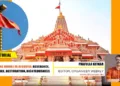
The Resonance Of Ram Mandir: Unveiling Ayodhya’s cultural, religious, and economic tapestry

Ayodhya, the sacred city that has lingered in the cultural consciousness of Indians for centuries, is poised to make history on January 22, 2024. The occasion marks the official opening of the Ram Mandir through the Pran Pratishtha ritual, symbolizing the consecration of Bhagwan Ram's murti

Pallabi GogoiPallabi Gogoi
Jan 12, 2024, 08:00 pm IST
in Bharat, Opinion, Culture
Follow on Google News
FacebookTwitterWhatsAppTelegramEmail

On January 22, 2024, India will officially open the Ram Mandir through the ritual of Pran Pratishtha, signifying the consecration of Lord Rama’s idol at the recently completed Ram Temple in Ayodhya. The ceremonial event will be accompanied by a week-long ritual, commencing on January 16, 2024. Ayodhya, previously confined to the realm of myth, is set to reenter our national history and consciousness. It has perennially held a place in the collective consciousness of the majority of Indians throughout the centuries.

India embarked on a transformative journey in the late 1980s, marked by the emergence of Mandal politics and the Ram Janmabhoomi movement. The Bharatiya Janata Party (BJP) adeptly harnessed the synergies between these two forces, resulting in the BJP-led National Democratic Alliance’s inaugural term from 1998 to 2004. Despite experiencing a slowdown during the United Progressive Alliance years, this momentum has resurged under the leadership of Narendra Modi. The establishment of the Ram Mandir does not mark the conclusion of a venture aimed at constructing a Hindu Rashtra. Rather, echoing the sentiments of LK Advani, the architect of the BJP’s Ram temple movement, it signifies the commencement of an “integral part of the historical process of Hindu self-renewal and self-affirmation.”

In 1990, Lal Krishna Advani, the leader of the party, embarked on a Rath Yatra to demand that a Ram temple to be built in Ayodhya. According to BJP’s 1991 manifesto “as the party of law, order and justice, it (BJP) would ensure the security of life, liberty and honour of all citizens. It seeks the restoration of Ramjanmabhoomi in Ayodhya only by way of a symbolic righting of historic wrongs so that the old unhappy chapter of acrimony would be ended and a grand national reconciliation be affected. Hindu and Muslims are blood brothers, but on account of historical reasons, their relationship has not been harmonious. It shall be the endeavour of the BJP to make all Indians fraternal and friendly once again.”

For the people of India, the building of the Ram Mandir at Ayodhya has important cultural, religious, and social ramifications. The Indian way of life, philosophy, and culture have all been greatly influenced by the Rama philosophy. The birthplace of Lord Rama, Ayodhya, is a sacred city in Uttar Pradesh with great religious and historical significance. Due to its inclusion in ancient works such as the Ramayana and Mahabharata, Ayodhya has grown in importance as a Hindu pilgrimage site. The historical background and religious significance of the city are closely linked to its cultural character.

The city, ruled by King Dasharatha, was characterized as an affluent and peaceful monarchy. Among the notable kings who governed Kosaldesh’s capital city were Ikshvaku, Prithu, Mandhata, Harishchandra, Sagar, Bhagirath, Raghu, Dileep, Dashrath, and Ram. Shravasti became the capital of the kingdom during the Buddhist era, which spanned the 6th and 5th century BCE. Some academics think that Saketa, where the Buddha is supposed to have resided for a while, and Ayodhya are the same place. Throughout the ages, Ayodhya became a significant hub for Buddhism under the Mauryan and Gupta kingdoms, when stupas and monasteries were built there.

In the 16th century Babur built the Babri Masjid in Ayodhya following the destruction of the Ram Temple. Following this, in 1992, many activists destroyed the Babri mosque, which prompted the Liberhan Commission to look into the matter. The Supreme Court cleared the way on November 9, 2019, for the building of a Ram temple on the 2.77 acres of land in Ayodhya, where it was originally placed. With this ruling, a long-running legal, political, and interreligious battle that spanned more than a century is finally resolved. The BJP and the people behind the Ramajanmabhoomi movement had repeatedly insisted that even though the disputed structure in Ayodhya was not a mosque at all, it would be respectfully moved to a different location in order to honor the feelings of the Muslims who thought—or had been led to believe—that it was a “mosque.” Before the BJP offered its backing, from 1983 to 1989, the movement had already started to agitate the populace. It was a people’s movement led by Vishva Hindu Parishad (VHP), a part of Rashtriya Swayamsevak Sangh (RSS). The BJP’s pledge to the voters to remove obstacles preventing the construction of a temple at the exact location of the Rama idols, as well as the other political parties’ antagonistic and hostile stance, were simply the results of a mass movement that had already begun to take shape, challenging the post-independence political practices of all parties except the BJP.

The building of the Ram Mandir, in the BJP’s unwavering opinion, is a symbol of the national self-respect and our cultural legacy being upheld. The BJP views this as solely a national matter and will not allow any special interest to give it a sectarian bent. It represents the culmination of a long-standing cultural and religious aspiration for many Hindus in India. A sense of common religious identity is fostered by the Ram Mandir, which serves as a unifying symbol. The movement to build the Ram mandir at Ayodhya can never be considered as a political movement. It was a religious movement that reached its pinnacle because of the participation of individuals connected to history, culture, and religion. The construction of Ram Mandir also offers a chance for mutual understanding and conversation amongst faiths. People from different religion has contributed for the fund needed to build the Ram Mandir which shows harmony across various religious groupings.

The forthcoming economic impact is poised to be substantial, driven by the extensive infrastructure investments outlined for Ayodhya and its surrounding areas, including the development of a sprawling new township spanning 1,200 acres. As Ayodhya ascends as a prominent religious destination in the coming years, Uttar Pradesh is poised to gain a formidable catalyst for both growth and income. The Ram Mandir is anticipated to evolve into a sought-after tourist attraction, hosting religious and cultural events. Preliminary estimates suggest that Ayodhya could witness a staggering influx of 4.5 million visitors monthly, totaling nearly 54 million annually—surpassing the estimated annual visitors to Tirupati, which stands at 30 million. Consequently, the direct and ripple effects of increased tourism activities in and around Ayodhya are expected to provide a substantial boost to the state’s economy, creating employment opportunities and boosting various sectors such as hospitality, transportation, and local businesses.
Topics: bhagwan ramAyodhya Ram Mandir
Share24TweetSendShareSend
✮ Subscribe Organiser YouTube Channel. ✮
✮ Join Organiser's WhatsApp channel for Nationalist views beyond the news. ✮
Previous News

Interfaith: Afifullah tricks Hindu woman with false marriage promise; now forcing to convert

Next News

Maharashtra: PM Modi inaugurates MTHL ‘Atal Setu’ for boosting trans city connectivity, reducing traffic snarls

Related News

Uttar Pradesh CM Yogi Adityanath

Uttar Pradesh: CM Adityanath’s call to protect Sanatan Dharma; Hoist Sanatan flag, unite against anti-dharma forces

Dharma Dhwaj in Ayodhya: Reverence, resilence, restoration, righteousness

Ayodhya, Nov 25 (ANI): A view of the Saffron flag on the top of Shri Ram Janmabhoomi Mandir during the Dhwajarohan Utsav, in Ayodhya on Tuesday. (DPR PMO/ANI Photo)

Dharma Dhwaj at Ayodhya Ram Mandir: Refixing the cultural displacement of Lord Macaulay

Sacred chants, garland exchanges and temple rituals defined a day rooted in heritage and collective devotion

Ayodhya and Janakpur draw lakhs of devotees as Dhwajarohan and Vivah Panchami create a day of deep spiritual unity

(Left) Dharma Dhwaj (Right) PM Narendra Modi

“If we want to make India developed by 2047, have to awaken Bhagwan Ram within ourselves”: PM Modi at ‘Dhwajarohan’

RSS Sarsanghchalak Dr Mohan Bhagwat

Dhwaj’ of Ram Rajya, which once flew high in Ayodhya, is now placed at its ‘shikhar’: RSS Sarsanghchalak Dr Bhagwat 

Load More

Comments

The comments posted here/below/in the given space are not on behalf of Organiser. The person posting the comment will be in sole ownership of its responsibility. According to the central government's IT rules, obscene or offensive statement made against a person, religion, community or nation is a punishable offense, and legal action would be taken against people who indulge in such activities.

Latest News

PM Modi presents Putin with Bhagavad Gita, chess set, and silver horse

Cultural ties strengthened: PM Modi presents Putin with Bhagavad Gita, chess set, and silver horse

Image for representational purpose only, Courtesy Vocal Media

Bihar to get ‘Special Economic Zones’ in Buxar and West Champaran

Thirupparankundram Karthigai Deepam utsav

Andhra Pradesh: AP Dy CM Pawan Kalyan reacts to Thirupparankundram row, flags concern over religious rights of Hindus

23rd India-Russia Annual Summit

India-Russia Summit heralds new chapter in time-tested ties: Inks MoUs in economic, defence, tourism & education

DGCA orders probe into IndiGo flight disruptions; Committee to report in 15 days

BJYM leader Shyamraj with Janaki

Kerala: Widow of BJP worker murdered in 1995 steps into electoral battle after three decades at Valancherry

Russian Sber bank has unveiled access to its retail investors to the Indian stock market by etching its mutual fund to Nifty50

Scripting economic bonhomie: Russian investors gain access to Indian stocks, Sber unveils Nifty50 pegged mutual funds

Petitioner S Vignesh Shishir speaking to the reporters about the Rahul Gandhi UK citizenship case outside the Raebareli court

Rahul Gandhi UK Citizenship Case: Congress supporters create ruckus in court; Foreign visit details shared with judge

(L) Kerala High Court (R) Bouncers in Trippoonithura temple

Kerala: HC slams CPM-controlled Kochi Devaswom Board for deploying bouncers for crowd management during festival

Fact Check: Rahul Gandhi false claim about govt blocking his meet with Russian President Putin exposed; MEA clears air

Load More
  • Privacy
  • Terms
  • Cookie Policy
  • Refund and Cancellation
  • Delivery and Shipping

© Bharat Prakashan (Delhi) Limited.
Tech-enabled by Ananthapuri Technologies

  • Home
  • Search Organiser
  • Bharat
    • Assam
    • Bihar
    • Chhattisgarh
    • Jharkhand
    • Maharashtra
    • View All States
  • World
    • Asia
    • Africa
    • North America
    • South America
    • Europe
    • Australia
  • Editorial
  • Operation Sindoor
  • Opinion
  • Analysis
  • Defence
  • Culture
  • Sports
  • Business
  • RSS @ 100
  • Entertainment
  • More ..
    • Sci & Tech
    • Vocal4Local
    • Special Report
    • Education
    • Employment
    • Books
    • Interviews
    • Travel
    • Health
    • Politics
    • Law
    • Economy
    • Obituary
  • Subscribe Magazine
  • Read Ecopy
  • Advertise
  • Circulation
  • Careers
  • About Us
  • Contact Us
  • Policies & Terms
    • Privacy Policy
    • Cookie Policy
    • Refund and Cancellation
    • Terms of Use

© Bharat Prakashan (Delhi) Limited.
Tech-enabled by Ananthapuri Technologies