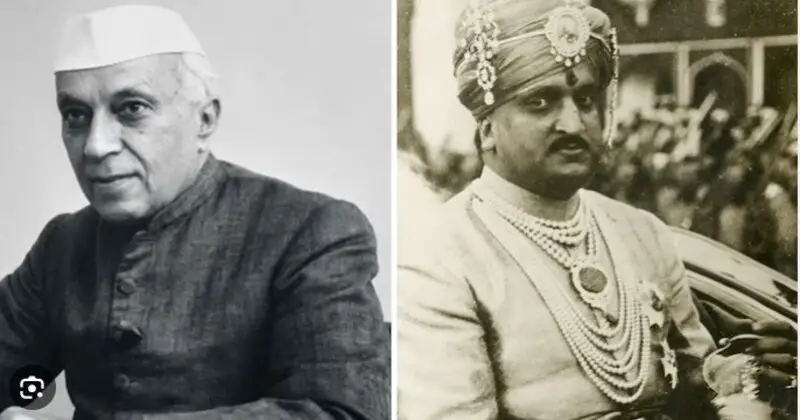
The clincher on who delayed accession of Kashmir is in Nehru’s speech itself dated July 24, 1952, in Lok Sabha where he mentioned that the question of accession “came up before us informally round about July or the middle of July (1947)” and further stated that “we had contacts with the popular organisation there, the National Conference, and its leaders, and we had contacts with the Maharaja’s Government also“.
Nehru then, in the same speech, went on to assert his own stance – “the advice we gave to both was that Kashmir is a special case and it would not be right or proper to try to rush things there”. Is there any other proof apart from 1952 speech? Yes….5 different sets of evidences….
First, on October 21, 1947, in a letter to MC Mahajan, Prime Minister of Kashmir, Nehru wrote, “It will probably be undesirable to make any declaration of adhesion to the Indian Union at this stage.” What do these words convey? Who was asking for accession and who was delaying it? Pakistan had already invaded Kashmir on October 20, 1947. On October 21, a day later, Nehru was still advising the Kashmir government not to accede to India till his personal wishes and agenda were fulfilled (which he explicitly enunciated in the same letter. This agenda was to install Sheikh Abdullah as PM of Kashmir.).
Second, in a speech delivered on November 25, 1947, in Parliament, when the issue was still evolving internationally, Nehru stated – “We did not want a mere accession from the top but an association in accordance with the will of her people. Indeed, we did not encourage any rapid decision.”
As clear as daylight, not once but on multiple occasions, Nehru himself stated as to who was putting conditions on accession and thereby delayed it till the personal agenda was fulfilled. It was all along Nehru who put conditions on accession, and NOT Hari Singh.
But this is not the only evidence, although more than sufficient as it is, available that throws a light on the chain of events.
Third, Acharya Kripalani, president of the Indian National Congress, visited Kashmir in May 1947. A report published in The Tribune on May 20, 1947, recorded this about Kripalani’s views: “Hari Singh was keen to accede to India and that it was not correct on the part of the National Conference to raise the demand of ‘Quit Kashmir’ against Hari Singh. ‘He is not an outsider’…He appealed to the National Conference in particular to give up the call of ‘Quit Kashmir’.”
The ‘Quit Kashmir’ movement was launched by Sheikh Abdullah in 1946. He was supported in this agitation by Nehru. Hari Singh, a Dogra king, was not an outsider to Kashmir and had as many rights in the Kashmir Valley as anyone else. Every other Congress leader understood the absurdity of replicating the ‘Quit India’ call against colonial British with a ‘Quit Kashmir’ call against a Kashmiri Hindu ruler. Yet, Nehru plunged headlong in support of Abdullah and even landed up in Kashmir to support him. This started a chain of events that had decades-long tragic consequences.
As early as 1931, during the Round Table Conference in London, Hari Singh had asserted in the House of Lords as Vice-Chancellor of Chamber of Prince’s: “I am an Indian first, and then a Maharaja.” The same Hari Singh was, thus, obviously pleading to join India in 1947 on multiple occasions but was thwarted on each occasion till Nehru’s agenda was fulfilled.
Fourth, Nehru’s note to Lord Mountbatten before his visit to Kashmir in June 1947 is unequivocal on what Hari Singh actually wanted. Nehru wrote in para 28 of that note – “The normal and obvious course appears to be for Kashmir to join the Constituent Assembly of India. This will satisfy both the popular demand and the Maharaja’s wishes.” So, Nehru was absolutely aware in June 1947 of what Hari Singh actually wanted. The only stumbling block was Nehru’s own agenda.
Fifth, with the July 1947 attempt of accession rebuffed by Nehru, an attempt was made by Hari Singh in September 1947 as well, a full month before Pakistan’s invasion.
Mahajan, Prime Minister of Kashmir at the time of accession, recounts his meeting with Nehru in September 1947. Writing in his autobiography, Mahajan states: “I also met Pandit Jawaharlal Nehru, the Prime Minister of India… The Maharaja was willing to accede to India and also to introduce necessary reforms in the administration of the state. He, however, wanted the question of administrative reforms to be taken up later on. Panditji wanted an immediate change in the internal administration of the state.”
Thus, we see that statements by Nehru, not once but on multiple occasions, and letters written by Nehru, along with corroborative evidence, unambiguously establish the fact that the only cause that delayed Kashmir’s accession to India was Nehru’s own personal obsession.
WHAT ACTUALLY HAPPENED – THE REAL STORY
Abdullah had given a call of ‘Quit Kashmir’ in May 1946. Hari Singh had him arrested on May 20, 1946. Nehru rushed in to support Abdullah, Hari Singh detained him at the border.
An aide of Nehru recorded in a note Nehru’s reaction on being detained – “He violently trampled his foot on the floor and told them that one day the Maharaja of Kashmir would have to repent and apologise to him for the discourtesy shown to the president-elect of the Indian National Congress.” Nehru, so embittered, ruthlessly chose his time to avenge the discourtesy.
Undeterred, Hari Singh tried again, this time through a new person. Mahajan, now PM-designate of Kashmir, personally approached Nehru to join India in September 1947. Hari Singh, by this time, had agreed to most demands made by Nehru, accepted to change the administration of Kashmir but only requested that it be done after accession.
Nehru still remained adamant and wanted the administration change – installation of Abdullah – first and accession later.
With Nehru adamant to have his way, Hari Singh made a further concession and released Abdullah from prison on September 29, 1947. Armed with this concession, Hari Singh’s government again approached Nehru to accede to India on October 20, 1947. Nehru refused again through a letter on October 21, and this time put in writing what he actually wanted – installation of Abdullah to head a provisional government. Nehru was very clear in his sequencing. Abdullah first, accession later.
In case anyone doubts this incontrovertible sequence of events, then there is one more proof – again by Nehru himself, and in writing.
In a letter to Sardar Vallabhbhai Patel on September 27, 1947, Nehru wrote: “There is no other course open to the Maharaja but this: to release Sheikh Abdullah and the National Conference leaders, to make a friendly approach to them, seek their cooperation and make them feel that this is really meant and then to declare adhesion to the Indian Union.”
Nehru could have forced Hari Singh to accept anything he wanted after the accession. This is exactly how it panned in every other princely state.
Logic, national interest and common sense dictated that Nehru first get the country united, forever close the door to Pakistan by making Kashmir irrevocably accede to India and then later, if he was so enamoured by Abdullah, make him head the government. This would have been the ‘India First’ approach. But for some inexplicable reason, Nehru put Abdullah first and India second.
Ultimately, history panned out the way it did. Pakistan got time to invade Kashmir and become a party and occupy large portions of it. Subsequent tragic events in Kashmir have all been a corollary of this original sin. As for Hari Singh – well, he indeed had to ‘Quit Kashmir’ and only his ashes returned later. As for Nehru, he, in his love for Abdullah, created an albatross around India’s aspirations that hobbled us for over seven decades.