





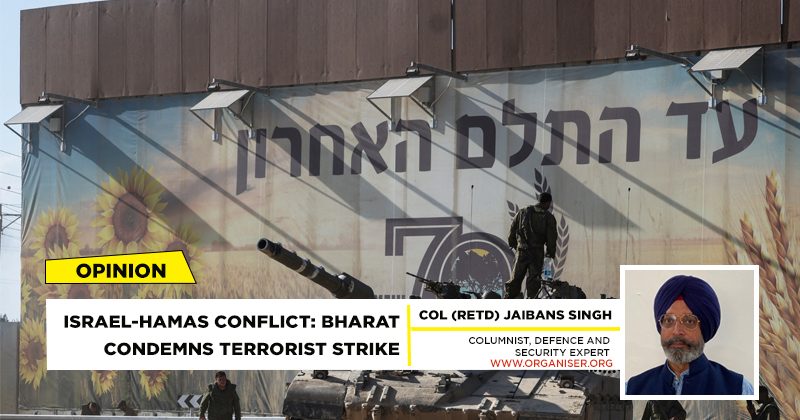
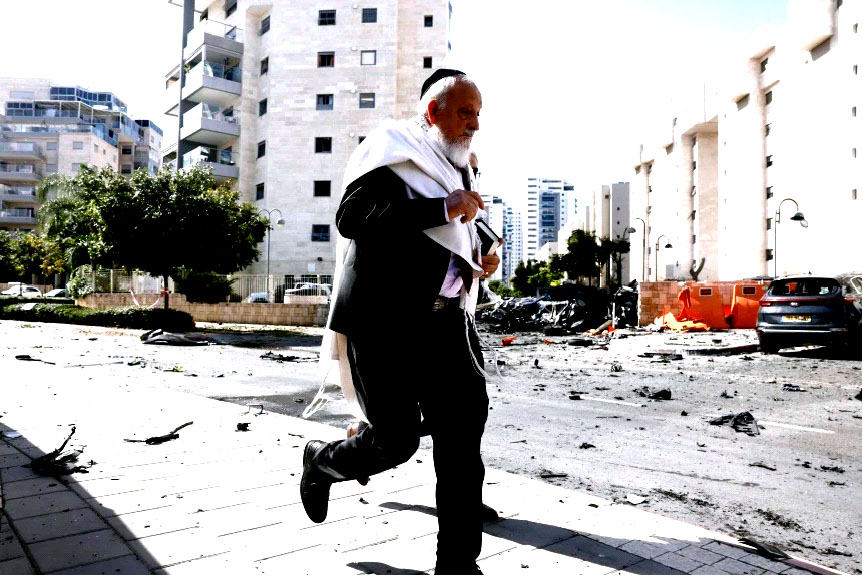
The ”Harakat al Mukwana al Islamiya” (HAMAS), the Palestinian lslamic fundamentalist organisation which has a terrorist wing called lzza din al Qassam, launched a ferocious attack on its arch enemy, Israel on October 7. The people of Israel were in a holiday mood as October 6 was Yom Kippur day and October 7 was Sabbath day, the most important religious festivals of the Jews. Israel has confirmed at least 1200 killed and about 100 taken hostages by Hamas in Gaza. After the initial shock, Prime Minister M Benjamin Netanyahu ordered mobilisation and retaliatory action by Israeli Defence Forces (IDF). War planes bombarded the Hamas headquarters, camps, anti-air batteries, rocket launch pads and tunnel networks.
Palestine president Mahmoud Abbas has confirmed 2000 casualties, 4000 wounded and mass destruction of buildings including residential complexes. The Israeli Defence Minister has ordered mobilisation of three lakh troops to launch an offensive in Gaza. Israeli Air Force fighter jets and artillery too have been carrying out selected destruction of Hamas strongholds. Israel, the homeland of Jews, is located on the eastern coast of the Mediterranean sea in the Middle East. It is surrounded by Lebanon in the North, Syria in Northeast, Jordan in the East and southeast and Egypt in southwest and south. Jerusalem is the proclaimed capital but de facto centre of power is Tel Aviv. The total area is 21,643 sq kms. It is the only Jewish nation in the world and has a history rolling back to the pre-biblical era.
There was a heavy migration of persecuted Jews from all over the world towards Palestine in the World War II period of holocaust perpetrated by Nazi Germany. However, the arrival of the Jews under protection of the British flared up into clashes with Arab native clans. The United Nations planned to partition Palestine into two separate Jewish and Arab states on November 29, 1947 but the Arabs rejected the plan. Israel achieved statehood on May 14, 1948. A new nation was born but with hostile Arab neighbours.
GOODWILL GESTURE
In 2005, then prime minister of Israel Ariel Sharon unilaterally decided to withdraw from the Gaza strip. The Jewish settlers were forced to leave their homes in spite of resistance, and evacuated to the mainland for safety reasons. Gradually, all elements of the IDF also were withdrawn as a goodwill step towards providing autonomy to Palestinians to run their own affairs. The whole world welcomed it, including the Arab fraternity.
The Gaza strip is approximately 363 kms long. It is located on the south-western corner of Israel linking with Sinai in Egypt to the southern edge and Mediterranean sea coast to the west. It has a population of 10 lakhs. It was handed over to the Palestine Liberation Organisation (PLO) in 1993/94 and permitted self rule as part of a peace agreement under the UN. Similarly in the West Bank (5900 sq km area) also, partial self-rule was initiated with the aim of lasting peace.
Yasser Arafat, founder chairman of Palestine Liberation Organisation (PLO) from 1969 to 2004 established the Palestine state with Ramallah declared as the capital. A Palestine legislative council was formed. Mahmoud Abbas is the current chairman and president of Palestine.
THE HAMAS MENACE
Hamas won legislative elections in 2006 and took over control of the Gaza strip. This group has overshadowed PLO and taken over the role of continuing the so-called freedom struggle. Their main arsenal is Qassam I and Qassam 2 rockets for attacking in range Israeli towns.
Israel has launched a number of operations to neutralise the Hamas menace since 2008. The never ending story of Gaza continues even after bloody rounds of 2008, 2012, 2014, 2021 and now 2023. Israeli PM Benjamin Netanyahu has vowed, in his address to the nation, that Israel will now go full blast after Hamas. 84 countries have supported Israel including USA and Bharat for taking action against the terrorist outfit Hamas, whereas 14 Muslim countries including Iran and Pakistan have shown support to Hamas.
Delhi’s ‘concerned’ citizens
The Palestine “embassy” in Delhi organised a “solidarity meeting”. A “group of concerned citizens of Delhi” namely Ravi Nair, Apoorvanand, Annie Raja, Hannah Mollah, N Sai Balaji, John Dayal and Harsh Mandar were the only ones to attend and express solidarity with the Palestinian Ambassador to Bharat. “We demand immediate end of Israeli occupation of Palestine, ensure ceasefire and a permanent solution to Israel and Palestine issue through diplomacy and dialogue,” they said, totally whitewashing the Hamas terror attack.
In Bharat, at the time of the creation of Israel, Vinayak Damodar Savarkar had supported the creation of Israel on both moral and political grounds, and condemned Bharat’s vote at the UN against Israel. Rashtriya Swayamsevak Sangh leader Madhav Sadashiv Golwalkar admired Jewish nationalism and believed Palestine was the natural territory of the Jewish people, essential to their aspiration for nationhood. Bharat officially recognized the State of Israel on September 17, 1950, and permitted the country to open a consulate in Mumbai in 1953. Yet the relationship remained informal in nature till 1992.
ERA OF FRIENDSHIP
Once formal ties were established in 1992, defense and trade relations took off and Israel quickly became Bharat’s second-largest defense partner. However, the two nations still did not enjoy a close relationship. When Ariel Sharon became the first Israeli prime minister to visit Bharat in 2003, he met with large protests by the public, mainly Muslim.
CWC: NO MENTION OF HAMAS ATTACK
“The CWC expresses its dismay and anguish on the war that has broken out in the Middle East where over a thousand people have been killed in the last two days. The CWC reiterates its long-standing support for the rights of the Palestinian people to land, self-government and to live with dignity and respect. The CWC calls for an immediate cease-fire and for negotiations to begin on all outstanding issues including the imperative issues that have given rise to the present conflict.”
After the formation of the BJP-led NDA government in the centre under Prime Minister Narendra Modi in 2014, the relationship between Bharat and Israel began to take a friendly turn. In 2015 and 2016, Bharat abstained from a UN vote that discussed whether Israel should be brought before the International Criminal Court for its alleged war crimes during the 2014 crisis in Gaza. In 2017, Modi became the first PM to visit Israel. Today, the relationship spans a broad spectrum, from tourism to defense.
From not recognizing Israel to becoming friends, and now balancing relations with different countries, Bharat has followed the principles of righteousness and justice. Publicly, Bharat still supports the Palestinian cause and hosted Palestinian President Mahmoud Abbas in New Delhi in 2018. Prime Minister Modi’s condemnation of the terrorist strike by Hamas and offer of support to Israel is looked upon by the civilised world as a step in the right direction.














Comments