Ancient Hindu kingdom in greater Armenia
December 5, 2025
  • Read Ecopy
  • Circulation
  • Advertise
  • Careers
  • About Us
  • Contact Us
Android AppiPhone AppArattai
Organiser
  • ‌
  • Bharat
    • Assam
    • Bihar
    • Chhattisgarh
    • Jharkhand
    • Maharashtra
    • View All States
  • World
    • Asia
    • Europe
    • North America
    • South America
    • Africa
    • Australia
  • Editorial
  • International
  • Opinion
  • RSS @ 100
  • More
    • Op Sindoor
    • Analysis
    • Sports
    • Defence
    • Politics
    • Business
    • Economy
    • Culture
    • Special Report
    • Sci & Tech
    • Entertainment
    • G20
    • Azadi Ka Amrit Mahotsav
    • Vocal4Local
    • Web Stories
    • Education
    • Employment
    • Books
    • Interviews
    • Travel
    • Law
    • Health
    • Obituary
  • Subscribe
    • Subscribe Print Edition
    • Subscribe Ecopy
    • Read Ecopy
  • ‌
  • Bharat
    • Assam
    • Bihar
    • Chhattisgarh
    • Jharkhand
    • Maharashtra
    • View All States
  • World
    • Asia
    • Europe
    • North America
    • South America
    • Africa
    • Australia
  • Editorial
  • International
  • Opinion
  • RSS @ 100
  • More
    • Op Sindoor
    • Analysis
    • Sports
    • Defence
    • Politics
    • Business
    • Economy
    • Culture
    • Special Report
    • Sci & Tech
    • Entertainment
    • G20
    • Azadi Ka Amrit Mahotsav
    • Vocal4Local
    • Web Stories
    • Education
    • Employment
    • Books
    • Interviews
    • Travel
    • Law
    • Health
    • Obituary
  • Subscribe
    • Subscribe Print Edition
    • Subscribe Ecopy
    • Read Ecopy
Organiser
  • Home
  • Bharat
  • World
  • Operation Sindoor
  • Editorial
  • Analysis
  • Opinion
  • Culture
  • Defence
  • International Edition
  • RSS @ 100
  • Magazine
  • Read Ecopy
Home Opinion

Ancient Hindu kingdom in greater Armenia

The Hindu princes erected the gods and goddesses they had worshipped in India in Ashtishat, an Armenian city. Hindus battled to defend their community during Armenia's Christianisation process, but in the end, the Christian armies conquered the community of Hindus

Arunansh B. GoswamiArunansh B. Goswami
Oct 15, 2023, 02:00 pm IST
in Opinion
Follow on Google News
FacebookTwitterWhatsAppTelegramEmail

Did you know two Hindu princes from Kannauj, an ancient city in India, once ruled an ancient Armenian province? Did it come as a surprise? Well, yes, indeed, and the province’s name was Taron. In Hittite sources, Taron is mentioned under the name Taruishi, and in Latin under the name Tavrancium. The name of the entire ashkharh (province) where Taron is located was Turuberan.

These Hindu princes who moved to Taron were from an ancient Indian city that finds a prominent place in the annals of Indian history because of a great ruler known as Harshvardhana; this city was known as Kanyakubja in Hindu scriptures Valmiki Ramayana, Maharashtra and Puranas and later as Kannauj; now situated in the state of Uttar Pradesh in present-day India, and is famous for its local perfume industry known locally as Kannauj “Attar”. Fa-hien, the Chinese pilgrim, visited Kannauj between 399 and 414 A.D. during the reign of Emperor Chandragupta II. Descendants of Jaichand, ruler of Kannauj, moved to the present Indian State of Rajasthan and founded the cities of Jodhpur and Bikaner. It was indeed during the rule of Harshavardhana, the Pushyabhuti ruler of Kannauj, a Hindu who later embraced Mahayana Buddhism (A sect of Buddhism), that Kannauj became one of the most prominent cities in India. It was from this city that two Hindu princes moved to Armenia. Let’s learn about their saga and saga of an ancient Hindu community that settled in Armenia.

Armenia is the first Christian country in the world, and St. Gregory, the illuminator and the Apostle of Armenia, brought Christianity to this country. Here is some more information about him, especially for our non-Armenian readers: he was a Parthian Prince who converted to Christianity and later, in turn, converted King Tiridates III of Armenia, who in turn imposed Christianity on his people 20 years before Constantine did it, the same Constantine who founded the city of Constantinople also known as the second Rome. Readers must be wondering why the author is writing about St. Gregory here. One of his first disciples was Zenob, or Zenobias, who happened to be a Syrian. It was he who, at the instance of his master, wrote a History of Taron. In that work, he refers to the history of a Hindu colony in Armenia since the middle of the second century before the commencement of the Christian era.

Zenob the Syrian wrote, “Demeter and Gisaneh were brothers, and they were both Indian princes. They had conspired against Dinaksi, their King, who, being apprised, sent troops after them either to put them to death or to banish them from the country. Having narrowly escaped, they fled to King Valarsaces, who bestowed on them the principality of the district of Taron, where they built a city and called it Veeshap.

They afterwards went to the city of Ashtishat and set up idols in the names of those they had worshipped in India. After fifteen years, the King killed both brothers; I do not know why and conferred the principality on their three sons, Kuars, Meghtes and Horean. Kuar built the city of Kuars, Meghtes built a village on the plain and called it Meghti, and Horean built a village in the province of Paloonies and called it Horeans.

After some time, Kuar, Meghtes and Horean resolved to go to the mountain called Kharkhi, and they found the place to be healthful and beautiful, for it was cool and abounded in game, grass and wood. There, they raised edifices and set up two idols, one in the name of Gisaneh and the other in the name of Demeter.”

Let’s understand what exactly Zenob the Syrian means in the statements above. King Valarsaces has written about a brother of Arsaces the Great and the founder of the Arsacid dynasty, which ruled Armenia from 149 B C. to 428 AD. It has been written about them that the Arsacids encouraged the development of Hellenistic cities and tolerated the formation of vassal kingdoms. When it comes to the name of the Indian princes mentioned by Zenob the Syrian, as per historian of Armenian origin Mesrovb Jacob Seth, Gisaneh may have been the corrupt form of Krishna, and Demeter the Hellenised form of Juggernath (Jagannath, a form of Bhagwan Krishna) or Gonesh (Ganesh son of Bhagwan Shiva who is a part of Puranic Hindu holy trinity and Mother Parvati). Similarly, Kuars may be identified with Koilash, also known as Kailash, the holy mountain now in China which is believed to be the home of Bhagwan Shiva on earth, Meghtes with Mukti which means salvation, Horean with Horendra or Harendra, meaning Bhagwan Shiva and Artzan with Arjun who was an important hero in the epic battle of Mahabharata fought in South Asia. It was to Arjun that Bhagwan Krishna told the Bhagwat Gita, all of which are genuine Hindu names of Ancient India, according to the historian of Armenian origin Mesrovb Jacob Seth.

In the Armenian city of Ashtishat, famous for its temples of the national gods and goddesses of heathen Armenia, the Hindu princes set up the deities they had worshipped in India. When the Christianisation of Armenia started, Hindus fought to the last man standing to protect their community, and finally, the Christian armies conquered the community of Hindus. As per Mesrovb Jacob Seth, “the Hindus, who up to the advent of Christianity in Armenia had remained a distinct community became gradually merged into the native Christian population, as no reference is made to them by any of the Armenian historians who came after Zenob, who, as has been stated before, flourished in the beginning of the 4th century.” This shows that there indeed may be many people in Armenia today who may have Indian ancestry.

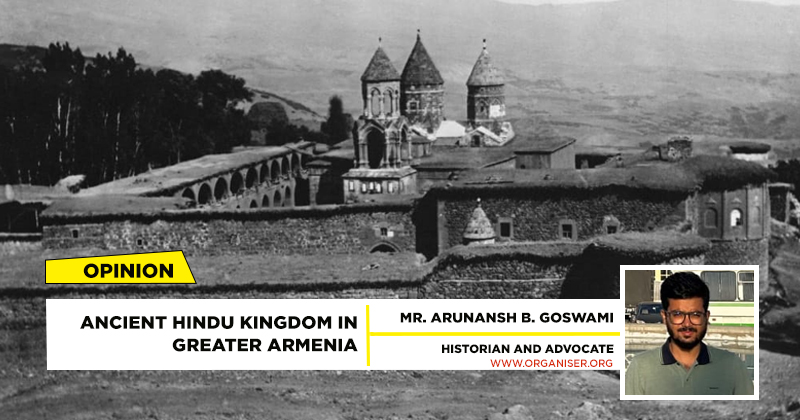
It has been mentioned that the Surb Karapet Monastery in Mush was built in 301 A.D., where once stood the temples dedicated to Hindu princes Gisaneh or Krishna and Demeter or Ganesha or Jagannath. After building the monastery, St. Gregory deposited the St. John the Baptist relics and Athanagineh, the martyr he had brought from Ceaseria. It was considered the most important monastery in Turkish (Western) Armenia and the second most important of all Armenian monasteries after Etchmiadzin. Later, the Turks destroyed this monastery during the 1915 Armenian Genocide, and its local Kurds used stones for building purposes. The history of Indo-Armenian cultural interaction is very old and needs to be studied more.


Topics: Hindu communityArmeniaAncient hindu kingdomArmenia's Christianisation process
Share36TweetSendShareSend
✮ Subscribe Organiser YouTube Channel. ✮
✮ Join Organiser's WhatsApp channel for Nationalist views beyond the news. ✮
Previous News

IndiaSize to revolutionise apparel Industry

Next News

Navaratri: Celebrating Feminine Creation

Related News

Minority hindu community in certain regions of India need equal constitutional protection

From safeguards to selective privileges: The distortion of minority rights

Locals protesting against the mosque in Sanjauli (Source: Aaj Tak)

Sanjauli Mosque Row: Hindus demand action on illegal construction; locals raise concern over demographic change

Islamists attack Hindu devotees during Durga Puja (Source: OpIndia)

Nepal: Islamists attack Hindu devotees during Durga Puja murti immersion, prompting police action to restore order

Donald Trump flanked by Azerbaijan's president, Ilham Aliyev (left), and Armenia's prime minister, Nikol Pashinyan (right), during the signing ceremony at the White House on 8 August 2025

Sham Peace Mediation Repeats: Trump makes Armenian Christians bow to Azerbaijan-Turkey Islamic axis for US-Europe gains

Armenia seeks Indian weapons used in Operation Sindoor to fight Azerbaijan; Keen to expand defence partnership

Islamic vendors caught contaminating food

Urine Jihad Exposed: Islamic vendors caught contaminating food, targeting Hindus

Load More

Comments

The comments posted here/below/in the given space are not on behalf of Organiser. The person posting the comment will be in sole ownership of its responsibility. According to the central government's IT rules, obscene or offensive statement made against a person, religion, community or nation is a punishable offense, and legal action would be taken against people who indulge in such activities.

Latest News

PM Modi presents Putin with Bhagavad Gita, chess set, and silver horse

Cultural ties strengthened: PM Modi presents Putin with Bhagavad Gita, chess set, and silver horse

Image for representational purpose only, Courtesy Vocal Media

Bihar to get ‘Special Economic Zones’ in Buxar and West Champaran

Thirupparankundram Karthigai Deepam utsav

Andhra Pradesh: AP Dy CM Pawan Kalyan reacts to Thirupparankundram row, flags concern over religious rights of Hindus

23rd India-Russia Annual Summit

India-Russia Summit heralds new chapter in time-tested ties: Inks MoUs in economic, defence, tourism & education

DGCA orders probe into IndiGo flight disruptions; Committee to report in 15 days

BJYM leader Shyamraj with Janaki

Kerala: Widow of BJP worker murdered in 1995 steps into electoral battle after three decades at Valancherry

Russian Sber bank has unveiled access to its retail investors to the Indian stock market by etching its mutual fund to Nifty50

Scripting economic bonhomie: Russian investors gain access to Indian stocks, Sber unveils Nifty50 pegged mutual funds

Petitioner S Vignesh Shishir speaking to the reporters about the Rahul Gandhi UK citizenship case outside the Raebareli court

Rahul Gandhi UK Citizenship Case: Congress supporters create ruckus in court; Foreign visit details shared with judge

(L) Kerala High Court (R) Bouncers in Trippoonithura temple

Kerala: HC slams CPM-controlled Kochi Devaswom Board for deploying bouncers for crowd management during festival

Fact Check: Rahul Gandhi false claim about govt blocking his meet with Russian President Putin exposed; MEA clears air

Load More
  • Privacy
  • Terms
  • Cookie Policy
  • Refund and Cancellation
  • Delivery and Shipping

© Bharat Prakashan (Delhi) Limited.
Tech-enabled by Ananthapuri Technologies

  • Home
  • Search Organiser
  • Bharat
    • Assam
    • Bihar
    • Chhattisgarh
    • Jharkhand
    • Maharashtra
    • View All States
  • World
    • Asia
    • Africa
    • North America
    • South America
    • Europe
    • Australia
  • Editorial
  • Operation Sindoor
  • Opinion
  • Analysis
  • Defence
  • Culture
  • Sports
  • Business
  • RSS @ 100
  • Entertainment
  • More ..
    • Sci & Tech
    • Vocal4Local
    • Special Report
    • Education
    • Employment
    • Books
    • Interviews
    • Travel
    • Health
    • Politics
    • Law
    • Economy
    • Obituary
  • Subscribe Magazine
  • Read Ecopy
  • Advertise
  • Circulation
  • Careers
  • About Us
  • Contact Us
  • Policies & Terms
    • Privacy Policy
    • Cookie Policy
    • Refund and Cancellation
    • Terms of Use

© Bharat Prakashan (Delhi) Limited.
Tech-enabled by Ananthapuri Technologies