





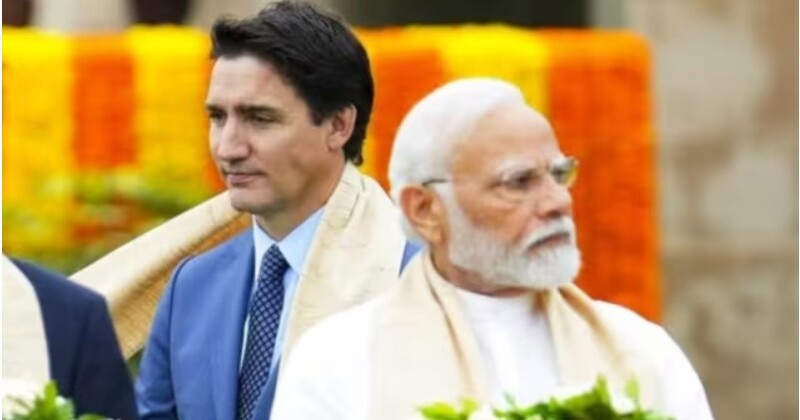
New Delhi: The tension between India and Canada is escalating over the assassination of Khalistan supporter and Khalistan Tiger Force terrorist Hardeep Singh Nijjar. Serious allegations have been made by Canada’s Prime Minister Justin Trudeau against India. As per records, the Indian government has issued a staggering 26 appeals over the past five years. These appeals were made in an effort to bring individuals involved in heinous crimes to justice, but the Trudeau government has consistently refrained from taking any substantial action or providing a positive response.
According to sources within Indian security agencies, Canada is currently harbouring 13 wanted terrorists and criminals who are accused of carrying out violent acts in India. One notable figure among them is Sandeep Singh, also known as “Sunny,” who is employed as a superintendent in the Canada Border Services Agency.
Canada is a safe haven for terrorists and crime. @MEAIndia #canadaindia pic.twitter.com/jVGsdQCosK
— Pramod Kumar Singh (@SinghPramod2784) September 21, 2023
The list of individuals sought by India includes Arsh Dalla, a prominent Khalistani terrorist, and Sukha Duneke, a notorious Punjabi gangster. Sukha Duneke was brutally murdered on a Thursday, with over 30 cases pending against him. Despite this, the Trudeau government has consistently denied India’s requests to extradite these individuals.
Canada’s Lack of Cooperation: A Concern for Indian Authorities
A high-ranking official from an Indian security agency revealed that Canadian Prime Minister Justin Trudeau had accused India’s secretive intelligence agency of operating within Canada without providing any concrete evidence. Trudeau’s government has been dismissive of India’s extradition requests, despite compelling evidence provided by Indian authorities.
Canadian lies exposed by India. India says Canada has not shared any information or evidence with India on killing of Khalistani Hardeep Singh Nijjar either before or after. India however has shared all information on Khalistani terrorists in Canada which they haven’t acted upon. pic.twitter.com/N2fqbbBByw
— Aditya Raj Kaul (@AdityaRajKaul) September 21, 2023
The security agency official stated, “We possess substantial evidence against these fugitives who fled to Canada in connection with their criminal activities. We have shared this evidence with the Canadian government, as well as with other nations. Trudeau’s government seems to be intentionally sheltering these individuals and ensuring their safety. Even after three months since the death of Khalistani terrorist Hardeep Singh Nijjar, the Canadian police have failed to locate those involved in his murder.”
Gang Violence Suspected Behind Nijjar’s Murder
According to Indian authorities, this entire situation appears to be rooted in gang violence, with Khalistani organizations exploiting it against India. There are clear indications of other organizations operating behind the scenes to manipulate this situation. It is also possible that Trudeau remains unaware of the full truth behind this complex issue.
Trudeau Accuses India in Canadian Parliament
Recently, Justin Trudeau stirred controversy by publicly alleging, in the Canadian Parliament, that he possesses ample evidence proving India’s involvement in the murder of Nijjar. Subsequently, Canada ordered the return of Pawan Kumar Rai, a 1997 batch Indian Police Service officer, to India.
#BREAKING: Canadian Prime Minister @JustinTrudeau after being snubbed in India during G20, now blames India for the killing of Khalistani radical Hardeep Singh Nijjar on Canadian soil. Nijjar was killed in an internal gang fight of Khalistanis at a Sikh Gurudwara in June. pic.twitter.com/Ei42OC15QU
— Aditya Raj Kaul (@AdityaRajKaul) September 18, 2023
Despite Trudeau’s accusations and the extradition order, there is no concrete evidence linking India to the murder of Nijjar. The Royal Canadian Mounted Police (RCMP) is actively investigating the case and has sought assistance from local and national law enforcement agencies.
However, an RCMP officer, speaking on the condition of anonymity, informed that they have yet to identify any suspects in the Nijjar case. According to the officer, Nijjar had assumed the position of chairman at the Saree Ka Guru Nanak Sikh Gurudwara in 2018, which has significant local influence. As a result, Nijjar had gained adversaries within the Sikh community.
Growing Frustration and International Scrutiny
India’s repeated appeals for extradition have not yielded the desired results, leading to growing frustration within the Indian government. This issue has also drawn international attention, with concerns raised about Canada’s role in harboring individuals wanted for serious crimes in India. The Indian government continues to urge Canada to take action against individuals involved in criminal activities and terrorism and to uphold its commitment to international law enforcement cooperation. Meanwhile, Indian security agencies are determined to pursue these cases and bring the accused to justice, whether or not they continue to find sanctuary abroad.
As the extradition saga between India and Canada continues to unfold, the international community watches closely, hoping for a resolution that will uphold justice and ensure that criminals do not find safe haven in foreign lands. It remains to be seen whether Canada will heed India’s calls for cooperation or maintain its current stance in the face of mounting pressure and scrutiny.
India and Canada relation history
India and Canada have shared a complex relationship since establishing diplomatic ties in 1947. Initially close partners, their collaboration on international issues like the Korean War and the Suez Crisis waned in the 1970s, partly due to India’s nuclear test in 1974. Tensions escalated in the 1980s and 1990s due to India’s support for Sikh separatists in Canada, with reciprocal accusations of interference. However, recent years have seen a thaw in relations, driven by factors like the growing Indian diaspora in Canada and increasing economic ties. High-level visits by leaders from both countries, such as Canadian PM Stephen Harper’s 2010 visit to India and Indian PM Narendra Modi’s 2015 visit to Canada, marked improvements in relations. Today, India and Canada collaborate closely in trade, investment, and security, addressing global issues despite challenges related to Sikh separatism and human rights concerns.











Comments