





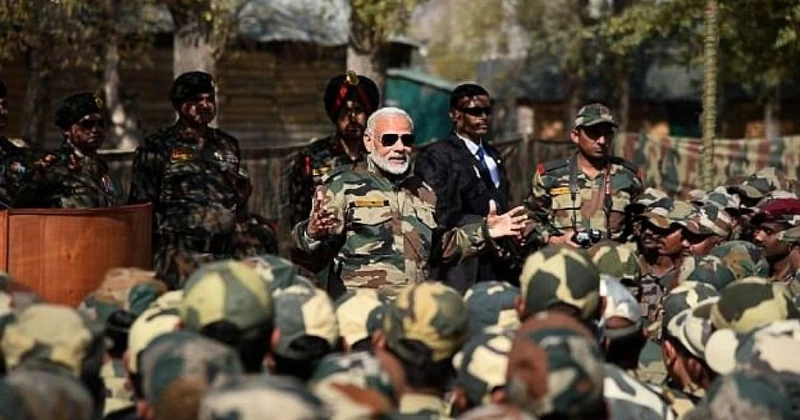
Amid the ongoing Corps commander talks with the Chinese People’s Liberation Army (PLA), the Indian Army have airlifted around 68000 troops in the eastern Ladakh region after the deadly Galwan Valley clashes occurred between the two armies in June 2020.
As per the sources of the Defence Ministry, the India Air Force (IAF) airlifted over 300 infantry combat vehicles, around 90 tanks, and artillery alongside airlifting around 70000 troops near the site of a skirmish between the two armies in eastern Ladakh, the deployment was made as a countermeasure to contain the Chinese aggression in the mountainous terrain.
The IAF also deployed Rafales, MiG 29s and Sukhoi-30s to conduct air patrols and prepare them to respond to any potential development occurring near the northern border. The deployment and the air patrols conducted by the IAF include its fighter aircraft, attack helicopters and multi-mission choppers capabilities to carry out all weather, day and night combat missions in the valley.
The IAF also enhanced its air defence capabilities by moving a range of surface-to-air guided missiles to frontline bases alongside installing various radars to put round-the-clock surveillance on the eastern border. Additionally, efforts are to convert the frontline landing ground of IAF in Nyoma, a natural flat on Ladakh’s plateau, to a full-fledged base.
The task is being assigned to the Border Road Organisation (BRO), expected to be completed in a year and a half. On completion, the base will have a modern military infrastructure with a two and a half kilometres long runway. Overall, this will be the fourth such base for the IAF after Siachen, Kargil and Leh and will boost the operational readiness for the fighter aircraft in case of a conflict between the two neighbours.
Corps Commander talks
It is to be noted that the recent revelation about the deployment of troops and other equipment in the Ladakh region has come to light at a time when the officials of the PLA and the Indian Army are set to hold the Corps Commander level talk on August 14.
The meeting, scheduled in Chushul, would be the nineteenth meeting between the officials of both armies to resolve the ongoing standoff between the two giant neighbours in the Ladakh region. Earlier, the eighteenth Corp Commanders level talks were held in Chushul moldo meeting point on the Chinese side in April this year.
So far, disengagement has been carried out by India and China at the Northern and Southern Banks of Pangong Tso Lake, Gogra hot spring, Patrolling Point (PP) 15 and Galwan, where deadly clashes occurred in 2020. However, both armies are still in a deadlock over disengagement near the Depsang and the Demchok, which India has identified as additional friction points.
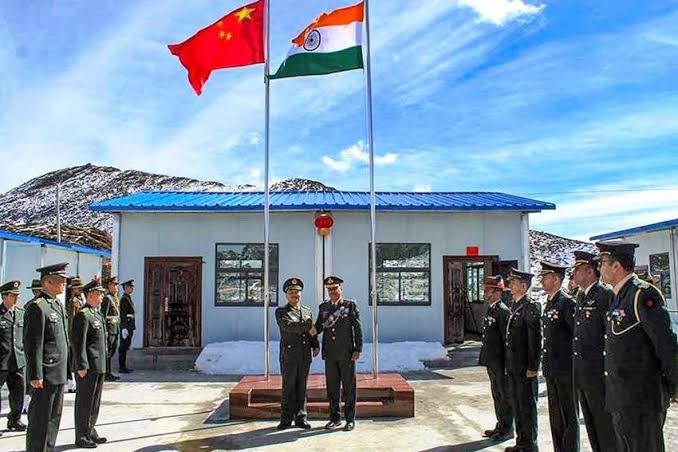
The Indian side has repeatedly asserted the restoration of the status quo ante as of April 2020 and is expected to push for the same in the upcoming meet. Lt Gen Rashim Bali will lead the Indian delegation for the talks.
In a pre-emptive measure, the Narendra Modi led government has also decided to deploy paramilitary troops to safeguard the Siliguri Corridor in times of peace. As per the reports, the government will deploy troops from the Border Security force (BSF), Indo-Tibet Border Police (ITBP) and Seema Shashastra Bal (SSB) to guard the highly strategic 60 km long narrow stretch which is only 22 Km wide at places.
The much-needed move from the Indian government arrived after the Chinese government had recently shown signs of desperation to commence the border talks with the kingdom of Bhutan, which has been on a halt since the Doklam standoff of 2017. It is to be noted that the corridor provides the only land route which connects the northeast region to the Indian heartland.
The relationship between the two giant neighbours has turned hostile in recent years after the violent clashes between the PLA and the Indian Army in Galwan Valley in June 2020, where as many as 20 Indian soldiers were martyred in action. Earlier, the Chinese side claimed only a handful of casualties on their sides; however, various reports about the clashes later claimed heavy casualties on the Chinese side ranging between 40 to 50 deaths on the Chinese side.











Comments