Indian Judiciary: “Tarikh pe Tarikh” for common man but midnight hearing for privileged
December 5, 2025
  • Read Ecopy
  • Circulation
  • Advertise
  • Careers
  • About Us
  • Contact Us
Android AppiPhone AppArattai
Organiser
  • ‌
  • Bharat
    • Assam
    • Bihar
    • Chhattisgarh
    • Jharkhand
    • Maharashtra
    • View All States
  • World
    • Asia
    • Europe
    • North America
    • South America
    • Africa
    • Australia
  • Editorial
  • International
  • Opinion
  • RSS @ 100
  • More
    • Op Sindoor
    • Analysis
    • Sports
    • Defence
    • Politics
    • Business
    • Economy
    • Culture
    • Special Report
    • Sci & Tech
    • Entertainment
    • G20
    • Azadi Ka Amrit Mahotsav
    • Vocal4Local
    • Web Stories
    • Education
    • Employment
    • Books
    • Interviews
    • Travel
    • Law
    • Health
    • Obituary
  • Subscribe
    • Subscribe Print Edition
    • Subscribe Ecopy
    • Read Ecopy
  • ‌
  • Bharat
    • Assam
    • Bihar
    • Chhattisgarh
    • Jharkhand
    • Maharashtra
    • View All States
  • World
    • Asia
    • Europe
    • North America
    • South America
    • Africa
    • Australia
  • Editorial
  • International
  • Opinion
  • RSS @ 100
  • More
    • Op Sindoor
    • Analysis
    • Sports
    • Defence
    • Politics
    • Business
    • Economy
    • Culture
    • Special Report
    • Sci & Tech
    • Entertainment
    • G20
    • Azadi Ka Amrit Mahotsav
    • Vocal4Local
    • Web Stories
    • Education
    • Employment
    • Books
    • Interviews
    • Travel
    • Law
    • Health
    • Obituary
  • Subscribe
    • Subscribe Print Edition
    • Subscribe Ecopy
    • Read Ecopy
Organiser
  • Home
  • Bharat
  • World
  • Operation Sindoor
  • Editorial
  • Analysis
  • Opinion
  • Culture
  • Defence
  • International Edition
  • RSS @ 100
  • Magazine
  • Read Ecopy
Home Opinion

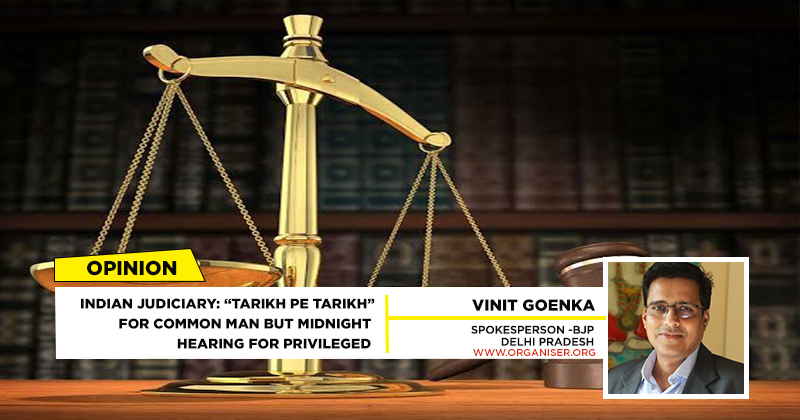
Indian Judiciary: “Tarikh pe Tarikh” for common man but midnight hearing for privileged

By getting into judicial activism, Judiciary seems to have assumed the role of a protector, sometimes even at the cost of objectivity

Vinit GoenkaVinit Goenka
Jul 23, 2023, 10:00 am IST
in Opinion
Follow on Google News
FacebookTwitterWhatsAppTelegramEmail

On July 1, 2023, at around 9:30 pm late evening, when Supreme Court was still on vacation, a special hearing by three judge bench was held for “Teesta Setalvad”, and the Supreme Court granted interim protection to Teesta Setalvad by staying for seven days the order of Gujarat High Court, passed on the same day, asking her to surrender immediately.

On July  6 2023 a reputed newspaper carried two articles which caught my attention. The first article was titled, “SC extends Teesta’s Interim Protection” and the second article was titled, “SC Collegium Recommends Elevation of 2 HC Chief Justices.” The two headlines were a euphemism for two major ills afflicting the judiciary, that is, judicial overreach and lack of transparency.

The question to ponder upon is, once considered the strongest pillar of the country’s democracy, is the judiciary slowly be turning into its weakest link. By stepping into the powers of the executive and the legislative on numerous occasions, is the judiciary normalising encroachments. Couple of recent incidences depict how the judiciary has been systematically silencing and intimidating the other two pillars of democracy. The first is that of the extension granted to Enforcement Directorate Director Sanjay Mishra which the Supreme Court ruled as illegal. In this case, the court did not just go beyond the powers vested in it by the Constitution but in a way, also raised questions on the integrity of an officer who has been fighting hard to eradicate corruption. The second incident of judicial overreach was seen when the Supreme Court stayed an order of the National Green Tribunal, appointing the Lieutenant Governor of Delhi as the chairman of a high-level committee to deal with pollution in Yamuna River.

In both the instances, by getting involved in even the routine decisions of the other two arms, isn’t the judiciary is setting a dangerous precedent. By getting into judicial activism, it seems to have assumed the role of a protector, sometimes even at the cost of objectivity. India is a country where there is a pendency of 4.7 crore court cases, but perhaps ignoring that, the court held late night sessions to hear the bail pleas of privileged people such as Teesta Setalvad and Kanhaiya Kumar. Irony is, when it came to pronouncing judgement in the 1996 Lajpat Nagar bomb blast case that took the lives of 13 civilians, the court took 27 years! The court needs to answer why was a terrorist activity funded by external agencies not treated with the same urgency? It was a crime that struck at the very idea of Bharat. Moreover, a judgement that is delivered after 27 years cannot be considered a relief. Such long delays make a mockery out of the victims’ sufferings and completely erode the confidence of citizens in the judiciary.

By taking up cases of highly Influential “Teesta” on a war footing on a Saturday late night when courts were on vacation, calling a 3-judge bench out of turn, the courts could not have passed on a grimmer message for thousands of men and women who are languishing in various prisons across the country, waiting for their cases to be taken up for hearing, for many years. The priorities shown by the courts made it clear that justice is available only for those who can afford top-notch lawyers of the Lutyens circle or the Big Elite Club of Lawyers or Influencers. Those who do not have the resources to pay exorbitant legal fees or do not have the right connections are unfortunately left at the mercy of “Tarikh pe Tarikh”.

While we criticise dynasties in politics, we tend to overlook is how judiciary is in fact run by dynasties. A 2016 report by a leading magazine found that 11 out of the 28 Supreme Court judges belonged to families of judges or legal stalwarts. For years, those in the legal profession have worked hand-in-gloves to insulate the institution. The present collegium system was introduced in 1993 and has made judiciary an exclusive club of the haves. According to the data released by the Union government, out of 537 High Court judges appointed between 2018-’22, 79 per cent belonged to forward communities. If one has to give an interpretation to this, it means that the topmost layer of the judiciary is represented by the elites and those coming from humble backgrounds have no place in the system. The exclusion is real and is making justice inaccessible for the have-nots.

Despite the issues being out in the open, the judiciary refuses to submit itself to a transparent process yet assumes the power to rule over those who are in their offices after a fair selection process. The bureaucrats, technocrats and even those entering the lowest ranks of the police force go through a rigorous and open selection process and their appointments are challengeable in courts. The politicians too face an election every five years which make them accountable to the citizens and elections are challengeable in courts. Even a housing secretary goes through a fair selection process. Yet those who occupy the most important position in the smooth functioning of a society hide themselves behind the collegium system and maintain that their appointments cannot be challenged. Their promotions are held so sacred that not even a question can be raised as it would impact the so-called judicial independence. It is rather ironical that when it comes to judicial appointments, the lords fear their own system and refuse to be part of it.

In its quest to stay insulated, the judiciary has often used its most powerful weapon which comes in the form of contempt of court. But that weapon has lost its sharpness when on 31 August 2020, the court imposed a token fine of Re 1 after having found Advocate Prashant Bhushan guilty of contempt of court for his tweets that were critical of the Supreme Court and some of its judges. In view of the stand taken by the court, the said offence can no longer be considered a deterrent as anyone can now challenge the court. In fact, this may present an opportunity for the courts to be more transparent and accountable.

It needs to be kept in mind that if one pillar of democracy decides to encroach on the powers of the others, it will not only undermine the ideals of the nation but will also put a huge question mark on the future of Bharat. A democracy cannot be made into a power tussle, it has to keep the interests of the citizens at the forefront. In the end, by upholding the ideals of Dr Bhimrao Ambedkar, all that can be hoped is that the lordship will let he/she/they enjoy the democratic ideals as guaranteed by the Constitution.


Topics: IndiaSupreme CourtIndian JudiciaryGujarat RiotsTeesta SetalvadGujarat High Court
Share16TweetSendShareSend
✮ Subscribe Organiser YouTube Channel. ✮
✮ Join Organiser's WhatsApp channel for Nationalist views beyond the news. ✮
Previous News

Hizbul terror conspiracy case: NIA raids absconding terrorist’s residence in J-K

Next News

Dark days of India’s emergency, when rumour-mongering and instigation were a norm

Related News

23rd India-Russia Annual Summit

India-Russia Summit heralds new chapter in time-tested ties: Inks MoUs in economic, defence, tourism & education

Russian Sber bank has unveiled access to its retail investors to the Indian stock market by etching its mutual fund to Nifty50

Scripting economic bonhomie: Russian investors gain access to Indian stocks, Sber unveils Nifty50 pegged mutual funds

Prime Minister Narendra Modi and Russian President Vladimir Putin

India on the side of “peace” in Russia-Ukraine conflict, PM Modi asserts for swift peaceful solution

Russian Economic Development Minister Maxim Reshetnikov and Commerce and Industry Minister Piyush Goyal

Piyush Goyal holds talks with Russian counterpart, discusses cooperation in textiles, automobiles and agriculture

Prime Minister Narendra Modi and Russian President Vladimir Putin(File Photo)

President Putin hails leadership of PM Modi, says, India has right to buy Russian oil just like the US

The Supreme Court of India

Supreme Court allows extra support for overburdened BLOs, says SIR duties are mandatory for government staff

Load More

Comments

The comments posted here/below/in the given space are not on behalf of Organiser. The person posting the comment will be in sole ownership of its responsibility. According to the central government's IT rules, obscene or offensive statement made against a person, religion, community or nation is a punishable offense, and legal action would be taken against people who indulge in such activities.

Latest News

PM Modi presents Putin with Bhagavad Gita, chess set, and silver horse

Cultural ties strengthened: PM Modi presents Putin with Bhagavad Gita, chess set, and silver horse

Image for representational purpose only, Courtesy Vocal Media

Bihar to get ‘Special Economic Zones’ in Buxar and West Champaran

Thirupparankundram Karthigai Deepam utsav

Andhra Pradesh: AP Dy CM Pawan Kalyan reacts to Thirupparankundram row, flags concern over religious rights of Hindus

23rd India-Russia Annual Summit

India-Russia Summit heralds new chapter in time-tested ties: Inks MoUs in economic, defence, tourism & education

DGCA orders probe into IndiGo flight disruptions; Committee to report in 15 days

BJYM leader Shyamraj with Janaki

Kerala: Widow of BJP worker murdered in 1995 steps into electoral battle after three decades at Valancherry

Russian Sber bank has unveiled access to its retail investors to the Indian stock market by etching its mutual fund to Nifty50

Scripting economic bonhomie: Russian investors gain access to Indian stocks, Sber unveils Nifty50 pegged mutual funds

Petitioner S Vignesh Shishir speaking to the reporters about the Rahul Gandhi UK citizenship case outside the Raebareli court

Rahul Gandhi UK Citizenship Case: Congress supporters create ruckus in court; Foreign visit details shared with judge

(L) Kerala High Court (R) Bouncers in Trippoonithura temple

Kerala: HC slams CPM-controlled Kochi Devaswom Board for deploying bouncers for crowd management during festival

Fact Check: Rahul Gandhi false claim about govt blocking his meet with Russian President Putin exposed; MEA clears air

Load More
  • Privacy
  • Terms
  • Cookie Policy
  • Refund and Cancellation
  • Delivery and Shipping

© Bharat Prakashan (Delhi) Limited.
Tech-enabled by Ananthapuri Technologies

  • Home
  • Search Organiser
  • Bharat
    • Assam
    • Bihar
    • Chhattisgarh
    • Jharkhand
    • Maharashtra
    • View All States
  • World
    • Asia
    • Africa
    • North America
    • South America
    • Europe
    • Australia
  • Editorial
  • Operation Sindoor
  • Opinion
  • Analysis
  • Defence
  • Culture
  • Sports
  • Business
  • RSS @ 100
  • Entertainment
  • More ..
    • Sci & Tech
    • Vocal4Local
    • Special Report
    • Education
    • Employment
    • Books
    • Interviews
    • Travel
    • Health
    • Politics
    • Law
    • Economy
    • Obituary
  • Subscribe Magazine
  • Read Ecopy
  • Advertise
  • Circulation
  • Careers
  • About Us
  • Contact Us
  • Policies & Terms
    • Privacy Policy
    • Cookie Policy
    • Refund and Cancellation
    • Terms of Use

© Bharat Prakashan (Delhi) Limited.
Tech-enabled by Ananthapuri Technologies