What made Ambedkar’s ‘little Corner’, the echo chamber’s noisy realm?
Dr BR Ambedkar described the Uniform Civil Code (UCC) in the constituent assembly debates as a “little corner”. He said that it was indeed too late to ask the question of whether we could do it, considering that there were uniform laws for every aspect of human relationships. “It is therefore too late now to ask the question whether we could do it. As I say, we have already done it,” he claimed.Even though the vision of the framers of our Constitution was evident in the Constituent Assembly debates so far as insertion of Article 44 is concerned, a lot of discourse around the adoption of the Uniform Civil Code today opposes it.
Firstly, a glimpse into the parliamentary debates that took place when the Hindu Codes were in the oven back in the day, may explain why a measure which was touted as a “moderate” one for “social reform” may have been stonewalled into being just that.
Ambedkar’s “little corner”, the Uniform Civil Code is the little corner for change no more, but a realm, with hoarse noise glaring from the echo chambers, even though the Indian judiciary has been eloquently supportive of it
Former Prime Minister Jawaharlal Nehru, in spite of opposition against the Hindu Codes, pushed the legislation. However, it is worth pondering upon, why the Former Prime Minister, who justified the Hindu Code Bills on the pretext of social reform and equality for the sexes for the country’s majority populace, did not do the same for the minorities and push a Uniform Civil Code at the time instead?If Nehru truly believed that women were ‘shackled and unfree’, why was the privilege of “freedom” and “unshackling” only accorded to Hindu women? The proposition that needs to be pondered upon is not whether one supports equal rights for women or if social reforms are essential (it is a given they are), but whether Nehru’s decision was substantive for India as a whole. It is also important to reflect upon why the lack of equal rights for all could have led to the existing undercurrents of opposition to the Code, 75 years after independence.
N C Chatterjee, who had challenged the Hindu Codes during parliamentary debates had said, “Why not frame, if you have got the courage and wisdom to do it, one Uniform Civil Code? Why are you then proceeding with communal legislation?” Ananga Mohan Dam called the Hindu Codes a “Racial Suicide”. Lakshmi Kanta Moitra declared that the introduction of the divorce clause in the Hindu Code bills was the ‘rudest possible shock’ as the Shastra had rendered marriage “sacred” and “inviolable”. The most vociferous opposition against the bills came from Dr Rajendra Prasad, who was the President of the Indian National Congress at the time. It was his view that the controversial nature of the bill would ‘affect the chances of the Congress at the next election’. It may be safe to say that the conviction with which the decision was still made by Nehru, of bolstering the Hindu Code Bills, stemmed from the idea that the Hindu vote could be taken for granted. Perhaps, the only plausible reason for not codifying Muslim personal laws and introducing the UCC was political and Congress enjoyed en bloc Muslim votes in elections, till the 90s.
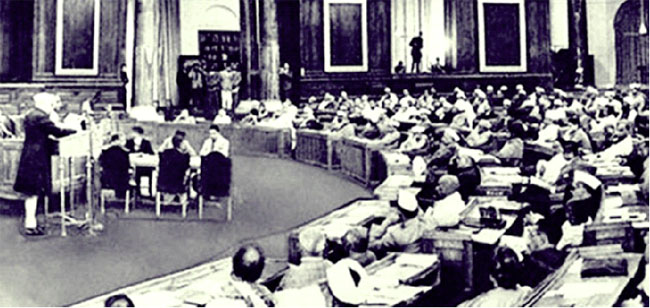
“My feeling is strong on the point that we shall be riding roughshod on the cherished sentiments of the vast bulk of our people and that without having any warrant or sanction from them simply because we consider certain things to be right,” said Dr Prasad in his letters exchanged with the former Prime Minister.
It is also not out of place to ponder upon the reason why the British did not delve into the personal law domain during their rule in India, even though they framed laws for every other aspect of Indian society. This was a measure to further their agenda of “Divide and Rule” which Nehru seems to have propelled over the years.While for the minority communities, Nehru regarded the imposition of a uniform civil code as “unwise”, the Hindu Code Bills were harped upon as achievements. “You have to make beginnings somewhere,” he is known to have said, as the courage to do what he thought was right upturned into complacency over the years, with no sign of the Uniform Civil Code as was envisaged for the whole of India. Noteworthily, A.S. Gopal has pointed out that the reason why the Government did not dare to touch the Muslim community when it introduced the Hindu Code bills was because of Nehru’s incessant thrust on “generous treatment” of minorities. Needless to say, minority communities were left out and did not progress as they remained bound by centuries-old personal laws while Nehru banished invoking Manu and Yājñavalkya while justifying the Hindu Code bills for the majority population.“It is very unfair for Manu or Yājñavalkya or anybody else to be brought in as a witness as to what should be done in the present conditions”, he said.This lack of courage by even successive governments to effectuate uniform reforms for all so as to bring substantive equality for the entire country has only realised echo chambers, which shockingly consider the Uniform Civil Code an anathema to the basic structure of the Constitution.
Ambedkar’s “little corner”, the Uniform Civil Code is the little corner for change no more, but a realm, with hoarse noise glaring from the echo chambers, even though the Indian judiciary has been eloquently supportive of it.
Last year, the then Chief Justice of India, Sharad Arvind Bobde urged academics to watch how the Uniform Civil Code governs all Goans on issues of marriage and succession. “Goa has what constitutional framers envisaged for India – a Uniform Civil Code,” he said, adding that all intellectuals should simply go to Goa to learn its administration of justice to know “what it turns out to be”. Though the first time Courts spoke of the Uniform Civil Code was in 1985 in the Shah Bano case by the Supreme Court where it urged the Government of the day to adopt a Uniform Civil Code, the Rajiv-Gandhi led government overturned Supreme Court’s landmark judgment in 1986 by passing the Muslim Women Act (Protection on Divorce Act), reeling equality in the shackles of time.Recently, the Delhi High Court while adjudicating a matrimonial dispute expressed the pressing need for a Uniform Civil Code. Justice Pratibha M. Singh said that the need for the Code has been envisioned under Article 44 of the Constitution and has been reiterated from time to time by the Supreme Court while bringing to light that cases like the present one highlighted the need for such a Code “common to all” would enable uniformity in all principles of marriage, divorce, succession etc., adding that citizens will be in a better position to safeguard their rights, without conflicts and contradictions of various personal laws.In a 40-page comprehensive judgment, the bench of Justice Suneet Kumar of Allahabad High Court has also observed that “The stage has reached that the Parliament should intervene and examine, as to whether the country requires a multiplicity of marriage and registration laws or the parties to a marriage should be brought under the umbrella of single Family Code.”
Unfortunately, the echo chambers do not agree. A senior Congress leader has called the demand for UCC “a cloak for imposing Hindu Personal Law”, which he considers “deeply anti-women and has been made progressively more and more pro-women”. This is indeed in stark contrast to what the Constitution-makers envisaged for India and solidifies the deliberate lull of previous governments in realising the Constitutional dream.