





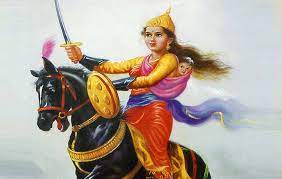
Rani Lakshmibai, originally named Manikarnika Tambe, was born on November 19, 1828, into a Marathi Karhade Brahmin family. Moropant Tambe and Bhagirathi Sapre were her parents. Unfortunately, Lakshmibai’s mother passed away when she was four. Her father served under Peshwa Baji Rao II of the Bithoor district. Lakshmibai received her education at home, acquiring the ability to read and write. Additionally, she received training in various physical activities such as shooting, horsemanship, fencing, and Mallakhamba. She had three horses named Sarangi, Pavan, and Badal.
In May 1851, Manikarnika entered into marriage with Gangadhar Rao Newalkar, who held the title of Maharaja of Jhansi, and in accordance with tradition, she was subsequently named Lakshmibai. In 1852, Lakshmibai gave birth to a son named Damodar Rao, who unfortunately passed away after four months. The couple adopted Gangadhar Rao’s cousin, who was then renamed Damodar Rao. The adoption process occurred in the presence of a British officer, who was given a letter from the Maharaja instructing that the adopted child should be treated with respect and that Jhansi should remain under Lakshmi Bai’s rule for her lifetime.
However, in November 1853, following the Maharaja’s death, the British East India Company, under the governance of Lord Dalhousie, applied the Doctrine of Lapse. This policy led to the rejection of Damodar Rao’s claim to the throne, as he was the adopted son of both the Maharaja and Rani Lakshmibai. In March 1854, Lakshmibai was given an annual pension of Rs. 60,000 and was asked to vacate the palace.
The War of Independence, which began in Meerut on May 10, 1857, significantly impacted Jhansi. Upon hearing the news, Lakshmibai took measures to enhance the city’s defences and organised a Haldi Kumkum ceremony to instil confidence in her people, assuring them that the British were weak. She convinced the people that there was no need to fear them.
On March 7, 1854, the British issued a gazette dissolving the State of Jhansi. Rani Lakshmibai was outraged by this injustice when Major Ellis, an English officer, came to meet her. He read out the official declaration dissolving the state, and in response, the furious Rani Lakshmibai told Ellis, “Meri Jhansi Nahin Doongi” (I shall not part with my Jhansi). Ellis heard her refusal and left.
Rani Lakshmibai’s unparalleled bravery inspired her army, and even her female attendants, disguised in men’s uniforms, joined the battlefield. Lakshmibai’s courage forced the British army to retreat
During the War of 1857, which began in January and spread to Meerut on May 10, Jhansi, along with Delhi and Bareilly, also gained freedom from British rule. After Jhansi’s liberation, Rani Lakshmibai assumed control of Jhansi and prepared to defend it against a potential British attack. Sir Hugh Rose was appointed by the British to capture Rani Lakshmibai alive. On March 20, 1858, Sir Hugh camped with his army three miles from Jhansi and sent a message to Lakshmibai demanding her surrender.
However, she stood on the ramparts of her fort, motivating her army to fight the British instead. The battle commenced, and Jhansi’s cannons started overpowering the British. Despite three days of continuous firing, the fort of Jhansi remained unattacked. Faced with this obstacle, Sir Hugh decided to resort to treachery. Finally, on April 3, Sir Hugh Rose’s army entered Jhansi.
The soldiers began looting the people, prompting Rani Lakshmibai to break through the enemy blockade and join forces with Peshava. During the night, she and her trusted cavalry of 200 tied her 12-year-old son Damodar to her back and left the fort, chanting the slogan ‘Jai Shankar.’ She penetrated the British blockade and rode towards Kalpi, accompanied by her father, Moropant. While breaking through the British army, her father was injured, captured by the British, and hanged.
After continuously riding for 24 hours, covering 102 miles, the Rani reached Kalpi. The Peshwa assessed the situation and decided to assist her by providing the required squads of his army. On May 22, Sir Hugh Rose attacked Kalpi. Rani Lakshmibai, with her lightning-fast movements and sword in hand, led a forceful attack that inflicted setbacks on the British army.
Disturbed by these setbacks, Sir Hugh Rose deployed his reserved camel troops to the battlefield. The arrival of fresh reinforcements affected the zeal of the revolutionaries, and the British captured Kalpi on May 24. The defeated leaders, including Rani Lakshmibai, Raosaheb Peshwe, the Nawab of Banda, and Tatya Tope, gathered at Gopalpur. Rani Lakshmibai proposed taking over Gwalior, which was ruled by Shinde, a pro-British ruler. She successfully captured Gwalior and handed it over to the Peshwa.
Upon learning about the defeat of Gwalior by Rani Lakshmibai, Sir Hugh Rose realised that the situation could spiral out of control if time were wasted. He marched towards Gwalior, where Lakshmibai and the Peshwa decided to confront the British. Lakshmibai took charge of safeguarding the east side of Gwalior. Her unparalleled bravery inspired her army, and even her female attendants, disguised in men’s uniforms, joined the battlefield. Lakshmibai’s courage forced the British army to retreat.
On March 23, 1858, Sir Hugh Rose, the commanding officer of the British forces, demanded that Rani Lakshmibai surrender the city of Jhansi, warning of its destruction if she refused. In response, Lakshmibai firmly refused and proclaimed their fight for independence. She invoked the words of Lord Krishna, expressing that if they were victorious, they would enjoy the rewards of victory. They would earn eternal glory and salvation if defeated and killed on the battlefield.
On March 24, 1858, the British forces began bombarding Jhansi. The city’s defenders appealed to Lakshmibai’s childhood friend Tatya Tope for assistance. Tatya Tope responded by sending over 20,000 soldiers to fight against the British Army. Unfortunately, these reinforcements could not relieve Jhansi, and as the destruction continued, Rani Lakshmibai and her son managed to escape from the fort on her horse named Badal. Although Badal did not survive, Lakshmibai and her son survived the ordeal.
During their escape, Lakshmibai was accompanied by her loyal guards, including Khuda Bakhsh Basharat Ali (commandant), Gulam Gaus Khan, Dost Khan, Lala Bhau Bakshi, Moti Bai, Sunder-Mundar, Kashi Bai, Deewan Raghunath Singh, and Deewan Jawahar Singh. They travelled secretly to Kapli, where they joined additional forces led by Tatya Tope. However, on May 22, 1858, the British forces attacked Kapli, resulting in Lakshmibai’s defeat.
Rani Lakshmibai, Tatya Tope, and Rao Sahib fled from Kalpi to Gwalior, where they joined the Indian forces defending the city. Their objective was to occupy the strategically important Gwalior Fort. The forces managed to capture the city without facing opposition and declared Nana Sahib the Peshwa of the Maratha dominion, with Rao Sahib as his governor. However, Lakshmibai failed to persuade other leaders to defend the force. On June 16, 1858, the British forces successfully attacked Gwalior. The following day, on June 17, near the Phool Bagh of Gwalior, the British forces charged the Indian forces commanded by Rani Lakshmibai. In the ensuing battle, the British Army killed around 5,000 Indian soldiers.
Lakshmibai was dismounted from her horse and wounded. There are differing accounts of her death: some suggest that she was found bleeding on the roadside and fired at a soldier who recognised her, while others state that she was dressed as a cavalry leader and suffered severe injuries. She passed away on June 18, 1858.













Comments