





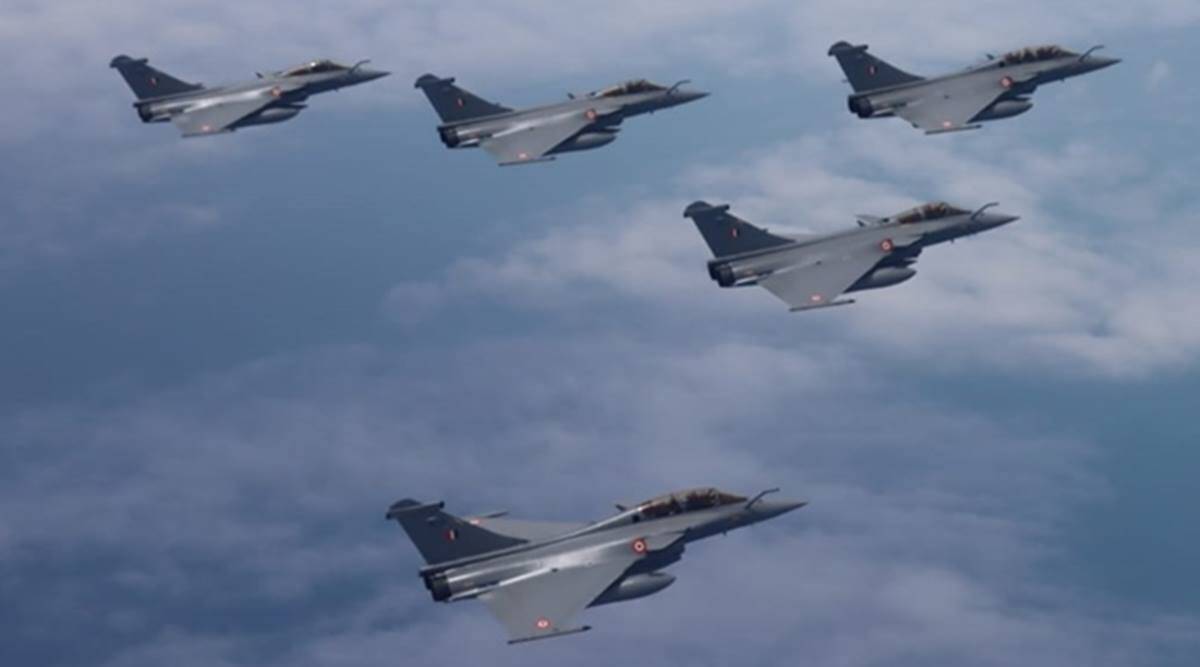
On May 31, 2023, four omni-role Rafale jets of the Indian Air Force (IAF) took off from Hashimara Air Force Station in West Bengal (the eastern sector of the Air Force). They engaged in an exercise in which they warded off enemy jets on the way and finally conducted precision strikes in the Indian Ocean Region. The mission lasted for six hours.
According to an IAF Officer, the jets fought their way through a “large enemy force package” along the coastline and then headed for their ‘weapons release point’ at a target in North Andaman. The 4.5 generation fighters were refuelled on their way through refuelling by IL-78 tankers twice while going as well as on their way back. The mission validated the capacity of the Indian Air Force to project power and conduct strikes at long ranges.
The Indian Air Force carried out a mission at a time when China has been ramping up its presence in the Indian Ocean Region (IOR), which is primarily considered the backyard of the Indian Navy.
The Indian Air Force has a total of 36 Rafales. They were inducted under a deal worth 59,000 crores from France in September 2016. The fighters are stationed at Hashimara, Ambala. The base at Hashimara is strategically located near the Sikkim-Bhutan-Tibet trijunction and the volatile narrow Siliguri Corridor. This area is also called “Chicken’s Neck.”
India has been showing its defences along the Siliguri Corridor amid the ongoing military confrontation with China in Eastern Ladakh, which is into its fourth year now.
The Rafael fighter jets have sharpened the air force’s capabilities with their high weaponry, high-tech sensors, superior radar for detection, and impressive payload. The aircraft can perform nuclear strike deterrence, air defence, air superiority, and reconnaissance.
The India-specific requirements of the Rafael Jets include cold engine start and the ability to carry out operations in high-altitude bases such as Leh. As Air Marshal Anil Chopra of the Center of Air Power Studies said- “the latest drill showcases the capabilities of the IAF to strike targets in anywhere in the IOR, Persian Gulf and Malacca Strait.
The Rafales have a combat range of 780 km to 1650 km depending on the mission and are armed with long stand-off weapons such as the 300km plus ‘Scalp’ air-to-ground missile.
They also have the top-notch Meteor Missile (air-to-air missile), which has a strike range of 120 to 150 km, better than any missile currently operated and carried by any Pakistani and Chinese jets. It can take nine tonnes of weapons on as many as fourteen hard points.
The IAF has also ordered the Hammer air to ground precision-guided munitions with a strike range of 20 to 70km to destroy bunkers, hardened shelters and other targets for the jets. IAF Rafael recently debuted in an overseas exercise. They participated in Exercise Orion at the Mont-De-Marsan airbase in France from April 17, 2023, till May 2, 2023.
The drills involved the air forces of France, the UK, Germany, the US and Greece, Italy and the Netherlands and Spain.
However, the IAF continues to grapple with just 31 fighter squadrons. Its requirement is more than 42, which are necessary to handle the threat from Pakistan and its “all-weather friend” and iron brother China.
Earlier this month, the IAF had grounded its three squadrons of the MiG-21 fighter aircraft (Bison) for comprehensive engine and technical checks after one of the jets crashed into a village and killed three women on May 8, 2023, in Hanumangarh District of Rajasthan.
While the MiG-21 is now progressively being cleared for flying after the technical checks, the three squadrons of these single-engine jets will be phased out by 2025.














Comments