PM Modi, Volodymyr Zelenskyy steal limelight: G-7 seeks 'Chinese help' but warns against militarisation
July 2, 2026
  • Read Ecopy
  • Circulation
  • Advertise
  • Careers
  • About Us
  • Contact Us
Android AppiPhone AppArattai
Organiser
  • ‌
  • Bharat
    • Assam
    • Bihar
    • Chhattisgarh
    • Jharkhand
    • Maharashtra
    • View All States
  • World
    • Asia
    • Europe
    • North America
    • South America
    • Africa
    • Australia
  • Editorial
  • International
  • Opinion
  • RSS @ 100
  • More
    • Op Sindoor
    • Analysis
    • Sports
    • Defence
    • Politics
    • Business
    • Economy
    • Culture
    • Special Report
    • Sci & Tech
    • Entertainment
    • G20
    • Azadi Ka Amrit Mahotsav
    • Vocal4Local
    • Web Stories
    • Education
    • Employment
    • Books
    • Interviews
    • Travel
    • Law
    • Health
    • Obituary
  • Subscribe
    • Subscribe Print Edition
    • Subscribe Ecopy
    • Read Ecopy
  • ‌
  • Bharat
    • Assam
    • Bihar
    • Chhattisgarh
    • Jharkhand
    • Maharashtra
    • View All States
  • World
    • Asia
    • Europe
    • North America
    • South America
    • Africa
    • Australia
  • Editorial
  • International
  • Opinion
  • RSS @ 100
  • More
    • Op Sindoor
    • Analysis
    • Sports
    • Defence
    • Politics
    • Business
    • Economy
    • Culture
    • Special Report
    • Sci & Tech
    • Entertainment
    • G20
    • Azadi Ka Amrit Mahotsav
    • Vocal4Local
    • Web Stories
    • Education
    • Employment
    • Books
    • Interviews
    • Travel
    • Law
    • Health
    • Obituary
  • Subscribe
    • Subscribe Print Edition
    • Subscribe Ecopy
    • Read Ecopy
Organiser
  • Home
  • Bharat
  • World
  • Operation Sindoor
  • Editorial
  • Analysis
  • Opinion
  • Culture
  • Defence
  • International Edition
  • RSS @ 100
  • Magazine
  • Read Ecopy
Home World Europe

PM Modi, Volodymyr Zelenskyy steal limelight: G-7 seeks ‘Chinese help’ but warns against militarisation

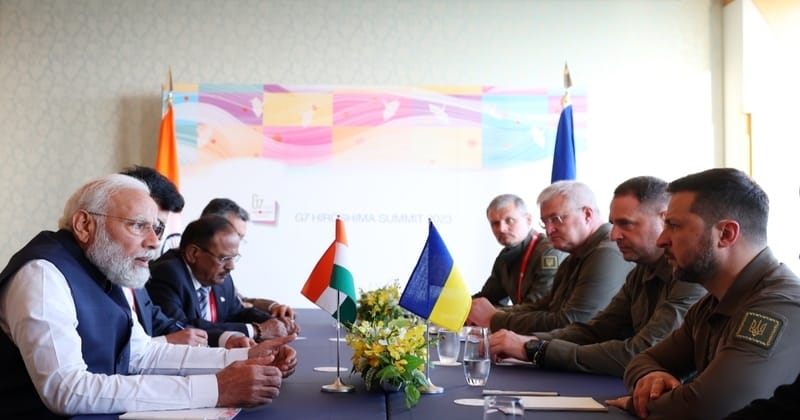
PM Modi, on May 20, met Ukrainian President Volodymyr Zelensky on the sidelines of the G7 Summit in Japan's Hiroshima. This is the first time the two leaders have held a meeting since the Russian invasion of Ukraine

Nirendra DevNirendra Dev
May 22, 2023, 05:00 pm IST
in Europe, Bharat, USA, East Asia, Australia, China
Follow on Google News
PM Modi in a discussion with Ukrainian President Volodymyr Zelensky

PM Modi in a discussion with Ukrainian President Volodymyr Zelensky

FacebookTwitterWhatsAppTelegramEmail

PM Modi’s maiden meeting with Ukraine President Volodymyr Zelenskyy in person since the outbreak of conflict in Hiroshima on the sidelines of the G-7 Summit in Hiroshima was a major talking point during the just concluded G-7 Summit and Quad Leaders’ Meet.

“Zelenskyy got off to a fast start on his visit”, and both the leaders held “amicable talks”, commented ‘The Japan Times’.

PM Modi and the Ukrainian president were invited to the G-7 Summit by this year’s host, Japanese PM Fumio Kishida, and hence the in-person meeting was crucial. Of course, both PM Modi and Zelenskyy have held tele talks, and all occasions and all major diplomatic stages, the Prime Minister (Modi) and the Indian Government have consistently backed the idea of dialogue to resolve the crisis.

External Affairs Minister Dr S Jaishankar has also told Rajya Sabha that India’s policy towards the Russia-Ukraine conflict required “immediate cessation of violence and end to hostilities and also a return to the path of dialogue and diplomacy”.

Even on May 20, after his meeting with the Ukrainian president, PM Modi tweeted, saying, “Conveyed our clear support for dialogue and diplomacy to find a way forward. We will continue extending humanitarian assistance to the people of Ukraine”.

International media and India watchers are aware of the fact that India and Russia have close economic and defence ties and also that India, on multiple occasions, abstained from voting in the UN and has rather taken a more neutral stance on the conflict. However, Modi’s message on Twitter that he had conveyed New Delhi’s “clear support for dialogue and diplomacy to find a way forward” found prominent mention in the media reports globally, including in Japanese newspapers.

Volodymyr Zelenskyy also held talks with other world leaders, including German Chancellor Olaf Scholz and British Prime Minister Rishi Sunak.

US President Joe Biden told G-7 leaders that the US would assist with training Ukrainian pilots on modern fighter aircraft, including American-made F-16s. “Ukraine is expected to mount a counteroffensive this spring against Russian troops,” says USA Today.

The Ukrainian leader’s arrival at Hiroshima Airport was broadcast live on many Japanese TV channels.

“Japan. G7. Important meetings with partners and friends of Ukraine. Security and enhanced cooperation for our victory. Peace will become closer today,” he wrote on Twitter after making the nearly 9,000-kilometer journey to Hiroshima on a French military jet from the Saudi Arabian city of Jeddah.

Interestingly on the global stage, Volodymyr Zelenskyy’s presence in Hiroshima has been seen as a diplomatic coup by Japanese PM Kishida.

The leaders of the Quad group – Australia, India, Japan and the United States – delivered a thinly veiled swipe at Beijing’s behaviour on May 20 at the summit.

“We strongly oppose destabilising or unilateral actions that seek to change the status quo by force or coercion,” a Quad statement said, using diplomatic language that appeared to refer to China’s economic tactics to gain leverage over poorer countries and also its military expansion in the Pacific.

Olive branch and ‘warning’: G-7 stance on China

The G7 countries, many of which have economies that are deeply intertwined with China, also held out an olive branch, it has been stated by analysts.

“We will seek to address the challenges posed by China’s non-market policies and practices, which distort the global economy. We will counter malign practices, such as illegitimate technology transfer or data disclosure,” the Group of Seven — G 7 – leaders said on May 20 in a joint statement after their Summit at Hiroshima.

“We remain seriously concerned about the situation in the East and South China Seas. We strongly oppose any unilateral attempts to change the status quo by force or coercion,” – they also said.

If these were warning to China over its “militarisation activities”, they also sought to win Beijing’s support to pursue Russian leadership to halt its invasion of Ukraine.

“There is no legal basis for China’s expansive maritime claims in the South China Sea, and we oppose China’s militarisation activities in the region,” the statement said and also maintained —“We call on China to press Russia to stop its military aggression and immediately, completely and unconditionally withdraw its troops from Ukraine.

“We encourage China to support a comprehensive, just and lasting peace based on territorial integrity and the principles and purposes of the UN Charter, including through its direct dialogue with Ukraine,” the statement said.

“Our policy approaches are not designed to harm China nor do we seek to thwart China’s economic progress and development. A growing China that plays by international rules would be of global interest,” the statement said.

 

Topics: ChinaHiroshimaVolodymyr ZelenskyyG-7 stance on ChinaJapanUkrainian PresidentRussia-Ukraine conflictPM ModiG7 Summit
Share1TweetSendShareSend
✮ Subscribe Organiser YouTube Channel. ✮
✮ Join Organiser's WhatsApp channel for Nationalist views beyond the news. ✮
Previous News

New Parliament building set to glorify India’s Democratic history

Next News

Khandvi to Kolhapuri- Indian cuisine with millets served to Pacific nations leaders at lunch hosted by PM Modi

Related News

By enabling direct yen-rupee settlements, India and Japan are laying the foundation for a more efficient, resilient and strategically integrated economic partnership

Beyond De-Dollarisation: What India-Japan’s Yen-Rupee trade framework really means

Japanese Prime Minister Sanae Takaichi and Prime Minister Narendra Modi

Indo-Japan Summit: Tech & AI are the pillars of partnership; MoUs inked on defence, critical minerals & clean energy

Japanese Prime Minister Sanae Takaichi recieves a ceremonial welcome at Rashtrapathi Bhavan, New Delhi

India-Japan Annual Summit: 150 firms commit $12.5bn investment; Maritime security, economy & tech ties on the agenda

Alang's Comeback: How Modi Government Strengthened India's Maritime Economy

Congress’ assault on Alang China sponsored? How Modi’s vision saved India’s maritime lifeline

Chinese President Xi Jinping

From Economic Miracle to Authoritarian Revival: Why Xi is rewriting China’s social contract

Renaming the Indo-Pacific Command as US Pacific Command: Decoding the strategic calculus of US & stakes for India

Load More

Latest News

India-Pak reconciliation appeal in an open letter by a section of Indians draws fire amid cross-border terror concerns

By enabling direct yen-rupee settlements, India and Japan are laying the foundation for a more efficient, resilient and strategically integrated economic partnership

Beyond De-Dollarisation: What India-Japan’s Yen-Rupee trade framework really means

(Left) J&K LG Manoj Sinha performing puja (Right) LG Manoj Sinha flags off the bus carrying pilgrims for the Amarnath Yatra

Amarnath Yatra 2026: LG Manoj Sinha flags off first batch of pilgrims amid tight security

Japanese Prime Minister Sanae Takaichi and Prime Minister Narendra Modi

Indo-Japan Summit: Tech & AI are the pillars of partnership; MoUs inked on defence, critical minerals & clean energy

With 55% of India’s ethanol production, UP is reshaping the sugar industry and driving national energy security

UP’s Sugarcane Revolution: How ethanol production transformed rural economy & strengthened India’s energy future

(Left) Rajasthan Chief Minister Bhajan Lal Sharma lights the ceremonial lamp (Right) Pragya Pravah National Convenor J Nandakumar

Lokmanthan is an effort to reestablish the ancient tradition of dialogue: J Nandkumar, Pragya Pravah National Convenor

Keralam's Bloodiest Marad Massacre saw Foreign Funding! Yet 'Secular’ Fronts Now Opposes FCRA to Keep Foreign Tap Open

Keralam’s Bloodiest Marad Massacre saw Foreign Funding! Yet ‘Secular’ Fronts Unite to Pass Resolution Against FCRA

Dr Mohan Bhagwat at Sindhu Education Society, Nagpur

Partition-displaced were ‘struggling warriors’, not refugees; chose nation and Dharma over wealth: Dr Mohan Bhagwat

125-Year-old Gurdwara Sri Guru Singh Sabha Sahib in Farooqabad vandalised by Islamists

‘Highly deplorable and targeted act of vandalism’: India slams Pakistan for demolition of 125-year-old Gurudwara

Mohammed Osman and Jahangir Pasha held for allegedly supplying beef as mutton to hotels in Hyderabad

Telangana: Mohammed Osman & Jahangir held for supplying beef as mutton to hotels in Hyderabad

Load More
  • Privacy
  • Terms
  • Cookie Policy
  • Refund and Cancellation
  • Delivery and Shipping

© Bharat Prakashan (Delhi) Limited.
Tech-enabled by Ananthapuri Technologies

  • Home
  • Search Organiser
  • Bharat
    • Assam
    • Bihar
    • Chhattisgarh
    • Jharkhand
    • Maharashtra
    • View All States
  • World
    • Asia
    • Africa
    • North America
    • South America
    • Europe
    • Australia
  • Editorial
  • Operation Sindoor
  • Opinion
  • Analysis
  • Defence
  • Culture
  • Sports
  • Business
  • RSS @ 100
  • Entertainment
  • More ..
    • Sci & Tech
    • Vocal4Local
    • Special Report
    • Education
    • Employment
    • Books
    • Interviews
    • Travel
    • Health
    • Politics
    • Law
    • Economy
    • Obituary
  • Subscribe Magazine
  • Read Ecopy
  • Advertise
  • Circulation
  • Careers
  • About Us
  • Contact Us
  • Policies & Terms
    • Privacy Policy
    • Cookie Policy
    • Refund and Cancellation
    • Terms of Use

© Bharat Prakashan (Delhi) Limited.
Tech-enabled by Ananthapuri Technologies