Decoding RBI’s decision to withdraw Rs 2000 banknotes from circulation 
December 5, 2025
  • Read Ecopy
  • Circulation
  • Advertise
  • Careers
  • About Us
  • Contact Us
Android AppiPhone AppArattai
Organiser
  • ‌
  • Bharat
    • Assam
    • Bihar
    • Chhattisgarh
    • Jharkhand
    • Maharashtra
    • View All States
  • World
    • Asia
    • Europe
    • North America
    • South America
    • Africa
    • Australia
  • Editorial
  • International
  • Opinion
  • RSS @ 100
  • More
    • Op Sindoor
    • Analysis
    • Sports
    • Defence
    • Politics
    • Business
    • Economy
    • Culture
    • Special Report
    • Sci & Tech
    • Entertainment
    • G20
    • Azadi Ka Amrit Mahotsav
    • Vocal4Local
    • Web Stories
    • Education
    • Employment
    • Books
    • Interviews
    • Travel
    • Law
    • Health
    • Obituary
  • Subscribe
    • Subscribe Print Edition
    • Subscribe Ecopy
    • Read Ecopy
  • ‌
  • Bharat
    • Assam
    • Bihar
    • Chhattisgarh
    • Jharkhand
    • Maharashtra
    • View All States
  • World
    • Asia
    • Europe
    • North America
    • South America
    • Africa
    • Australia
  • Editorial
  • International
  • Opinion
  • RSS @ 100
  • More
    • Op Sindoor
    • Analysis
    • Sports
    • Defence
    • Politics
    • Business
    • Economy
    • Culture
    • Special Report
    • Sci & Tech
    • Entertainment
    • G20
    • Azadi Ka Amrit Mahotsav
    • Vocal4Local
    • Web Stories
    • Education
    • Employment
    • Books
    • Interviews
    • Travel
    • Law
    • Health
    • Obituary
  • Subscribe
    • Subscribe Print Edition
    • Subscribe Ecopy
    • Read Ecopy
Organiser
  • Home
  • Bharat
  • World
  • Operation Sindoor
  • Editorial
  • Analysis
  • Opinion
  • Culture
  • Defence
  • International Edition
  • RSS @ 100
  • Magazine
  • Read Ecopy
Home Bharat

Decoding RBI’s decision to withdraw Rs 2000 banknotes from circulation 

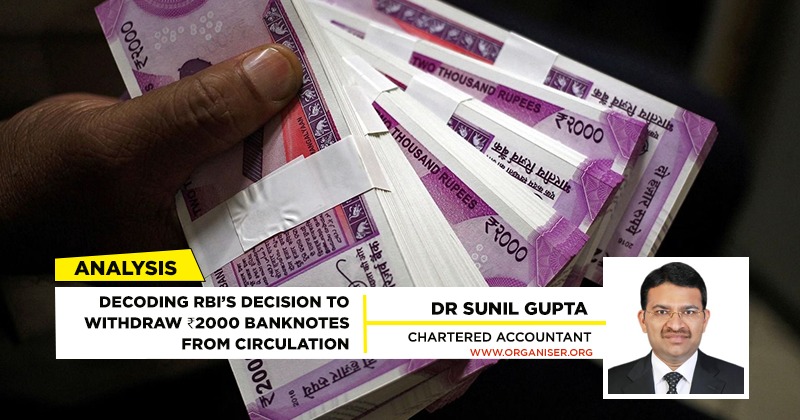
RBI on May 19 decided to withdraw Rs 2000 banknotes from circulation. However, this decision is notsimilar to what happened in November 2016. The biggest difference is that Rs 2000 denomination banknotes will continue as legal tender

Dr Sunil GuptaDr Sunil Gupta
May 21, 2023, 09:00 am IST
in Bharat, Analysis
Follow on Google News
FacebookTwitterWhatsAppTelegramEmail

On the official website of the US government, there is a page about ‘American money’. The page clearly mentions that the paper currency in the world’s largest economy comes in seven denominations, with the 100 dollar banknote as the biggest. This is followed by a statement that the US “no longer issues” larger denominations, including the 10,000 dollar bill, “but they are still legal tender”. In the circular dated May 19, 2023, issued by India’s central bank, the statement “banknotes in Rs 2000 denomination will continue to be legal tender” is in bolder text.

The reason is the Reserve Bank of India (RBI) has not taken away the legal tender status of the Rs 2000 denomination banknote. This means that the public must exercise refrain before commenting that the decision on Rs 2000 banknotes is exactly similar to what happened in 2016 when the then circulating Rs 500 and Rs 1000 banknotes were stripped of their legal tender status.

Decoding the latest decision of the RBI on Rs 2000 banknotes requires a little understanding of the macroeconomy and the current situation of the world economy. Let’s try.

Inflation and rising interest rates

In the same economy where the 10,000 dollar bill is discontinued but remains legal tender, the inflation situation is literally out of control. The US has recorded a multi-decade high inflation rate, with things like supply chain disruption due to the Ukraine conflict and strong consumer sentiment and spending capacity of members of the public contributing to prices going north. European countries are no different. From the Bank of England to the European Central Bank (ECB), virtually every central bank is on a record-setting spree of raising policy interest rates in a bid to manage inflationary pressures.

It is true that the expression ‘millions are choosing between heating and eating’ has become a political narrative in Britain. At the same time, the other problem is that advanced economies are facing the threat of an impending recession that can create new issues like subdued economic activity and joblessness. During such times, central banks typically favour a dovish stance, which means expansionary monetary policy measures like keeping policy rates low are adopted. By contrast, most central banks right now are stubbornly hawkish, with the interest rate in the US rising with every Fed meeting.

India is a country that subscribes to the globalisation model, and hence thinking that the Indian economy can remain untouched by the dominant global macroeconomic forces is foolish. Inflation in India is high, with nothing but global forces to blame, but in comparison to the situation in the US or other advanced economies, we are still faring better.

Banknotes and inflation

What causes inflation? Excessive money circulating in the economy is indeed one of the biggest factors that stokes inflation. More money creates more demand for goods and services (Indian food delivery company Swiggy recently announced that it turned profitable in record-setting time), which is why central banks hike interest rates during inflationary times so that borrowing becomes expensive. But this can create a new problem because higher rates make borrowing difficult even for businesses, which in turn slows down the economy.

Corporate earnings in the US and elsewhere are under intense pressure. Reason – higher rates are hampering credit growth. Is there any other option that is better than senselessly hiking interest rate in every policy meeting? Maybe yes. The Indian central bank seems to have taken the lead by taking away excessive liquidity from the economy without hiking the policy rate. The Rs 2000 banknote decision appears to have been adopted as a part of the same strategy.

Clean Note Policy

The expression ‘Clean Note Policy’ finds mentioned in the RBI circular, but virtually no one seems to be willing to discuss it in detail. The policy was introduced in 1999, and directives also included the discontinuation of stapling of currency notes/ packets. The only objective is to have clean banknotes in circulation so that the transacting parties do not resort to cancelling the transaction just because the banknote is soiled or mutilated.

It is easy to understand that because Rs 2000 denomination banknotes were not issued after March 2017 — the RBI circular clarifies — the currently circulating banknotes are now quite old and vulnerable to soiling. The solution was nothing but to withdraw these notes. What is different is that the central bank has made it clear that new Rs 2000 denomination banknotes would not be printed and circulated. The members of the public have more than four months to get their 2000 denomination banknotes deposited or exchanged with their banks. Where’s the inconvenience?

Conclusion

No, the decision of the RBI on Rs 2000 denomination banknotes is not exactly similar to what happened in November 2016. A few elements, like there is a deadline to get the concerned notes exchanged, are comparable. However, the biggest and most critical difference is that the RBI has expressly mentioned that Rs 2000 denomination banknotes “will continue as legal tender”. In fact, this statement is repeated four times in the circular so that it is not missed.

There is still some doubt about what the RBI plans to do with the legal tender status after the September 30, 2023, deadline. Still, suppose one looks at what the US government’s website says on higher denomination dollar banknotes. In that case, it seems quite possible that Rs 2000 denomination banknotes would continue to be legal tender even after September 2023, although not to be used in regular transactions by the public.

The RBI seems to have been motivated by two things — one is taking some measure that does not include raising the policy interest rate but still sucks excessive liquidity from the economy, and the second — expressly mentioned in the circular — is taking back notes under the Clean Note Policy. There is literally nothing to panic about. Instead, RBI’s prudence at a time when virtually every central bank of the world is puzzled about inflation and interest rates needs at least some applause.


Topics: Rising interest ratesRBI plansInflationReserve Bank of IndiademonetisationClean Note PolicyRs 2000 currency notesAmerican money
Dr Sunil Gupta
Dr Sunil Gupta
The writer is a Chartered Accountant, author and blogger. He has served as an Independent Director on the Boards of India?s most influential public sector banks. [Read more]
ShareTweetSendShareSend
✮ Subscribe Organiser YouTube Channel. ✮
✮ Join Organiser's WhatsApp channel for Nationalist views beyond the news. ✮
Previous News

Instagram may unveil Twitter-like text-based app in June, first look leaked

Next News

Can Karnataka survive an unstable party and reckless promises?

Related News

(Left) Special coin commemorating the centenary of RSS (Right- L To R) Union Minister of Culture Gajendra Singh Shekhawat, RSS Sarkaryavah Dattatreya Hosable, PM Narendra Modi, Delhi CM Rekha Gupta

RSS at 100: Know how to get the coin released by PM Modi to commemorate Sangh’s centenary

Rural households in Kerala bear the brunt as inflation crosses double digits, widening the gap with national trends.

Kerala govt under fire as state tops national retail inflation for 8th month, soaring to 9.04 per cent in August

RBI unviels the Special Rupee Vostro Accounts(SRVAs) to facilitate rupee-denominated trade

RBI unveils Special Rupee Vostro Accounts: An economic masterstroke to counter US tariffs and propel rupee-based trade

Sri Jagannath Puri Mandir

Odisha: Inventory of Srimandir Ratna Bhandar in Puri set to begin soon; RBI nominates two officials

RBI slashes repo rate to 6 per cent: EMIs may drop— Know the impact on Real Estate

Tariff War: India should prepare to seize the opportunity

Load More

Comments

The comments posted here/below/in the given space are not on behalf of Organiser. The person posting the comment will be in sole ownership of its responsibility. According to the central government's IT rules, obscene or offensive statement made against a person, religion, community or nation is a punishable offense, and legal action would be taken against people who indulge in such activities.

Latest News

PM Modi presents Putin with Bhagavad Gita, chess set, and silver horse

Cultural ties strengthened: PM Modi presents Putin with Bhagavad Gita, chess set, and silver horse

Image for representational purpose only, Courtesy Vocal Media

Bihar to get ‘Special Economic Zones’ in Buxar and West Champaran

Thirupparankundram Karthigai Deepam utsav

Andhra Pradesh: AP Dy CM Pawan Kalyan reacts to Thirupparankundram row, flags concern over religious rights of Hindus

23rd India-Russia Annual Summit

India-Russia Summit heralds new chapter in time-tested ties: Inks MoUs in economic, defence, tourism & education

DGCA orders probe into IndiGo flight disruptions; Committee to report in 15 days

BJYM leader Shyamraj with Janaki

Kerala: Widow of BJP worker murdered in 1995 steps into electoral battle after three decades at Valancherry

Russian Sber bank has unveiled access to its retail investors to the Indian stock market by etching its mutual fund to Nifty50

Scripting economic bonhomie: Russian investors gain access to Indian stocks, Sber unveils Nifty50 pegged mutual funds

Petitioner S Vignesh Shishir speaking to the reporters about the Rahul Gandhi UK citizenship case outside the Raebareli court

Rahul Gandhi UK Citizenship Case: Congress supporters create ruckus in court; Foreign visit details shared with judge

(L) Kerala High Court (R) Bouncers in Trippoonithura temple

Kerala: HC slams CPM-controlled Kochi Devaswom Board for deploying bouncers for crowd management during festival

Fact Check: Rahul Gandhi false claim about govt blocking his meet with Russian President Putin exposed; MEA clears air

Load More
  • Privacy
  • Terms
  • Cookie Policy
  • Refund and Cancellation
  • Delivery and Shipping

© Bharat Prakashan (Delhi) Limited.
Tech-enabled by Ananthapuri Technologies

  • Home
  • Search Organiser
  • Bharat
    • Assam
    • Bihar
    • Chhattisgarh
    • Jharkhand
    • Maharashtra
    • View All States
  • World
    • Asia
    • Africa
    • North America
    • South America
    • Europe
    • Australia
  • Editorial
  • Operation Sindoor
  • Opinion
  • Analysis
  • Defence
  • Culture
  • Sports
  • Business
  • RSS @ 100
  • Entertainment
  • More ..
    • Sci & Tech
    • Vocal4Local
    • Special Report
    • Education
    • Employment
    • Books
    • Interviews
    • Travel
    • Health
    • Politics
    • Law
    • Economy
    • Obituary
  • Subscribe Magazine
  • Read Ecopy
  • Advertise
  • Circulation
  • Careers
  • About Us
  • Contact Us
  • Policies & Terms
    • Privacy Policy
    • Cookie Policy
    • Refund and Cancellation
    • Terms of Use

© Bharat Prakashan (Delhi) Limited.
Tech-enabled by Ananthapuri Technologies