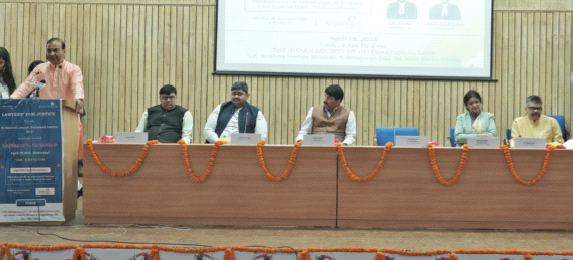
“For all constitutional issues, the debate must be ongoing, for no society, no culture is static, things change, society evolves, requirements evolve, the law cannot be stagnant and the Constitution cannot be stagnant,” said Justice Sachin Datta, Delhi High Court Judge, in the Valedictory Ceremony of the first-ever National Lawyers’ Parliament Festival, organised at the Indian Society of International Law on April 29.
The Justice Dutta was the Chief Guest. The conference was organised by the efforts of Lawyers for Justice, in association with Rajdhani Yuva Sansad.
Describing the Constitution as a living document, Justice Datta extensively dealt with the interplay of Part 3 (Fundamental Rights) and Part 4 (Directive Principles of State Policy) of the Constitution.
The conference hosted more than 300 law students and practising advocates from across the country. The conference’s agenda was “Discussion of the introduction of Uniform Civil Code in India: Need of the Hour”.
In the Valedictory Ceremony, Prafulla Ketkar, Editor Organiser, said, “Organiser always stood for the national issue. The first ever case in India even before the adoption and enactment of the Constitution about Freedom of Speech and about the First Amendment, if you ever read the reference, you will find two publications — ‘Organiser‘ and Red Cross.”
Pointing out that the first censorship, even before the Constitution, was imposed on Organiser for reporting the plight of Hindus in the Eastern and Western part of Pakistan during the Partition, Prafulla Ketkar said, “Since then, ‘Organiser’ has been raising issues like Jammu and Kashmir, North East and Common Civil Code. We always stood for healthy debates and national interest. Unfortunately, in the name of secularism, we have highly communalised the debate about Common Civil Code. In reality, this was the issue related to secularism.”
Member of Parliament Manoj Tiwari, who joined the conference as the Chief Guest in the inaugural ceremony, said, “I have no hesitation in saying that many people, who are elected as Parliamentarians, have less knowledge about the law. However, I am happy to inform you that the Government has abolished 2,000 unnecessary laws, which were of no use for officers, legislatures and bureaucrats.”
In her speech, Monika Arora, advocate at the Supreme Court of India, a Special Guest for the inaugural ceremony, said, “ Article 1 of the Constitution, which says ‘India that is Bharat’, suggests that we should look at the Constitution from the perspective of Bharat. Now we are in India, but India came into existence only in 1947. However, if one has to look at Bharat, where should one look upon? In this regard, our Constitution says that if you want to look at India, look at thousand years of history of Bharat and its culture. India has uniform criminal law and uniform civil law. But, India has no family law that comprises marriage, divorce, succession, and adoption. So, India needs family law. And we have to only work on uniform family law. Else everything is fine. Pointing out that Article 44 of the Constitution states that “The State shall endeavour to secure the citizen a Uniform Civil Code throughout the territory of India,” Monika Arora said. But why don’t we read Article 37? Article 37 of the Indian Constitution states that the Directive Principles of State Policy (DPSP) are not enforceable by any court. However, the principles laid down are fundamental to a country’s governance. Therefore, it is the duty of the State and Central Government to use these principles when making and enforcing laws in their respective States.”
While speaking on the Uniform Civil Code, Monika Arora said, “In 1947, when the issue of UCC was raised then the direction was right, but the condition was not as the country had gone through Partition and poverty was also one the big issues.”
“In 1937, Muslim Personal Law (Shariat) Application Act, 1937, was forcibly passed due to the pressure from Islamic radicals as they threated the British Government not to touch their law. Still, today the Muslim society is governed by this law.”-Monika Arora, advocate, Supreme Court
Pointing out that in Vaidik Kaal we had laws based on scriptures, Monika Arora said, “Then India was attacked and Huns and Sakas came. However, they settled down here. Then Mughals invaded and destroyed Hindu temples and changed the law by the force of sword. Then Aurangzeb came and invited 500 Islamic scholars from across the globe and asked them to make Islamic code of conduct. These scholars worked for years and made ‘Fatawa Alamgiri’. It is the ‘Fatawa Alamgiri’ on which basis the Sharia Law still exist in India. This is the basic book on its basis the Muslim society is governed.”
“When Britishers came they avoided interfering in Islamic and Hindu laws as their intentions was only to govern the country. However, there were many reforms happened in Hindu laws under British Governments. However, due to the opposition from Muslim society, no amendment happened in Muslim laws. Ironically, in 1937, Muslim Personal Law (Shariat) Application Act, 1937, was forcibly passed due to the pressure from Islamic radicals as they threated the British Government not to touch their law. Still, today the Muslim society is governed by this law. There are six section in this act. Section 2 says that all Muslims should be governed by Shariat,” she further added.
Senior Advocate Ashwani Upadhyay, who was Special Guest at the conference, said, “Is Uniform Civil Code a new subject for us? No, it was implemented thousand years back in Bharat. If one reads the Uttar Kand of ‘Ramayan’, whatever we are discussing today was implemented then. That’s why the people talk about Ramrajya as this Common Civil Code was implemented long years before.’ We say Bharat has a ‘Sanvidhan’. Interestingly, there is no English word of this. For women, we use the word ‘Grihani’, which means ‘A person whose whole family in her debt’. So there is no match of women and ‘Grihani’. Unfortunately, we think in Hindi, live in Hindustan and use imported word like religion and Constitution, which do not elaborate the true meaning of ‘Sanvidhan’ and ‘Dharma’. Can different rule be applied in one family? No. It is India’s Constitution and it must be looked from India’s perspective, not from the point of American, British or French.”
Notably, Advocate Piyush Gupta (Member, Bar Council of Delhi) and Advocate K.K Tyagi are the founder trustees of the Lawyers’ for Justice which is a trust working for creating awareness in the society and also recently organised a large scale peaceful demonstration to pay homage to victims of West Bengal. To further the said cause, a delegation of lawyers also met the Hon’ble President of India, Sh. Ram Nath Kovind Ji (as he was then) in May, 2022.
Advocate Isha Kapoor and Advocate Jai Saini are the founders of Rajdhani Yuva Sansad which is a youth run organization aimed at contributing towards the cause of nation building and impacting democratic values along with diplomatic skills in the youth.