





A broader scrutiny of the functioning of Indian media, its failures, its successes and limitations would be a relevant exercise at the national level too; but that’s a gigantic task. In the North East, the media has had a different journey—some of it would not be understood even by those in the so-called mainstream national media.
Generally speaking, local newspapers were launched in State capitals like Imphal (Manipur) and Kohima (Nagaland) with different intentions. Some were launched with a business-like purpose—local entrepreneurship seeking to tap the State Government’s vast advertising revenue.
Gunning Down Journalist-Cum-Politician
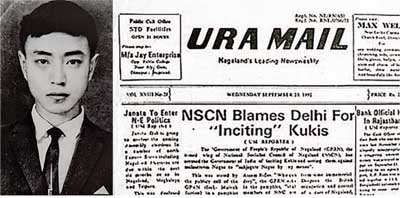
The tag of ‘local Editors’ gave newspaper owners a social prestige and gradually an influence and a possible entry into politics. In some cases such as Chalie Kevichusa, who was killed by NSCN-IM in Dimapur in 1992, used to run his English weekly paper Ura Mail passionately. He was also the last of the ‘idealist’ politicians Nagaland knew. There have been a few newspapers which backed their respective ethnic/tribal community and also perhaps one or the other factions of militant groups in a subtle way.
The new age media and the ‘New India’ as envisioned by Prime Minister Shri Narendra Modi calls for a situation when people of North East should know what is happening in Sri Lanka and Ukraine. The people, politicians and other intellectuals and leaders of pressure groups—business chambers and student bodies—need to accommodate themselves to the ‘people’ of the rest of India, the neighbouring countries and the rest of the world
From a primordial economy, the region is today a telling picture and is viewed as a different world. It is also ‘Westernised’ in many respects and the use of English is abundant in Nagaland and Meghalaya. A visitor to the North East can now easily discard the conventional tribal theory of the indigenous people. In more ways than one, North East is also an urban society. In all these, keeping the right balance is a hugely challenging task.
In most cases, the media has failed to do much though it goes without saying that ‘mere survival’ in journalism is near impossible and often fatal in the North East. In the nineties, journalists on receipt of Threat Missives used to call them Love Letters.
But the media should have done more on the basics—which was found wanting. How? There is an inherent fear of the ‘outsiders’. Media in the North East in general did not do much to change this mindset. Therefore, a traditional mindset of ‘reactionary’ resistance to all things that is ‘not local’ persisted.
The new world and the new internet media cannot be kept at bay. But as nothing much was done, the paranoia also persisted. A point that needs to be emphasised is that the pristine seclusion in the far-flung valleys and hills is no longer a virtue.
The new age media and the ‘New India’ as envisioned by Prime Minister Shri Narendra Modi calls for a situation when people of North East should know what is happening in Sri Lanka and Ukraine. The people, politicians and other intellectuals and leaders of pressure groups—business chambers and student bodies—need to accommodate themselves to the ‘people’ of the rest of India, the neighbouring countries and the rest of the world.
Interactions Between Journos Is Missing
Journalists in the North East ought to open up first with their fellow colleagues across the States. How much does a journalist in Kohima know about Mizoram and vice versa? More importantly, how much ‘interest’ he or she takes about what is happening in other States is crucial. There is yet another important aspect of the functioning of media in the region. Have we so far done enough?
Forget politicians and babus, even social activists and influential student organisations, most of the time, have been obsessively insecure about admitting failures!
Parochialism has survived as it is encouraged to flourish. Mufti Mohammed Syed as Union Home Minister under VP Singh Government at Centre had called the apex Naga Students’ Federation a ‘parochial body’. No local or regional media tried to probe into the intricacies involved. It is perhaps for all student bodies in the North East. The Khasi Students’ Union of Meghalaya at times came under scrutiny of the fourth estate. But that ought to be attributed to individual bravado.
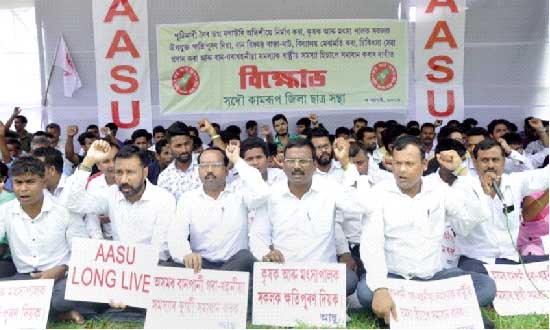
In this context, one can cite the role of the All Assam Students’ Union in the 1980s. How did they let such a vital mass movement—probably first since Independence against a foreigner influx—later was allowed to turn into an ‘anti-Bengali’ (Bongal-kheda) stir?
At the same time about a decade later, it came to light that the ULFA leaders were taking help from Bangladeshi agencies, taking shelter in the neighbouring country and also running hotels and establishing other business units. What was the media doing?
Instead, during the peak of anti-ULFA agitation; journalists were alleged to have sympathised with the militant group.
No Accountability for Human Rights Violations
There is another angle. In most cases of alleged human right excesses committed by forces, the Army and Para Military Forces get the blame. Media will not hesitate to expose such incidents. But political leadership is seldom criticised. Mizoram capital Aizawl was bombed but Indira Gandhi or Congress party was hardly held accountable.
In 1991-92, in Assam, there was a change in the functioning of the Army. While ‘Operation Rhino’ was launched against ULFA; the forces and the leadership understood that counter-insurgency operations were as much a ‘war of information’ as it was fighting with bullets.
Militants Cultivated a Robin Hood Image
However, there were exceptions and issues. Guwahati had a news weekly which had adopted an outright ‘pro ULFA’ stance and even justified various demands. Such articles helped the militant group cultivate a Robin Hood image for itself.
In Manipur, in 2007, the entire print medium had to stop publication of newspapers on three different occasions because of the diktats of militant groups. There are a number of instances of State Governments in Manipur, Nagaland and other States cutting down advertisements of the local media for being critical of the Government and politicians
This has been a general trend in States like Nagaland and Manipur as well. In Nagaland, a statement from one potent group even questioned a sitting Chief Minister’s lineage and called him ‘Anglo-Naga’. There was no screening, no editing.
Latching On To Rahul’s Chor Jibe
Many years later of course, Indian liberal media latched onto Rahul Gandhi’s venom against PM Narendra Modi when he described him as ‘chor’.
Someone who was born, studied and worked in the North East knows about reverse dicrimination faced by non-tribals in places like Shillong. The State of Meghalaya once saw the illogical and embarrassing slogan—‘Khashi by birth and Indian by accident’. Very few journalists showed the courage and intent to expose the hole. Bengali and Nepali settlers were attacked, and once even a number of Bihari families were burnt alive.
Senior journalist Patricia Mukhim wrote in The Hindu later—“The culprits were never caught and no one has been indicted in any of the acts of communal carnage that happened in Meghalaya”.
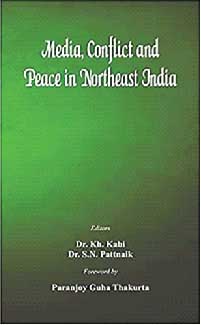
There were other revelations. The book Media, Conflict and Peace in North East India pointed out in 2015 that Kolkata-based The Telegraph had sourced 49.1 per cent of insurgency-related news to the NSCN militant group itself-seldom entertaining the other version.
Rightly goes a refrain—no longer only the State; even the non-State actors are ruling the roost in the media space. Nagaland’s only Christian Governor MM Thomas (from Kerala) had said, “You don’t give a second thought to writing against the State (Government) fully aware that the State will not retaliate to the extent these anti-national elements would”—as reported in Weekly Journal, Kohima—Feb 27, 1991.
In Manipur, in 2007, the entire print medium had to stop publication of newspapers on three different occasions because of the diktats of militant groups. There are a number of instances of State Governments in Manipur, Nagaland and other States cutting down advertisements of the local media for being critical of the Government and politicians.










Comments