





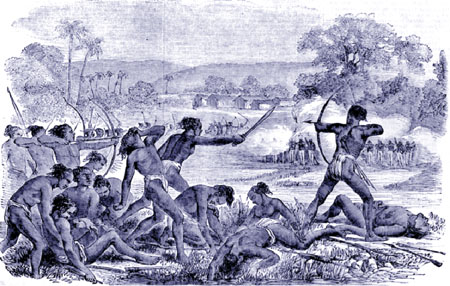
Mughal emperor Aurangzeb’s reign witnessed powerful regional groups like the Jats, Sikhs, and Marathas defying the authority of the Mughal state in their bid to create kingdoms of their own. They did not succeed in their efforts, but they influenced the future course of political events in their respective regions. Their continuous struggle against the empire for political ascendancy weakened the empire considerably. Aurangzeb, and after him Bahadur Shah I, by attempting to suppress the Rajputs, spurred them to battle against the Mughals. The later Mughals made an effort to follow a policy of reconciliation with the Rajputs, but by then it was already too late: the Rajputs no longer trusted the Mughals enough to ally with them for the welfare of the empire.
The Marathas too were becoming a formidable enemy. Their aim was at first limited only to regaining control over the region of Maharashtra, but it soon went on to include getting legal sanction from the Mughal emperor for collecting Sardeshmukhi and Chauth throughout Bharat. They forged northwards and, by 1740, succeeded in spreading their influence over the provinces of Gujarat, Malwa, and Bundelkhand. The Rajput struggle against the empire and the growing ambition and power of the Marathas, thus, adversely affected the Mughal might.
Another important state to make its appearance in the eighteenth century was that of Mysore. This territory located at the junction of the Eastern and Western Ghats was ruled by the Wodeyars. Various powers, interested in this territory, turned the area into a constant battlefield. In Travancore, Martanda Varma strengthened extended the boundaries of his state from Kanyakumari to Cochin.
The agriculturist Jat settlers living around Delhi, Mathura, and Agra revolted against the oppressive policies of Aurangzeb. After some initial setbacks, Churaman and Badan Singh succeeded in setting up the Jat state of Bharatpur. Meanwhile, Guru Gobind Singh transformed the Sikhs into a militant sect in defense of their religion and liberties. The credit for establishing a strong kingdom of Punjab goes to Ranjit Singh. He was the son of Mahan Singh, the leader of the Sukarchakiyamisl. Ranjit Singh brought under control the area extending from the Sutlej to the Jhelum. He conquered Lahore in 1799 and Amritsar in 1802. By the Treaty of Amritsar with the British, Ranjit Singh acknowledged the British right over the cis-Sutlej territories.
Unsung Heroes
Baxi Jagabandhu
Baxi Jagabandhu, was born at Rorar Garh near about 1769 and was the chief commander of the Army of the minor Khurda king Mukunda Dev. The history is silent on his role during the war against The British, however, deprived many aristocrat families of their control over their land, replacing them with non-Oriya aristocrats, and levied new taxes. Baxi Jagabandhu rallied the disgruntled Paikas from around Khurda and the nearby estates, got the support of the trival Khandha community of Ghumusar and led the fight against the British on April 1, 1817 and defeated them on 4 April 1817. Brigedier General Thomas, after receiving secret information of Buxi Jagabandhu’s presence in a Kandha tribal village of Ghumusar, made a sudden combing operation and gheraoed the area but failed in his attempt to arrest Buxi. On May 25, 1825, Buxi surrendered before the British rulers and stayed at Cuttack along with his family members. On January 24, 1829 Buxi Jagabandhu left the mortal world for the heavenly abode and after his demise the monthly pension granted for his maintenance was cancelled as per the terms and conditions of the British Government.
Perhaps the most formidable province to emerge was that of the Marathas. Under the capable leadership of the Peshwas, the Marathas uprooted the Mughal authority from Malwa and Gujarat and established their rule. At one time they claimed the right to be the chief inheritors of the Mughal dominion, but their authority was challenged by Ahmed Shah Abdali in the Third Battle of Panipat (1761). The Marathas quickly recovered from the defeat and offered the most formidable challenge to the English East India Company in the struggle for political supremacy in Bharat.
After the death of Madhavrao in 1772, his brother Narayanrao succeeded him as the fifth Peshwa. However, Narayanrao’s uncle, Raghunathrao, had his nephew assassinated and named himself as the next Peshwa, although he was not a legal heir. The English and the Maratha armies met on the outskirts of Pune. Though the Maratha army had a larger number of soldiers than the English, the latter had highly superior ammunition and cannons. However, the Maratha army was commanded by a brilliant general named Mahadji Sindhia (also known as Mahadji Shinde).
The Second Anglo-Maratha war started in circumstances similar to those of the first. After Peshwa Madhavrao Narayan committed suicide in 1795, Bajirao II, the worthless son of Raghunathrao, became the Peshwa. Nana Phadnavis, a bitter foe of Bajirao II, became the chief minister. The dissensions among the Marathas provided the English with an opportunity to intervene in Maratha affairs. The death of Nana Phadnavis in 1800 gave the British an added advantage.
Lord Hastings had the imperialistic design of imposing British paramountcy. By the Charter Act of 1813, the East India Company’s monopoly of trade in China (except tea) ended and hence the company needed more markets. The outbreak of the first of the Anglo-Sikh wars has been attributed to the action of the Sikh army crossing the River Sutlej on December 11, 1845. This was seen as an aggressive maneuver that provided the English with the justification to declare war.
The defeat in the First Anglo-Sikh War and the provisions of the treaties of Lahore and Bhairowal were highly humiliating for the Sikhs.
Sanyasi Revolution (1763-1800)
The British considered the Sanyasis looters and imposed restrictions on the Sanyasis barring them from visiting holy places. The Sanyasis rose in revolt against the British and raided English factories and government treasuries. This rebellion was centered in the forests of Murshidabad and Baikunthupur, Bengal. In 1771, 150 unarmed sanyasis were killed under the orders of Warren Hastings.
Unsung Heroes
Jatindra Nath Das
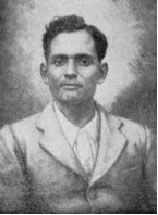
Jatindra Nath Das was Born on October 27, 1904 in Calcutta, West Bengal. He was the son of Bankim Das. He passed the matriculation and intermediate examinations in the First Division. Responded to Gandhi’s call, Education can wait, but Swaraj cannot, he plunged into the Non-Cooperation movement and was sentenced to 6 months of rigorous imprisonment for burning foreign cloth. During 1922-25 was actively working in South Calcutta Congress Committee and came in contact with Subhas Chandra Bose. Jatin at this point was attracted to the revolutionary movement, having lost hope that Swaraj could be achieved by non-violence. He was arrested on November 25, 1925, under the Bengal Criminal Law Amendment Act. He came in contact with Bhagat Singh at the session and was taken to U.P. to teach the revolutionary comrades in North India the art of bomb-making. With his help, a bomb factory was set up at Agra wherein bombs were made and stocked. He was arrested on June 14, 1929 in Calcutta, and was made an accused in the Supplementary Lahore Conspiracy Case, 1929-30.
In 1758, a treaty was made between the English and Ananda Gajapatiraju, the ruler of Vizianagaram, to jointly oust the French from the Northern Circars. The English captured the raja in 1793 and ordered him to go into exile with a pension. The raja refused. The raja died in a battle at Padmanabham (in modern Visakhapatnam district in Andhra Pradesh) in 1794. Vizianagaram came under the Company’s rule.
In every region, people rose in revolt against the British. In Kottayam, Kerala Varma Pazhassi Raja, in Travancore, Velu Thampi, the Dalawa, the Polygars in Tamil Nadu, Ahom kings in Assam, the Singhphos, the Khonds, Kukas, the Pagal Panthis, the Ramosis, the Santhals and the Bhils.
War of Independence of 1857
In 1757, after the Battle of Plassey, the British laid the first step towards getting power in northern Bharat. And in 1857 took place the major ‘Uprising’ which was a product of the character and policies of colonial rule after 1757, and after which noteworthy changes took place in the British policy of ruling over Bharat.














Comments