






In one stroke democracy was subverted, the Constitution was mutilated, Parliament became a rubber stamp, media and judiciary stood gagged
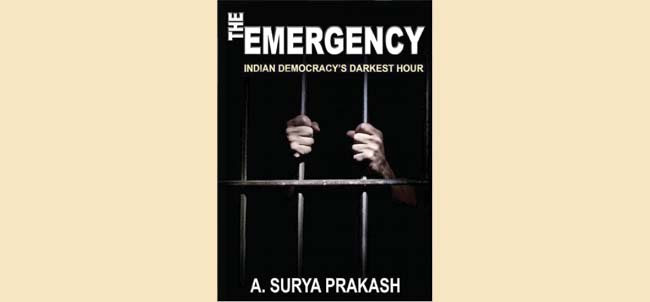
The Emergency — Indian Democracy’s Darkest Hour;
A Surya Prakash; Megh Nirghosh Media;
A Surya Prakash; Megh Nirghosh Media;
Pp 220; Rs : Rs 295
Every year torrid and sweltering June brings back horrid memories of the darkest hour of the Indian democracy which struck the nation during the night hours on June 25. Even after 43 years the memories of chilling terror that came in its fold keep ringing bells in our minds, as if cautioning us against the terrible woes that can befall a nation when democracy is snuffed out.
Senior journalist A Surya Prakash, who is currently serving as chairman of the Prasar Bharati, in his book, The Emergency—Indian Democracy’s Darkest Hour, very lucidly recounts the horrors of the Emergency days bringing alive all incidents that brought shame and disgrace to the nation.
Drawing largely from his professional experience as a journalist with Indian Express during those days and the testimonies recorded in the Shah Commission report the book provides a telling insight into the happenings.
One of the most interesting chapters, The Drama in the Prime Minister’s House, gives shocking details about how the entire government structure was spiked and all senior functionaries were kept in the dark. It underlines glaringly that Union Home Minister Brahmananda Reddy had no role to play in the decision the Prime Minister was taking to impose an internal emergency on the ground that law and order had broken down. Instead of the Union Home Minister briefing the Prime Minister on law and order situation, he was being briefed by the Prime Minister!
The buzzword was Mummy will Stay
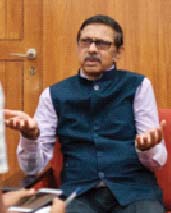
What do you think is the basic lesson from the Emergency?
I think one underlining lesson is that all kinds of aberrations can creep in once democracy is derailed. The institutions, human rights and liberties, all go for a six causing a serious moral vacuum in the State.
At any stage do you think it looked like an unending dark alley, in the sense that was there a stage when it looked the Emergency might never be lifted?
Yes, of course. During the entire 1976, one saw no hope whatsoever of Emergency being lifted at all. There was not even a remote murmur to that effect, and the general understanding was that it might carry on endlessly. “Mummy will stay” used to be a common word from Prime Minister Indira Gandhi’s son, Sanjay Gandhi.
Do you think the Emergency can ever be reimposed?
No. I do not think so. Now the institutions that caved in during those days are quite strong. Look at the media only. It has become far more too powerful these days. I remember how media was mocked at by political leaders those days, but no more perhaps because the reach of the media has extended far too much now. Even judiciary is much stronger. The political idiom has also drastically changed.
Do you think there was anything positive about the Emergency? In any form?
It will be preposterous to think like that. As my book says it was surely Indian democracy’s darkest hour. When your basic rights and liberties are suspended what positivity one can look for!
The mockery of it was highlighted in the fact that the letter the Union Home Minister wrote to the President, along with the draft proclamation of the Emergency for the President’s assent, was “on a plain sheet of paper. It was not on a letterhead of the Home Minister of India”.
As Indira Gandhi had kept his entire Cabinet in the dark, K Balachandran, secretary to the President, said, the Prime Minister had informed the President that she had not consulted the Cabinet due to the shortage of time, so she quoted the Transaction of Business rules to bypass the Cabinet. Balanchandra told the President that it would “constitutionally be impermissible” for him to sign such a proclamation. He told the President that he must act on the advice of the council of Ministers. The letter from the Prime Minister made it clear that the Union Cabinet had not considered the issue. But RK Dhawan from the PMO visited the President and got the proclamation signed. “Next day a revised letter was received from the Prime Minister”. The unconstitutional conduct of President Fakharuddin Ali Ahmed has been starkly brought about in the book.
The Prime Minister completely short-circuited the constitutional and legal provisions. Shockingly, a number of key individuals in the cabinet and the government were totally clueless about what transpired that night. They came to know about it much later but had no courage to ask even elementary questions. Even Union Law Minister HR Gokhale heard about the Presidential proclamation when he arrived for a cabinet meeting on June 26, the next day.
Cabinet secretary BD Pandey was clueless about it. In fact, by the time he got to know about it, a large number of arrests had already taken place during the night. Atma Jayaram, Director, Intelligence Bureau, got to know the next day when he reached his office. Home secretary SL Khurana too had no inkling about it till the next morning.
The book observes that anxious to cling to power at any cost, Indira Gandhi apparently leaned on her son Sanjay and his henchmen for support. Only SS Ray used to be around to provide legal advice. And before she realised what was happening, her democratically elected government had become an authoritarian regime that was cruel and oppressive. Hundreds of thousands of people were jailed and tortured, forcibly sterilized or thrown out of their homes and hearths in city-cleaning operations.
That the police crackdown was most severe on the RSS and the Bharatiya Jan Sangh is brought out by the fact that of the 6000-odd total political arrests, more than 4000 happened to be from these two organisations.
In its contextual message the book underlines that “If we have to protect ourselves from such tyranny, hereafter, we need to remember the story of the Emergency. It must be told and retold so that the idea of democracy gets replenished generation after generation”.
And on the political spectrum, the message is bold and loud. More tellingly, since Indira Gandhi had leaned on her son Sanjay and his henchmen during those horrid days of the Emergency the book also serves a telling reminder of how was the key player during those horrid days. “Her concern for Sanjay’s future well-being was not an inconsiderable factor in her fateful decision. The urge to compensate or over-compensate a son of the family is still part of the Nehru-Gandhi family’s political leit motif and the dynasticism and nepotism that is woven into the family’s approach to politics had become an excuse for lesser-known political dynasties to defend such aberrations. This must be firmly rejected by the people because it does not augur well for the healthy growth of democratic traditions.”



Comments