





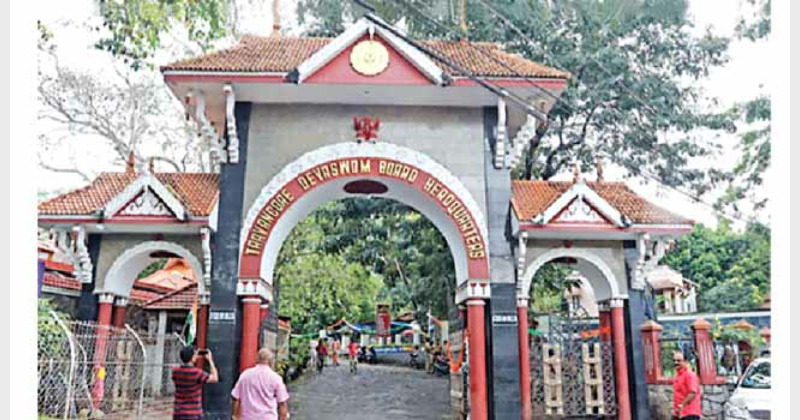
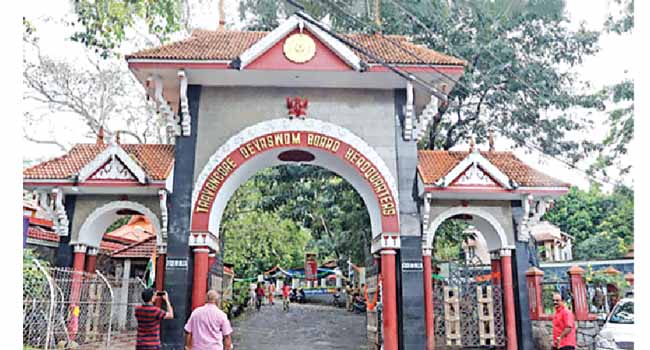
With its vice-like grip on the five Devaswom Boards in Kerala temples, the Communist athiests-controlled CPI(M) regime continues to deny economic benefits to the Hndus in Kerala
Jayakrishnan k
Hindus constitute more than 54% of Kerala’s population but their share in the State’s economy is far lower than that of the minority communities. Their presence is becoming less noticeable in every area of activity. A careful analysis shows that the most important culprits are the five Devaswom Boards that have become something of a curse on Kerala’s Hindu community. Unfortunately, Kerala’s Hindus have not yet realised this.
The Travancore Devaswom Board (TDB), the Cochin Devaswom Board, the Guruvayur Devaswom Board, the Malabar Devaswom Board and the Koodal Manikyam Devaswom Board were established to manage the affairs of temples in Kerala and they were supposed to take care of the religious interests of the Hindus. In the first place, it is unconstitutional for a secular government to conduct the religious affairs of a community. Here, we shall examine the disastrous economic consequences the Boards have had on the Hindu society in Kerala.
Places of worship have always made large contribution to religious communities. The temples’ wealth is used to build institutions for the community. Just look at how many schools, colleges and multi-specialty hospitals Kerala’s Christians have built over the years. Muslims, too, have achieved remarkable progress as a community, particularly in the wake of the economic boom in the Arabian Gulf countries. They run large number of hospitals and colleges.
I do not grudge my Christian or Muslim fellow citizens while I do acknowledge the fact that many Hindus like me have benefitted from their institutions. I wish to draw the attention to the pitiable record of Kerala’s Hindus in this regard.
Education, particularly professional education, is the foundation on which a successful modern society stands. This is particularly so in Kerala, where land is scarce and so traditionally education is given great importance. Though Christians form only a little over one fifth of the State’s population, they have been dominating in all walks of life. This is the result of the head start they have got in education because of the numerous schools that churches and missionaries started since the time of the princely states. Every town in Kerala with a Christian population has had a college for many decades. Almost all of them were built with the funds donated by the churches.
There has been explosive growth in the education sector with the advent of popular governments. And a large number of professional colleges—medical, dental, engineering—sprang up in the past 30 years or so. Most of them are run by minority religious groups.
How did this happen? It was not that the minority communities are smarter or that the Hindus lack initiative. The fact is that Christians and Muslims are free to use the income from churches, mosques and religious bodies to build institutions whereas Hindus do not derive any financial support from their temples because the income of the temples is swindled by the Devaswom Boards.
Misuse of Hindu Wealth
The Times of India reported on September 4, 2012 that the total annual revenue of the five Devaswom Boards at that time were Rs 1,000 crore, with the Guruvayur Devaswom Board, in the lead, making up Rs 400 crore.
With the economy growing fast, the temples’ income must have increased by at least by 25 per cent. Even if the Devaswom Boards together support some 3,000 temples that have little income at the rate of Rs 6 lakh each year, it will work out to only Rs 180 crore a year. And if the expenditure to maintain the bigger ones is put at Rs 200 crore, there should be a saving of some Rs 900 crore a year.
According to the Devaswom Minister’s own statement, the Travancore Devaswom Board’s income in 2017-18 was Rs 683 crore and expenses were Rs 678 crore. Of this, Rs 475 crore was spent on the salary and pensions of its employees. That is, 70 per cent of all revenues from all temples under the Board were spent to run something like a government department. The Malabar Devaswom Board has now decided to substantially increase the salaries of its staff.
Speaking about wages, it is shocking that pujaris, who form the most important component of the temple management system, are among the lowest paid employees. This is when there are reports that the Travancore Devaswom Board is planning a multicrore complex to house its senior leaders.
What have the Boards done for the benefit of the Hindu community in general? For some seventy years they have been usurping all the money devotees donate at the temples, which at current value should have been more than Rs. 80,000 crore. Have they built a medical college, an engineering college, or a decent hospital? Are there any schemes offering assistance to Hindu students?
Of late, there have been indirect attempts to exercise controls over cultural gatherings of Hindus. The annual Pooram festival in Thrissur undoubtedly attracts the largest crowds in Kerala. The government, through the Cochin Devaswom Board, apparently plans to use to build commercial complexes, part of the open ground where people including Christians and Muslims along with Hindus—gather. One should remember that most of Kerala’s art forms were born and nurtured on temple premises.
Indeed, Kerala’s Hindus gain nothing more than spiritual comfort from their temples.
Religion-based Reservation
There is another problem to be solved if the presence of Hindu students is to be reasonably good in key areas of higher education. The court order in a case (T.M.A. Pai and Others) has made matters really difficult for Hindus. It makes it mandatory for minority-run educational institutions to reserve 50 per cent of their seats for students from their respective communities. Minority students gain admission to these colleges also through merit, NRI and certain other quotas.
A case in point is medical education. More than half of the medical colleges in Kerala are run by the minorites and they follow the above formula. Some of them refuse to reserve half of their seats for admission from the government list, in violation of an agreement. One of them, KMCT Medical College, filled more than 70 of its 100 MBBS seats with students from one religious group in 2018-19
You can only imagine the percentage of Hindu students in the MBBS stream in Kerala. Even if there are colleges run by the majority community, the problem will remain to a large extent. In short, there is no level-playing field.
Dismantling the Boards
Only the following measures taken together can save Hindus from this predicament. One is the dissolution of the Devaswom Boards. The second is a Central law to ensure 50% reservation for Hindus in Hindu-run educational institutions. The Boards are trustees of all property owned by the temples they have been controlling. Therefore, they must be held solely responsible for the temples’ loss of movable and immovable property while being under them, and the government should take measures to restore the property to the temples. It is also logical that the temples are compensated for the losses they suffered while being controlled by the Boards.
Political parties that have ruled Kerala have a vested interest in the Boards. The present government is led by the Communist Party of India (Marxist), whose leaders are ideologically atheists. How can anybody expect them to help Hindus to ‘practise and propagate’ their religion? Their interest is only in the temples’ wealth. No wonder they want to convert Sabarimala into a round-the-year religious tourism centre.
The Congress, which leads the rival front which has shared power with the Left-led grouping, draws its support mainly from the minority communities. Using temple wealth for Hindus’ economic, educational and social progress has never appeared to be among its priorities.
In this situation, what is most urgent is a powerful popular movement to get the Devaswom Boards dissolved. The temples should be put under the charge of Trusts that have believers with impeccable records as members and are accountable to the community. It will be possible to build any number of “Guruvayur Medical Colleges’’ and “Swami Ayyappan Engineering Colleges’’, which will benefit the minority communities too. Deserving Hindu students, and entrepreneurs, can be given financial assistance and loans. In this context, it is important to mention the Supreme Court’s remark made during a recent hearing that temples should be administered by devotees, not the government.
Fortunately, the Devaswom Boards have not yet thought of taking over Hindu mutts, and so the Amritanandamyi Mutt’s institutions survive. But the danger is there and this applies to family-owned temples too. The Travancore Cochin Hindu Religious Act & Rules says that ‘’where the management of a religious institution has passed into the hands of several branches by division among the members of the original family, the institution may nevertheless be considered as being in the management of a single family’’. Just a complaint about “maladministration’’ can possibly lead to take over as the funds of the temple or mutt act as a powerful magnet.
A movement against this blatant assault on Hindus’ fundamental rights should be backed by members of the minority communities as well, for they would be working towards a win-win situation for all.
There are “secularists’’ among Hindus who do not value the contribution of temples to their welfare. It is better for them to remember that when they or their children seek admission to professional courses, they are unlikely to be asked if their politics is Left, Right or Centre. But they will certainly be asked if they are Christian, Muslim or Hindu.
It is said that an insecure minority is not good for secularism. An unhappy majority is a graver threat to secularism.
Anti-Secular, Unconstitutional
Kerala has five supposedly autonomous Devaswom Boards to administer Hindu temples and thereby control the religious and spiritual affairs of Hindus. Whether they have done anything for the welfare of Hindus is a contentious question. A more important question is whether they have constitutional validity.
India is a secular country: it has no state religion. It is a Union of States and Union Territories, and it is the duty of every State to follow the provisions of the Constitution provisions. Then how can a secular government, which should keep equal distance from all religions or treat all religions equally, run the affairs, including the places of worship, of one particular religion? In Kerala, and in other States too, Devaswom Boards and corresponding bodies function as proxies of the government.
Quite often atheists rule Kerala. How much interest will they show in the spiritual progress of one particular religious group? Already it is clear that they are not interested in imparting religious education in Hindu temples under the Devaswom Boards. On other hand, Christians and Muslims are free to teach their religions with funds generated by their places of worship and religious bodies.
Does it not violate the Constitutional provision that “all persons are equally entitled to the freedom of conscience and the freedom to profess, practice and propagate religion subject to public order, morality and health” and that all denominations can manage their own affairs in matters of religion (Articles 25 and 26). And Article 14 guarantees all citizens equality before law.
And, most importantly, it is a clear violation of Article 13. This Article prevents the State from making laws that are inconsistent with the Fundamental Rights and makes null and void such laws that existed prior to the commencement of the Constitution.
Prior to Independence, India comprised of princely states and regions under the British colonial government. The governments of these states were not necessarily secular and several of their laws, though violative of the Constitution, are still in force in India. Thus, taking over religious bodies or places of worship under such laws violates the Constitution.
(The writer is an advocate based in Kerala)









Comments