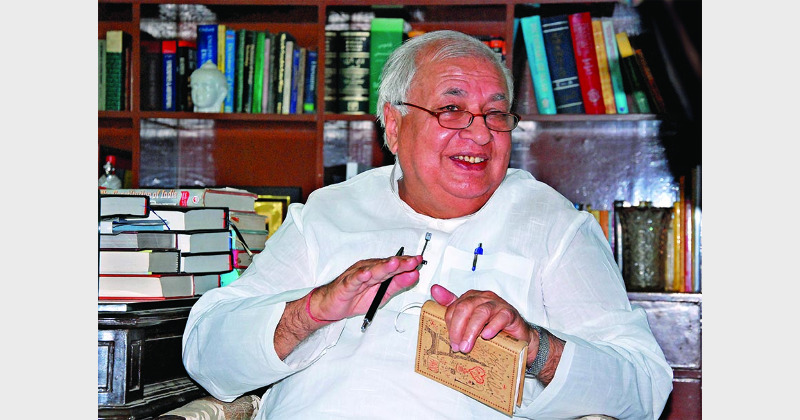
Talking to Chief News Coordinator of Organiser Dr Pramod Kumar and Senior Correspondent Nishant Kr Azad in Delhi on July 31, Shri Arif Mohammad Khan feels that once triple talaq comes to an end, Halala will die its natural death. He said he argued in the SC against triple talaq and when the polygamy issue is taken up, he will argue against that also. Excerpts:
Many times you have called triple talaq ‘anti-constitutional, anti-Quran and anti-humane’. Since the Bill to ban it has been passed in the Parliament, how do you see it?
This is a very positive step taken by the Government. It has performed its constitutional duty. It was an obligation of the government to ensure that the Supreme Court (SC) judgement is followed in letter and spirit. Unless some penal provision is incorporated or it is made a punishable offence, the law is not respected. The malpractice of triple talaq has its roots in history. In India, the obnoxious thing is being practised in the name of Islamic courts and enforcement of the Muslim law. In 2017, the Supreme Court held triple talaq unlawful on two counts. One, it is arbitrary. Second, it is part of the religious law. The parties defending this malpractice also admitted in their affidavit that it is ‘Haram’ (prohibited), and it is ‘bidat’ (innovative practice), which is not part of the original scheme. They said it is sinful but legally permissible—bad in religion, but good in law. On it, the SC judgement said that this is unimaginable that something in a religious law can be ‘bad in religion and good in law’. If something is bad in religion then it must be bad in religious law also.
The SC had directed the Government for legislation.
Yes, the people did not pay much attention to the minority judgement. The SC bench consisted of five judges. I find the minority judgement more revolutionary and radical. Justice Khehar and Justice Nazeer said they do not want to decide the case because both the parties are saying the same thing. The petitioners challenged triple talaq and those who came to defend it also said it is bad. When confronted with the question that if you do not want us to decide then who, in your opinion, is competent to decide this? Then the All India Muslim Personal Law Board (AIMPLB) conceded in its arguments that ‘Legislature has the authority’. So, the minority judgement said ‘why you want the bench to decide it’. Both of them are saying that the legislature has the authority and they are not challenging that authority. Therefore, we are asking the legislature that for six months we ban it and during those six months the government should make the law. So, even the minority judgement cannot be used by AIMPLB or the defenders of triple talaq in their favour. Other three judges said triple talaq is unlawful on two counts. First, the Constitution does not permit it because it is arbitrary. Second, we do not accept the contention that something which is bad in religion can be good in law.
I am glad that this government has taken note of that crisis. Always remember that the judgement of the Supreme Court itself enjoys the status of law. The Supreme Court laid down the law in August 2017 terming triple talaq unlawful. But it is happening thereafter also. More than 350 cases of triple talaq were filed after that judgement. Now the question is, if the Parliament enacts a law and the judgement of the SC enjoys the same status, do we have the right to flout it, do we have the right to violate it or do we have the right to ask people to violate it? The AIMPLB did that. Ten days after the SC judgement, they, at their conference in Bhopal, said the practice of triple talaq shall continue. In fact, it is only because of the leniency shown by our institutions. Otherwise, this should have been taken as contempt of SC.
But the political parties like Congress and AIMIM are condemning it saying it is an attack on the Muslim identity. What do you say?
I find this language and these assertions absolutely insulting for the Muslims, because the triple talaq, according to the defenders of the practice also, is prohibited and sinful. If they feel that an Act which is ‘haram’ and sinful is part of the Muslim identity, then I can only feel sorry about it and I would say it is highly insulting to everybody who comes from that community.
The AIMPLB has called the passage of the Bill ‘black day’ in Indian democracy. What do you feel?
We are a democracy and everybody has a right to have his/her opinion. You read the judgement of 1986 Shah Bano case. The AIMPLB could not deny the existence of the verse, which says ‘…and for the divorced woman a reasonable or fair provision or reasonable or fair maintenance is obligatory for those who are conscious of God’. But the AIMPLB said in the Court that this verse is addressed to some specially pious people, and not the ordinary Muslims. The SC made fun of it. It said what kind of argument you are giving. If they can go to the extent where they say the verses of the Quran are selectively applicable, they can say anything. According to them, the Quran is the law of Islam. It is part of their syllabus in madrasas. Everything which they teach on jihad violates the provisions of the Quran.
There is a big question mark over what is taught in madrasas, as it creates disturbance in the country. What do you think?
I do not think they have the potential to create disturbance in the country. The problematic thing is that their graduates control the mosques. More disturbing for me is that the speeches which they make go totally against the letter and spirit of the Quran. Quran is the basic book as far as the religion is concerned. How can anybody be allowed to make speeches which go against the letter and spirit of the Scripture?
“If the parties like Congress and AIMIM feel that an Act which is ‘haram’ and sinful is part of the Muslim identity, then I can only feel sorry about it and I would say it is highly insulting to every Muslim” – Arif Mohammad Khan
What should be done to curb such things taught in madrasas?
We as a society and also the agent of the society i.e. the government both the central and the states, should provide quality education to every child of the country. You give that access to the people and they will stop sending their children to madrasas. More than any action, just simply provide good education to their children.
But, there is a big group in media and politics which is afraid of mainstreaming of the Muslims?
They are afraid, but that does not affect the people. The clergy is still against girls’ education. You come with me to the most backward villages, where Muslims live and you will see Muslim girls going to schools on their bicycles by travelling 6 to 10 km. These fear-mongers have no effect on them. The only solution is to make education accessible to everybody. That is the solution to all the problems. During Atalji’s regime, education was made a fundamental right. Then AIMPLB was the only organisation in the whole country that officially opposed it. According to Islamic morality, education became compulsory eleven years before prayer became compulsory; then why were they opposing it? They were opposing it because they saw a threat that if education becomes the fundamental right and quality education became accessible for the children in all parts of India their catchment area will dry up.
The present government has taken many steps to popularise modern education among Muslims. Are you satisfied with those steps?
During the last two decades, there is very much awareness among the people. Now they want to send their children to schools. However, the Maulvis are still opposing it. Their opposition is more on girls’ education. But the people who can afford education are moving to nearby cities to ensure modern education to their children. The government needs to just make good schools available to them and improve the system in rural areas.
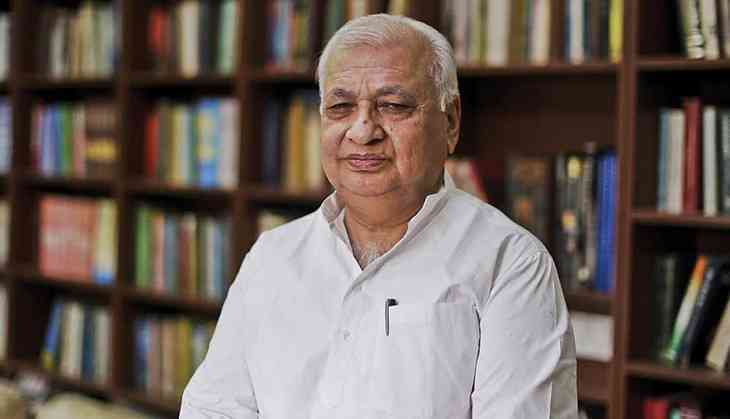
“The govts, both central and states, should provide quality education to every child. You give that access to the people, they will stop sending their children to madrasas” – Arif Mohammad Khan
Women are celebrating the passage of the Bill. But some still argue that the law cannot be implemented and it will not change the plight of Muslim women. What is your opinion?
The law was passed by the Parliament only yesterday. But the law is already in place through an ordinance. Very recently, some newspapers in Uttar Pradesh published detailed reports informing how the so-called Sharia courts in Kanpur and Lucknow have no work—no cases are coming to them. Why? Because law is already in place and triple talaq has already come to an end. Then why are they indulging in kite-flying? The ordinance cannot continue forever. Therefore, passing the ordinance into a bill was absolutely essential.
There is a voice against the practices of ‘Halala’ and polygamy also?
I think Halala is a related issue. Once triple talaq comes to an end, Halala will die its natural death.
And what about polygamy?
The petition in Supreme Court has already challenged triple talaq and polygamy as well. But the SC has decided to deal with individual issue separately. They have not dropped the petition. They said they would first take up the issue of triple talaq. Polygamy is still pending. Though I am not a practising lawyer, I argued in the SC against triple talaq. And, I intend to do the same, when the polygamy issue is taken up. Based on my studies of the Quran, I am convinced that polygamy is as untenable as triple talaq and has very weak ground. The Quran clearly directs to ‘marry those among you who are single’. I asked these people whether this verse is addressed to man alone, or it is addressed to both man and woman? They admitted that it is addressed to both. Then I said why a woman should marry a man who is already married. When the scripture is saying, ‘marry one who is single’, then why should she marry a man who already has a wife?
It is the victor who always writes the history. It is a patriarchal society. So, when they wrote the law, they ignored this particular verse of the scripture. Polygamy was permitted with many conditions. The context was that when the Battle of Uhud took place just outside Madina, one-third of the Muslim male population was wiped out. There were lots of widows and orphans. So, to take care of them, permission to marry more than one woman was granted, provided the man was able to do justice among them. A few verses later, the Quran says, “…and it is beyond your capacity to do true justice between two wives”. So, it does not ban polygamy, but it discourages polygamy. I firmly believe that the day this provision is scrutinised, it will also be found to be arbitrary and running against the letter and spirit of the Scripture. I am very sure that it will also be outlawed. I am of the opinion that why should the government wait for the SC. The Legislature should initiate the process.
There is an attempt to create a narrative that Muslims are insecure in India. What are the reasons behind this fear-mongering?
The reason is an insecure mind. This mind felt the same insecurity in 1937 also. From 1937 to 1947 they said we cannot live together; our religion, culture, the language will be under threat. And they asked for Partition. They said belonging to different religion means we are a different nation. What is new about it? In 1986, when BJP was not even in the picture, they had only two MPs in Lok Sabha and the Congress had 407 MPs, they said religion is in danger. This is not a recent phenomenon. They carried out a ferocious campaign in which a highly violent and contemptuous language was used for the SC judges. Security comes from your belief in yourself. What we witness today is the extension of the language, which was spoken in 1986—the same old Muslim League tactics.
Now since the voice for change is coming from within the Muslim society, do you think things have changed?
I wish you have seen 1986. In 1986, even those who were supporting me were hesitant and reluctant. They came to me after my resignation and tried to make me understand that there is no use in fighting the clergy because they are too powerful. More than 300 senior people including IAS, IFS, IPS officers and university professors, led by Badruddin Tyabji, wrote a letter to Prime Minister Rajiv Gandhi in my support urging not to succumb to the demand of AIMPLB because what they are pressuring you to do has nothing to do with Islam. But the government went their way. These very same people came to me with a request not to continue the fight. They were very genuine people, but very fearful to the clergy. Today, even if people like me are not there, the women and youngsters will carry forward this fight. This is a big change.
“In 1986, about 300 eminent Muslims had come to me with the request not to continue the fight against the clergy. But Today, even if people like me are not there, the women and youngsters will carry forward this fight. This is a big change” – Arif Mohammad Khan There is confusion over the word ‘minority’. If we talk in totality, people generally refer to Muslims as a minority. What is your opinion?
It is not the question of opinion. We have to follow the Constitution on it. Unfortunately, we have promoted such mindsets. The Constitution does not talk about any permanent minority or majority. During the British period, we became habitual to look at everything from the prism of Hindu-Muslim. But the Constitution put an end to that—no discrimination in the name of religion, no special rights in the name of religion or no exclusive rights in the name of religion. We need to make an effort to change our habits. The word minority as the constitutional term is only in the context of setting up educational institutions, nothing else.
Do you think the Government will be better equipped to deal with the personal laws of Muslims in a sensible manner?
Surely, because the situation which was created earlier on the issues like triple talaq is over after the SC decision in 2017. This time they could not say that it is interference in the religion, because everything the Court said was admitted by them in their own affidavit. But they hoped that by admitting all these things the SC would agree to leave the responsibility to them and would not give a judgement. But everything the SC said in 2017 judgement is written in the AIMPLB affidavit. They have themselves admitted that it is not the holy cow, which cannot be touched.
There is a section in the country, which has been working tirelessly to prove Modi government as anti-Muslim. Now, since Modiji talks about ‘Sabaka Vishvas’ how do you see this?
Regimes have changed; the law has changed; so many changes have taken place, but old habits change with great difficulty. This is not the first time. In early days after Independence, even the Muslims who were in Congress were described as ‘Sarkari Musalman’. I am not talking about every Muslim, as there were Muslims before 1947 who stood firmly against the Partition and Muslim League. But for a large section of the community, the Muslim League had become as if something sanctioned by the religion. Even after Independence, they made all kinds of allegations and doubted everything about the Congress. So, this section has always been there. One should not give them too much attention.