






The brutal attack on Assam Finance Minister Himanta Biswa Sarma and West Bengal BJP president Dilip Ghosh’s convoy by Trinamool Congress workers on May 7 shows the frustration and high-handedness of Mamata Banerjee
Niladri Roy
The political violence in West Bengal assumed the ugliest form on May 7 when the convoy of Assam Finance Minister Himanta Biswa Sarma and West Bengal BJP chief Dilip Ghosh was attacked in Purba Medinipur’s Khejuri by Trinamool Congress workers. According to reports ‘TMC goons’ blocked the roads even as the West Bengal police stood at the scene as ‘mute spectators’. “We are at Khejuri in Kanthi LS constituency and attacked mercilessly by @AITCofficial goons. Many of our workers are injured even as @MamataOfficial goons gheraoing and abusing us. @BJP4Bengal President @DilipGhoshBJP and I are stuck (sic),” Himanta Biswa Sarma tweeted. There is hardly any day when the political opponents are not attacked in the state by TMC goons. About two dozen people were killed during the Panchayat polls. Whenever the ruling party found losing ground it indulged in violence to retain power.
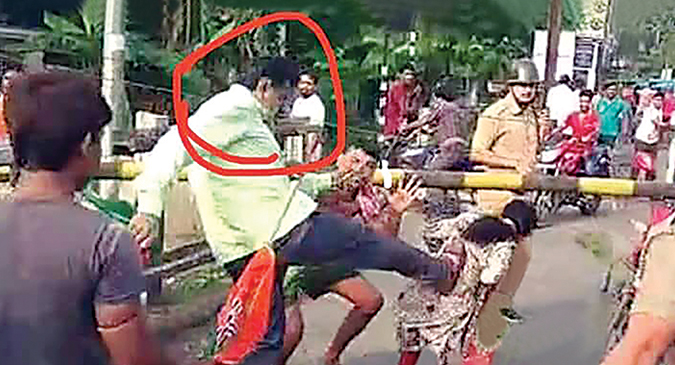
TMC leader Arshad Ujjaman kicking a BJP woman worker
The state has a long history of political violence. Between the 1970s and the 2000s, of course, lies the long period of the Left Front government– essentially the rule of the CPI(M), and the transformation of the spectacular violence of the Naxal period, its reduction to its most banal forms. In fact, this banalisation of violence as an everyday fact of life started in the interregnum era of Siddhartha Shankar Ray’s Congress regime from 1972 to 1977. It is well-known that the 1972 state assembly elections, held while the state was under president’s rule, were massively rigged. This poll outcome reinstated the Congress in power. What subsequently followed was one of the most virulent campaigns of combing areas, clearing them of Naxal and Left activists. Tens of thousands of Naxals were imprisoned without trial for years, while thousands were physically eliminated.
Thereafter set in a period of calm. The pipe guns and bombs would from now on be wielded by gangster and criminal elements allied to the government, and used to silence all voices of opposition. A regime of generalised everyday terror, described by the CPI(M) as a period of ‘semi-fascist terror’ came into being.
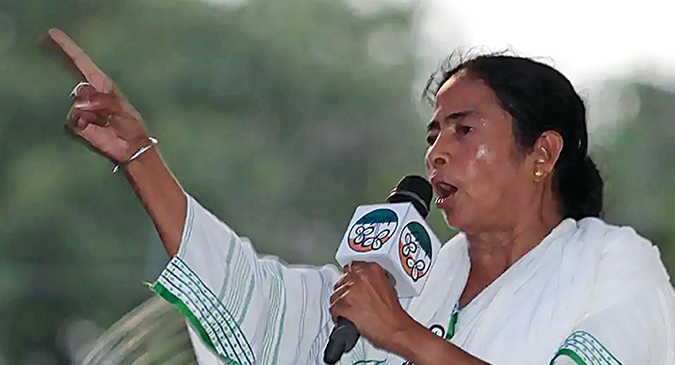
Mamata Banerjee
With the advent of the Left Front government in 1977, political prisoners were released, normal democratic processes were restored and the stage seemed set for a new phase in the political life of the state. And yet, it was precisely in this period of hope and expectation that the tragic developments in Marichjhanpi took place. To be precise, the violence in Marichjhanpi took place in 1979, within two years of the Left Front assuming power. That the Namashudra (Dalit) refugees who had long been forcibly settled in the wilds of Dandakaranya thought they could now move to Sunderbans and start a new life was also an indication of new hope. Little did the refugees realise that the game had changed. The violence accompanying the eviction of the refugees from Marichjhanpi was a joint undertaking of the state’s police and the party cadre.
between 2011 and 2018, the state witnessed the highest number of political killings. in other years too, it has consistently remained among the states with the highest number of such murdersIn retrospect, it seems, Marichjhanpi was an experiment in the political management of public opinion on the one hand, and the selective deployment of violence when it came to establishing the regime’s or the party’s supremacy, on the other. Thus a new chapter began in the history of West Bengal where ‘the party’ became the sole manager of conflicts and disputes, effectively mediating among the people so that they do not resort to large-scale violence.

Dilip Gosh
The situation, however, started to change from the late 1990s, with the formation of the Trinamool Congress in 1998 and its close alliance with the Bharatiya Janata Party (BJP) which had formed the first National Democratic Alliance (NDA) government at the Centre. The BJP was perceived as a dominant force and its distinctively Hindutva campaign, for the first time, began making electorally significant inroads in many areas: the party won the Dum Dum parliamentary seat in that election. The long and violent battles for dominance in Keshpur between CPI(M) and Trinamool Congress that continued from 1998 to 2000 were an early indicator of the CPI(M) beginning to lose its grip over the rural areas.
In 2006 and 2007 Singur and Nandigram were desperate attempts by peasants, at the point of dispossession, to hold on to their land. The peasant movements thus became a point of articulation of a normative challenge to the ill-thought out programme of neo-liberal industrialisation. The CPI(M)’s inability to see these developments as an opportunity for course correction eventually cost it heavily. The party finally lost its long-held power in the state, perhaps never to return again.
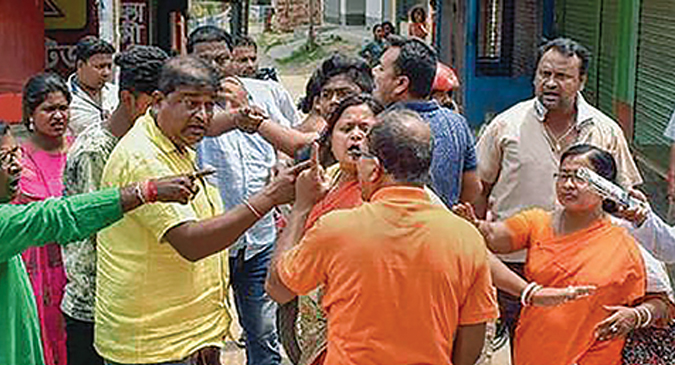
TMC and BJP workers in a scuffle outside a polling station, during the third phase of Lok Sabha elections in Malda district
It was against this anarchic model of governance that Mamta Banerjee got the mandate to rule West Bengal by its people. However, it is speculated that the entire lumpen Left cadre base was transferred to Trinamool Congress. It is hence no surprise that they choose to function in the manner they are used to. This meant that political violence remains unabated in the state.
In the years between 2011 and 2018, the state has the highest number of political killings. Even in other years, it has consistently remained among the states with the highest number of such murders.
The election is no less than a war, hunting down the opposition is part of that war, and lies of different degrees and colour are the only truth during the campaign. Leaders of the ruling party, Trinamool Congress, have been unambiguous in spelling out the mission of making Panchayats (rural local bodies) ‘Opposition-mukt’
There is an old adage in Bengali which says, “Maar na khele siksha hoyna”—(students do not learn without a beating by the teacher). Since political lessons are different from lessons imparted in school, classroom tools have given way in these elections to a burgeoning cottage industry of bomb-binding. More than 100 people died in the Panchayat Elections of 2018 and as many as 52 BJP workers were killed. 34% of the seats were won by TMC without a contest. Immediately after coming to power the TMC took to vandalism, forced the opposition parties to shut down their offices and drove their supporters out of villages. Political interference with policing is an old problem in West Bengal, from what has been gathered from officers still in service, interference has only increased with the change of regime, and it has come to such a pass that even actionable intelligence is often ignored out of political considerations. The failure to arrest violence is a blot on TMC government which is not only in power with a comfortable majority but also claims to be highly popular. The basic premise of political violence is that it militates against the concept of democracy and rule of law. It attacks at the heart of the constitutional setup, and therefore, drastic measures are required to curb this problem. The solution of such a systematic problem of political violence is only a methodical overhaul of the governance structure of the state.
The Union Government needs to show its mettle in such a case. West Bengal presents a textbook case of the breakdown of the constitutional machinery in a state, especially when we contextualise the present murders with the massive and widespread violence seen during the Panchayat polls in the state, just last year. There hasn’t been any such situation in our entire independent history. It is the utmost responsibility of the Union government that the rule of law is maintained and none of the federating units is subjected to mayhem of this magnitude, at the hands of a despotic Chief Minister.
Mamata Banerjee’s uncertainty about her political position could be seen in the violence unleashed by her party men during the Panchayat elections last summer when 16,000 of the 50,000 seats went uncontested by the opposition parties apparently because the ruling Trinamool Congress activists scared away all her adversaries. What is clearly worrying the Chief Minister is the jump in the BJP’s vote share from three per cent in 2013 to 23 per cent in a by-election this year where it secured the second place, relegating the Congress-Left combine to the third place. Moreover, a survey has predicted the BJP’s emergence as the principal opposition party in the state. An improved performance by the BJP will also undercut the Trinamool Congress leader’s national ambition as one of the architects of the anti-BJP mahagathbandhan (grand alliance) at the national level and of herself as a possible prime ministerial candidate.
In the elections of 2019 Central security forces were sent to West Bengal as early as two months before the Election Commission announced the dates of the seven-phase parliamentary polls that begin on April 11 and end on May 19. The jawans have since been staging route marches and area-domination exercises everywhere—from the once Maoist-overrun western districts of West Midnapore, Purulia and Bankura to even middle-class localities in Kolkata.
The immediate provocation was the allegation of the Opposition that the ruling Trinamool Congress (TMC) would never allow fair elections. After the first two phases of voting for Lok Sabha elections in West Bengal, a collective sigh of relief echoed in the local media. Though sporadic incidents of violence were reported from north Bengal, there were no deaths reported, and states like Andhra Pradesh outdid Bengal in bloodletting and political violence. Although a Congress worker was killed in a clash with TMC workers in the third phase, the relatively less murderous election season in Bengal was a welcome exception to the rule of political violence in the state. In an unfortunate continuum of the murderous cult dominating Bengal’s political landscape these days, it is the ruling Trinamool Congress that stands accused of perpetuating political violence by the three main opposition parties in Bengal, the BJP, the Congress and the Left parties.
A new situation has emerged in West Bengal. A situation potent with a range of possibilities and dangers of the kind the state hasn’t seen in a long while. Where West Bengal goes from here remains to be seen.
(The writer is a political thinker, entrepreneur and former financial analyst at HSBC, Kolkata)







Comments