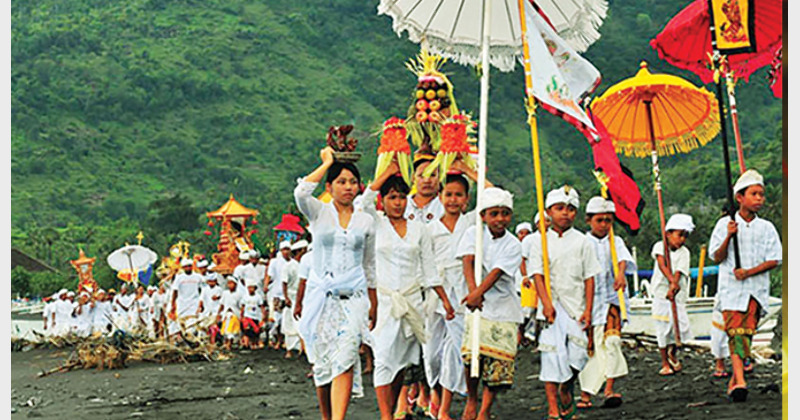
The Balinese Hindus have countless festivals and ceremonies year-round, but Nyepi is the most important one that has kept their traditional cultural diversity alive until now
Srikant Kumar
E very religion or culture all over the world has its own way to define and celebrate the New Year. For example, the Chinese have the Imlek year, as they called it “Gong Xi Fat Choy” in their own language. The Muslim societies have their Muharram year, and many of the people across the world using the Gregorian calendar, celebrate the New Year on January 1. In fact, in Bali, the only Hindu Indonesian Island celebrates Nyepi day –a new year unlike any other in the world by observing silence by completely shutting down everything for 24 hours.
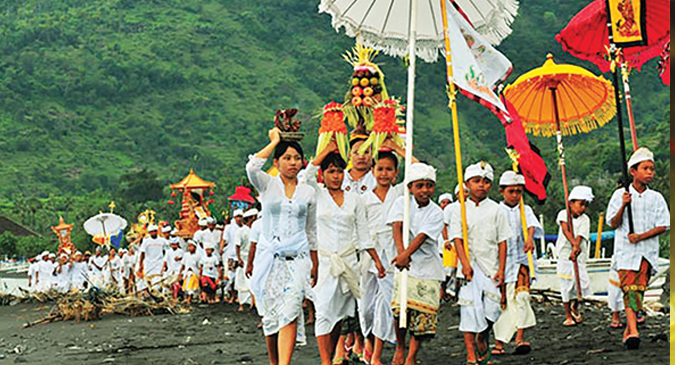
A procession by Balinese Hindus on Nyepi Day
History of Nyepi
The name Nyepi comes from ‘sepi’ or ‘silent’ in Balinese, and is commemorated each year on different date according to the Balinese Saka calendar. And this time, falls on March 7, 2019. The Balinese has adopted the Gregorian calendar for business and government purposes only. But for the endless procession of holy days, temple anniversaries, celebrations, sacred dances, building houses, wedding ceremonies, death and cremation processes and other activities that define Balinese life, they have two calendar systems, the Pawukon system and the lunar Saka calendar.

Processions by Hindus in Bali on Nyepi Day
The first is the Pawukon (from the word Wuku which means week) and Sasih. Wuku consists of 30 items starting from Sinta, the first Wuku and ends up with the Watugunung the last one. The Pawukon, a 210-day ritual calendar brought over from Java in the 14th century, is a complex cycle of numerological conjunctions that provides the basic schedule for ritual activities on Bali.
- New Year’s Day in the West might mean a hangover, a walk and a pub lunch, however, in contrast, the Balinese Hindu open their New Year in silence which they called Nyepi Day
- “People stay quietly with their families; it’s a very special day. It symbolises burning your own ego (Sapta Timira which means seven inner enemies) as well chasing bad spirits away,” says Prof. Suastra
The second is the Saka/Sasih calendar which has its origin in India, runs for 12 months of the lunar system with the month beginning a day after a new moon. It is equally important in determining when to pay respect to the Gods. The Nyepi Day is celebrated with the new moon of the end of the 9th month, which falls on the day following the dark moon of the spring equinox, and opens a new year of the Saka Hindu era which began in 78 A.D.
New Year’s Day in the West might mean a hangover, a walk and a pub lunch, however, in contrast, the Balinese Hindu open their New Year in silence which they called Nyepi Day. It is a day to make and keep the balance of nature which is the core aspect of Hinduness. It is based on the story of when King Kanishka I of India was chosen in 78 A.D. The King was famous for his wisdom and tolerance for the Hinduism and Buddhism societies. During that age, AjiSaka did Dharma Yatra (the missionary tour to promote and spread Hinduism) to Indonesia and introduce the Saka year. Since then this day is celebrated as a Nyepi day in Bali.
In fact, Nyepi starts much before the actual New Year day; there are several festivals and rituals that are performed in preparation for Nyepi. It is their belief that while doing the rituals and oblige to the prohibitions during Nyepi, your life will be purified and blessed, you will be Kedewaan, or like having the qualities of a deity.
Nyepi Traditions, Customs and Activities
There are several traditions followed before celebrating the Nyepi day which are as follows: Melasti or Mekiyis or Melis (three days before Nyepi) Melasti is meant to clean the pratima or arca or pralingga (statue), with symbols that help to concentrate the mind in order to become closer to God. It is a self-cleaning process of human as well as the entire universe with the sacred Hindu rituals. During Melasti Hindu Balinese will go and carry all the effigies of the Gods from all the village temples to the holy sea water in long and colourful ceremonies. There, they are having a bath by the Neptune of the Balinese Lord, the God Baruna, before being taken back home to their shrines. The purpose of this ceremony is to clean the human body (Bhuwana Alit) and entire earth (Bhuwana Agung) from the bad influences, bad deeds and bad thought. Furthermore, all the Balinese people wear the Balinese costume with white colour dominant.
Tawur Kesanga (The day before Nyepi)
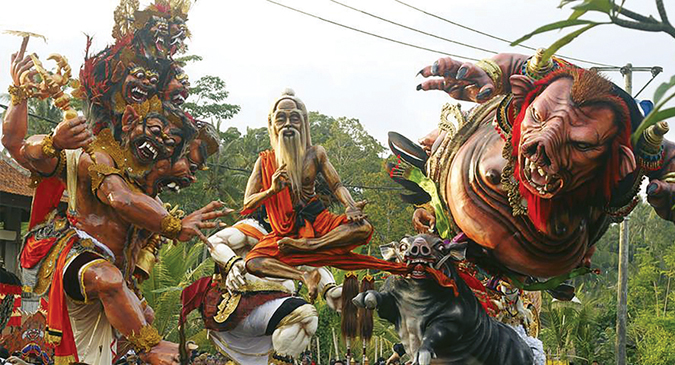
The day before Nyepi is known as Tawurkesanga or Pengerupuk and is the day on which evil spirit are driven away with most famous Ogoh-ogoh (the evil spirits) for carnival purposes. The Ogoh-ogoh monsters symbolise the evil spirits surrounding our environment which have to be got rid of from our lives. The carnivals themselves are held all over Bali following sunset with Bleganjur, a Balinese gamelan music accompanies mixture of the kulkul (traditional bamboo bell), claxons and drummer’s music. When Ogoh-ogoh is being played, everyone enjoys the carnival. In order to make a harmonic relation between human being and God, human and human, and human and their environments, TawurKesanga is performed at every level of society. Afterwards, they start making noises and light burning torches and set fire to the Ogoh-ogoh in order to get the Bhuta Kala (evil spirits), out of our lives.
Nyepi Day (New Year)
It is a day for strict meditation, fasting and silence for 24 hrs, starting at 6 a.m. and ending the next day at 6 a.m. Nyepi expects a day of absolute silence, based on the four precepts of Catur Brata such as: Amati Geni: No fire or light, including no electricity. Amati Karya: No form of physical working other than that which is dedicated to spiritual cleansing and renewal. Amati Lelunganan: No movement or travelling. Amati Lelanguan: Fasting and no revelry/self-entertainment.
On this day, every street is quiet – nobody does their normal daily activities except Pecalangs (traditional Balinese security men) who look after the street security. Pecalang wears a black uniform and an Udeng or Destar (a Balinese traditional “hat” that is usually used in ceremony). The Pecalangs main task is not only to control the security of the street but also to stop any activities that disturb Nyepi.
Religious rules state there should be no traffic, no fire, no work and no pleasure. Streets are eerily empty, shops and restaurants remain closed, the beaches are shut, use of electricity is kept to a minimum, there’s no transport – even the airport closes – and no internet. The Pecalang community police go on patrol, ensuring compliance and reprimanding anyone who steps outside their premises.
On Nyepi the world is expected to be clean and everything starts anew, with Man showing his symbolic control over himself and the “force” of the World, hence the mandatory religious control. It is meant to be a day of self-introspection to decide on values, e.g., humanity, love, patience, kindness, etc., that should keep forever. Balinese Hindus has many kinds of celebrations (some sacred days) but Nyepi is, perhaps the most important of the island’s religious days and the prohibitions are taken seriously. Everyone stays at home and reflect on the past year and pray for blessings for the New Year that has started. This whole process is self-disciplined.
Ngembak Geni (The day after Nyepi)
The day after Nyepi is known as Ngembak Geni. After Catur Berata Penyepian is over people feel very happy and enjoy going out to visit family and friends to ask forgiveness for past mistakes and doing the Dharma Canthi. Dharma Canthi are activities of reading Sloka, Kekidung, Kekawin, etc. (ancient scripts containing songs and lyrics).
“It’s a day for contemplation, to meditate, to fast, to go inside yourself and reflect on the past year,” says Professor I. Made Suastra at Udayana University. “People stay quietly with their families; it’s a very special day. It symbolises burning your own ego (Sapta Timira which means seven inner enemies) as well chasing bad spirits away,” says Prof. Suastra.
The Balinese Hindus have countless festivals and ceremonies year-round, but Nyepi is the most important one that has kept their traditional cultural diversity alive until now. Despite the large influx of tourists over the year, they have their culture still very much alive and unique. Indeed, Nyepi day has made Bali a unique island.
(The writer is convenor-Vivekanand Vichar Manch, JNU)