






CMIE has erroneously used a fall in investment proposals to project a decline in unemployment. Apart from CMIE, no other report suggests such a bleak picture of jobs in the country and we must take their data with a pinch of salt. Further, other surveys being showcased are hastily constructed conclusions at the best and fake news at the worst
Karan Bhasin
The last couple of months has seen an extended discussion regarding the situation of jobs in the country. This is not the first article that tries to address this issue and it will certainly not be the last given that political parties are trying to extensively use this issue to score points as they campaign for the 2019 elections. Beyond the political rhetoric, however, lies a simple undeniable fact: the last four years have been significantly better than the UPA-2 years in terms of job creation.

A bulk of evidence around the jobs is positive for the government while there is one source of data that paints a pessimistic view around the jobs. At the outset, we must state that the debate around the lack of jobs was initiated with Centre for Monitoring Indian Economy (CMIE) releasing its data. Since then, we’ve been arguing whether there have been adequate data for jobs or not using different sources of data on jobs. Since the debate had multiple sources and the fact that India’s economy was moving towards greater formalisation, a new survey called the Periodic Labour Force Survey (PLFS) was constituted.
CMIE Gets its Facts Wrong
The last five years of the Indian economy witnessed an unprecedented expansion of the aspirational class as the growth has been largely balanced. As a result of this balanced growth, ample opportunities were created across the skill differential while additionally, through the Start Up India, Stand Up India programme and the Mudra Yojana, the government gave a fresh push towards self-employment. Consequentially, on one hand we were promoting self-entrepreneurship for the semi-skilled and unskilled workers under Mudra Yojana, on the other we were creating innovation driven high skill opportunities through the Start Up India programme.
When the CMIE data came out, there was enough discussion around their estimates given that they claimed that there had been only a modest job growth. Ultimately, their latest estimate suggests that there has been a decline in the total number of employed people which has resulted in a sharp increase in unemployment in the economy. However, CMIE has erroneously used a fall in investment proposals to project a decline in unemployment. What truly matters is the real investment rates in the economy and the real investment rates as a percentage of GDP are at 31.4 per cent in 2017-18 (they were 31.1 per cent in 2013-14). This shows that CMIE has used investment proposals to project a decline in jobs, but it has ignored that real investment rates are higher than the 2013 levels. Moreover, apart from CMIE, no other report suggests such a bleak picture of jobs in the country so clearly CMIE is an outlier and we must take their data with a pinch of salt.
NSSO Report—Case of Sensationalising News
What about the National Sample Survey Office (NSSO) report that pegged unemployment levels at a 45-year high? Let’s first begin with logic, and then we will move on to some facts around the PLFS report that has been misused by journalists who perhaps are unaware of how to interpret these reports. In the 70s and 80s when the private sector was virtually non-existent, poverty levels were significantly high and growth rates were lower (the decade of 80s had a decent growth rate), unemployment rate could not be lower than what it is now. But does the report even suggest that unemployment is at a 45-year high?
Of course, not! journalists have been comparing the employment-unemployment survey with the PLFS to arrive at this conclusion. But the fact remains that both of these surveys have a different sampling framework. Consider this: Suppose I do a survey in New Delhi on jobs and find employment to be at 10 Lakh for 2016 and in 2017, I go to Goa and find the employment to be at 8 lakh. Now assuming that both Goa and Delhi have same working age population and labour participation rate, if I say that there has been a decline in 2 lakh jobs, would it be a sound conclusion? This is a clear attempt at comparing apples and oranges to construct a sensational headline that is only misleading people.
Apart from this, additionally, the PLFS data suggests a reduction in the population levels in the country. This is problematic as we know for a fact that between 2014 and 2017, there has been an increase in India’s population. When a survey is done for the first time, such sampling errors can occur given the complexity involved in the process and these errors can lead to erroneous conclusions. Another issue with the PLFS is the stagnant urbanisation rates as suggested by the data which is in contrast with what World Bank’s data on nightlight which suggests rapid urbanisation over the last five years. Clearly, PLFS has some severe issues that need to be addressed but even if there are such errors, releasing the data will enable us to critically look at it and recommend further changes that can help improve subsequent surveys.
Are high applicants for government jobs a sign of rising unemployment? Absolutely not! Indians in general have a high propensity for government jobs due to their stable nature. Government jobs are not just stable and secure, but they also provide one with a sense of prestige which is associated with it. Given that private sector didn’t exist much before the 90s, Indians have historically relied on government jobs and this has resulted in a significant bias and a higher appetite for government jobs which may not represent a rise in unemployment or even the lack of jobs in the economy. But sure, it always makes for a catchy headline.
Another fake news around the jobs is regarding the alleged promise by Prime Minister regarding 2 crore annual jobs being provided by him if he comes to power. The same has been claimed repeatedly by both Rahul Gandhi and his sister. The fact remains that Modi never made such a promise, and this has been evaluated by several fact checkers from time to time. Is it even ethical and acceptable that such reportage continues despite domain experts repeatedly highlighting the inaccuracy of such a claim? I leave that to the reader to judge.
But did Modi Deliver on Jobs?
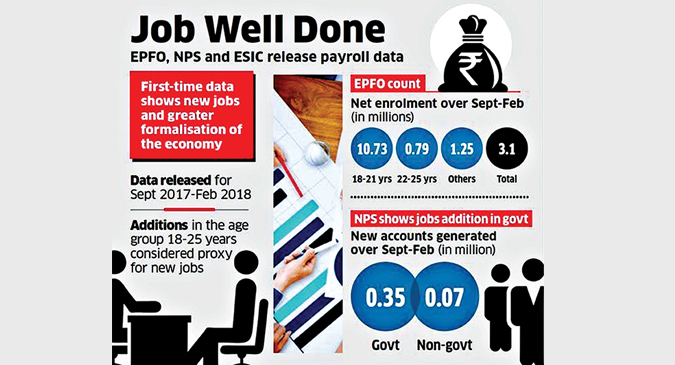
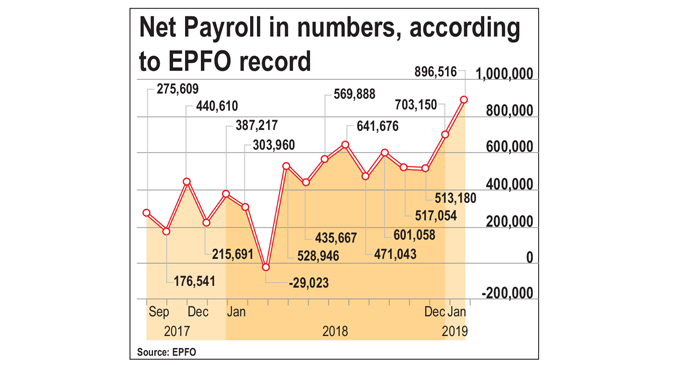
The answer to this question is a definite yes and we have evidence that conclusively demonstrates this. There are multiple sources of data that can be used to deduce whether there has been a positive change in the amount of jobs creation or not. The biggest and most important indicator for this is the EPFO statistics-based report that is released by MOSPI periodically. The reason why this indicator is important is because it doesn’t depend upon a survey, so it is free from any of the potential sampling errors. Additionally, EPFO measures formal sector employment which has all sorts of social security that must be provided to ensure dignity of labour. On these two counts, EPFO data is a very important indicator of jobs in an economy. However, the EPFO data set has come into questioning as people have argued that even if a firm has 19 members, the moment it adds an additional member, entire 20 people would become a member of the payroll and counted as additions.
However, this issue is partly resolved when we look at the age-wise segregation of new additions in EPFO. For below the age of 25, EPFO shows an increase of 4 million jobs between September 2017 to December 2018. In totality, it shows an addition of 72.32 lakh new subscribers as formal sector jobs touch 16-month high at 7.16 lakh in December. It is obvious that below the age of 25, the jobs added must be all fresh jobs and this will help us resolve the issue associated with the 19 members being counted when an additional member joins the payroll and all 20 come under EPFO. A new argument has been invented that because of change of rules and incentives under EPFO, more and more people are availing the benefits under the program, thus these jobs represent more formalisation rather than fresh creation of jobs. Even formalisation of jobs must be taken to be a welcome sign as formerly informal workers once formalised will benefit from social security schemes. But, with more people attending colleges and an increase in college enrolment rates, a addition of 4 million in the age group of below 25 years during a span of a little over than a year categorically demonstrates that there has been ample amount of “good” jobs that are being created in the Indian Economy.
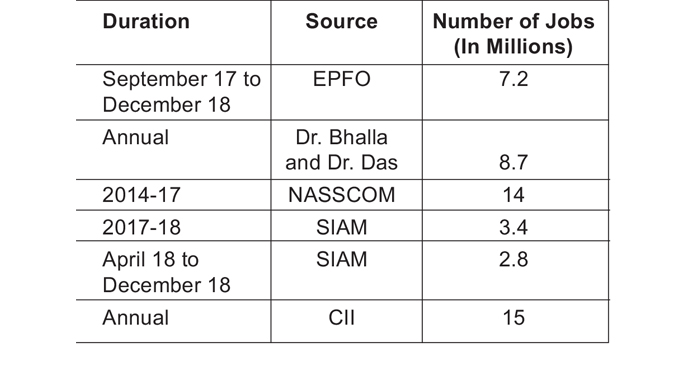
Dr Surjit Bhalla along with Dr Tirthatanmoy Das came out with their estimates that suggested around 8.7 million net annual jobs. These figures were based on all available sources of data and this has been one of the most rigorous estimates of job creation that has been provided by most commentators on the subject. Their work also highlights how the increased enrolment rates resolve the puzzle around the jobs as one has to adequately adjust the labour force participation rates (those who’re currently studying are not actively seeking jobs so they can’t be considered as unemployed).
There has been other data on jobs too, as NASSCOM has come out with a report that suggests that 1.4 crore jobs were created in automotive, IT-BPM, retail and textiles during 2014-17. This too suggests that there has been a robust job creation in the Indian Economy. Mr. Mohandas Pai and Mr Vaid have also explored this issue in detail as they’ve used SIAM’s report that showed how 3.4 million jobs were added in the automobile sector alone. The report further showed that 2.8 million jobs were added in the 9 months that ended on December 31, 2018. CII too reported around 13.5-14.9 million annual jobs being added into the economy under the Modi Government.
It is evident from multiple sources that on the question of job creation, the Modi Government has outperformed the previous government significantly. Both the ILO and the World Bank too don’t show an acceleration in India’s unemployment levels which suggests that perhaps the need of the hour is to improve and strengthen our labour market statistics. The only problem with jobs is the need to come up with a regular robust indicator of employment in the country. Such an indicator will make it easier to make a rigorous academic comparison and understand the actual situation of India’s labour market.
As far as jobs are concerned, data categorically shows that the last few years have been good and that India’s growth has led to a significant expansion of employment across the economy. The icing on the cake is that there has been a far more significant expansion of jobs in the formal sector and this is a welcome change as it will provide more workers with the protection of social security. India has managed to start the process of shifting from underemployment towards generation of more high-skills, semi-skilled and even unskilled formal sector employment. There is now a need to further the process by focusing on further skilling and re-skilling programs combined with labour reforms to unleash the untapped potential of India’s Growth Story.
(The writer is an Economist with the Gyan Foundation in New Delhi. He holds a Masters in Economics from TERI School of Advanced Studies and a Bachelors in Economics from the University of London)










Comments