





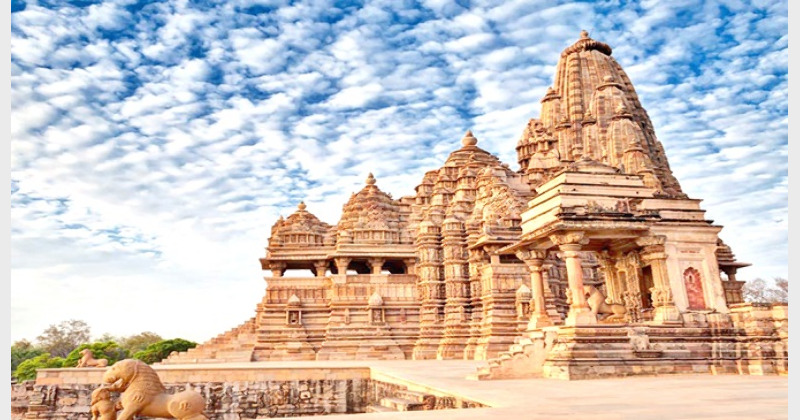
Have we lost the essence of our temple architecture, along with the 63 Khajuraho temples, in the ravages of time? The temples of Khajuraho used to signify transcendental aesthetic sense, all-encompassing philosophical outlook and the very Hindu mind of art appreciation, which were once cherished and celebrated by our ancestors who carved poetry out of sandstones
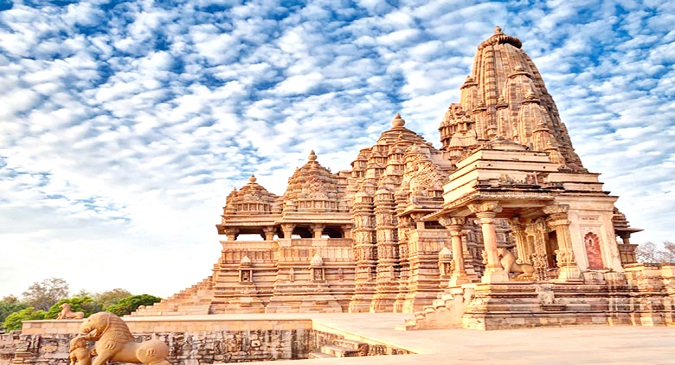
Kandariya Mahadeva Temple (Western Group) : The Kandariya Mahadeva temple is the largest temple in Khajuraho in terms of the architectural beauty and intrinsic sculpture. The temple is rich in interior carvings. A total of 872 statues-226 inside and 646 outside—have been counted
A thousand years have passed; still an exquisite scent of artistic beauty, like moonlight, permeates every nook and corner of the cultural capital of erstwhile Royal Chandelas, in the heart of Central India. If you have never seen an entire village is erected as a magnificent temple of beauty, you must visit Khajuraho, a small village in Chhattarpur district of Madhya Pradesh. Extended over an area of 21 sq. kilometres, the village is situated along a lake known as Khajuraho Sagar. Earlier known as Khajurvatika, which means garden of date palms, this royal city was once clustered round by golden date palm trees.
Khajuraho is a microcosm of the diverse Hindu worshipping systems. It is home to all Gods and Goddesses, from Bhagwan Shiva, Parvati Devi to his enemy Kam Deva, from Maha Vishu and Varaha Moorty to Chitragupt… As a testimony of Chandela’s accommodative attitude, a fair number of structures have been dedicated to Jains also. The temples are grouped into three geographical divisions: western, eastern and southern, of which the western group of temples are considered to be more important. Each temple structure represents profound beauty and philosophical outlook of Hindu civilization.

Brahma Temple
Myths obscure the real origin of Chandelas. According to a local guide, the founder of Chandela dynasty, Chandravarma was the son of Hemavati, the beautiful woman from Varanasi. “One day, while Hemavati was bathing in a pond, the moon god Chandra saw her and got attracted. He descended down to earth and spent a night with Hemavati. When worried about the dishonour of being an unwed mother, Chandra assured her that their son would become a great king. This child was the dynasty’s progenitor Chandravarma,” the guide explained. As per belief, Chandra taught his son new lessons of politics and governance, according to which Chandavarma ruled his country.
Most of the construction activities in Khajuraho started during the reigns of the Hindu Rajput kings Yashovarman and Dhanga, at the zenith of Chandela dynasty, between 970 and 1030 CE. The Lakshmana Temple and Vishwanatha temple highlight the legacies of King Yashovarman and King Dhanga respectively. The largest and most famous temple, Kandariya Mahadeva was built in the reign of King Vidyadhara. Of the total 85 majestic temples beautifully carved in sandstones, unfortunately, only 22 have survived the ravage of time, barbaric invasions and fatal apathy.
The first ever attack on Khajuraho was recorded by Abu Rihan-al-Biruni, the Persian historian who accompanied Mahmud of Ghazni in his raid of Kalinjar in 1022 CE. The attack was unsuccessful, and a peace accord was reached by the Hindu king and Mahmud.
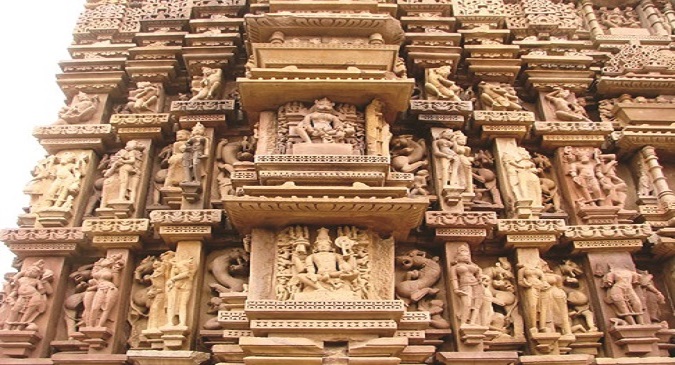
Chaturbhui Temple
After the fall of Chandela dynasty (AD 1150), after the attack of Delhi Sultanate, Khajuraho Temples suffered total destruction. The majority of temples were totally destroyed; many of the statues were disfigured. The local people were forced to leave Khajuraho, following the religious persecution of Muslim invaders. From the 13th century to 18th century, Khajuraho temples remained behind forest cover, away from popularity. In fact, it protected the surviving temples from further destruction. In 1495, Sikandar Lodi’s campaign of temple destruction included Khajuraho. But the barbarians could not locate the temple as it was surrounded by dense forest.
Moroccan traveller Ibn Battuta had mentioned about his visit to Khajuraho (1335 to 1342 CE) in his memoirs: “…near (Khajuraho) temples, which contain idols that have been mutilated by the Moslems, live a number of yogis whose matted locks have grown as long as their bodies. And on account of extreme asceticism, they are all yellow in colour. Many Moslems attend to these men in order to take lessons (yoga) from them.”
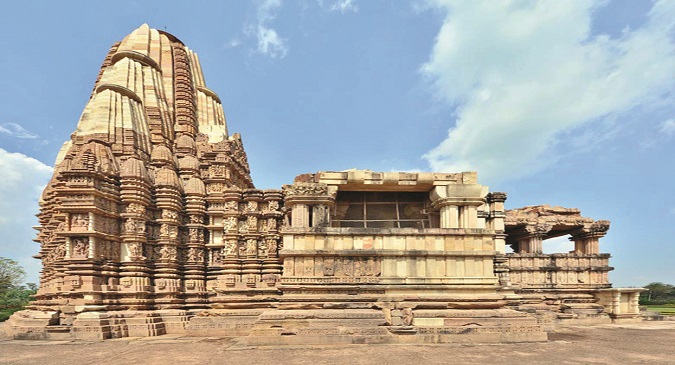
Duladeo Temple
Despite its divine beauty and grandeur, this ancient Hindu architectural marvel forlornly awaits unlikely salvation from the stigma of eroticism. In fact, the sexually explicit sculptures constitute hardly five percent, that too represents the Tantric practices. Interestingly, one can find an equal number of statues featuring motherly love, and the rest of the statues reflect celestial beauty, and the other three Purusharthas i.e. Dharma, Artha and Moksha.
The temples represent all aspects of human life, ultimately leading to Moksha. Osho Rajaneesh put it in simple albeit meaningful words: “These temples in Khajuraho have, on the outer side, beautiful women, beautiful men, and all in love postures. Inside there are no love postures. Inside you will find the temple empty, not even a statue of God. The idea is that unless you pass through your sexuality with full awareness, in all its phases, in all its dimensions – unless you come to a point when sex has no meaning for you… only then you enter the temple. Otherwise, you are outside the temple, your interest is there.”
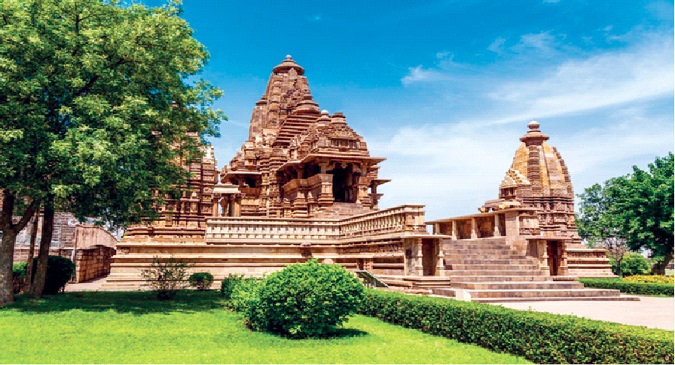
Lakshmana Temple (Western Group): The Lakshmana Temple, also dedicated to Vishnu, is the only complete temple remaining in Khajuraho
The temple is reported to have ‘rediscovered’ by a British surveyor, T.S. Burt in the 1830s. Contrary to popular belief, he was rather introducing the temple to the world. He was guided by the local Hindus to the temples. According to Alexander Cunningham, the temples were secretly in use by yogis and thousands of Hindus would arrive for pilgrimage during Shivaratri celebrated annually based on a lunar calendar.
With the British historians reintroduced the temples to the global audience through the prism of Victorian morality, ‘accidentally on purpose’, the focus was shifted from the Tantric spirituality and eternal artistic beauty to ‘eroticism’, even though in the Hindu context, sexuality is not a taboo (since there is no compartmentalized concept of ‘eroticism’ as such in Hindutva). The British perceived and projected the Khajuraho temples as ancient India’s perversion, moral decadence, and degradation. Unfortunately, great minds like Mahatma Gandhi were among those who fell in this ‘moral trap’. Mahatma Gandhi found these images “deeply distressing” and wanted the temples cleansed of these “indecent and embarrassing” representations. To his dismay, Gurudev Rabindranath Tagore had to write a letter to Gandhi, a sterling example of real cultural dissent, explaining that this was a national treasure and it could not be so cavalierly demolished because some people were uncomfortable that their ancestors were sexual beings!
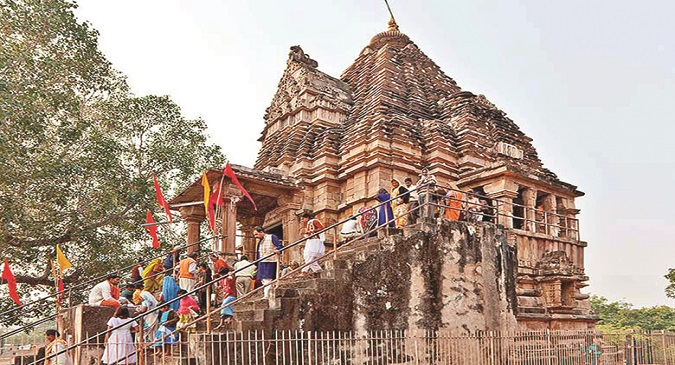
Matangesvara Temple
But the popular Indian psyche has not yet been freed from the colonial narrative. It is quite evident in the case of Khajuraho. The travellers will be appalled to see posters and hoardings inviting them for ‘erotic temple tours’ in and around the temple city. Now, Khajuraho attracts millions of tourists every year; all of them are lured by its ‘erotic value’. When we ascribe the monopoly of ‘beauty’ to medieval structures in and around Delhi, beautiful temple structures like Khajuraho are consciously pushed aside by painting them ‘erotic’ . As a result, families abstain from visiting Khajuraho citing it as a taboo subject.

Varaha Temple (Western Group)
The lack of awareness among local people about their rich cultural heritage scattered across the village, causes further havoc to the ancient monuments and sculptures. A few minutes spent on the banks of artificial water tanks near the temple circuit brought home to me the criminal negligence of our national treasure. Carved sandstones and beautiful statues once adorned the elegant temple structures, lie naked on the banks of the pond. Moreover, senseless local administrators have used some of the beautiful artefacts to rebuild the steps of the pond!
Poor maintenance of heritage sites is not new to Indians, but disrespecting our cultural remnants in such a pathetic way is rather atrocious and impudent.
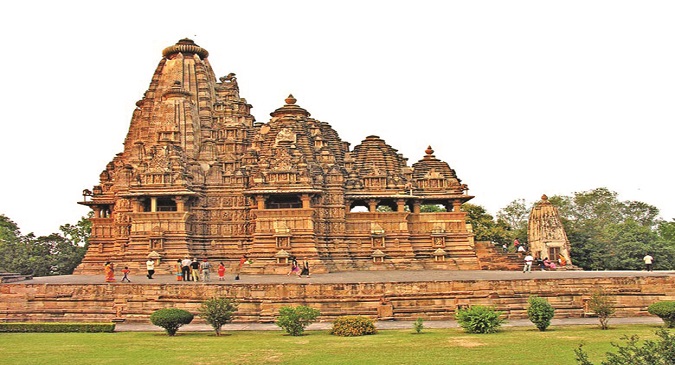
Vishwanath Temple
A visit to Khajuraho is quite revealing. It is a manifestation our great spiritual and architectural grandeur and, at a time, institutionalisation of Indian apathy. The descendants of a great legacy that claimed the superior imagination, transcendental aesthetic sense, all-encompassing philosophical orientation, seem to have lost the very Hindu mind of appreciation of art. When can we build a bridge to the highest aesthetic sense and imagination of our ancestors who carved poetry out of sandstones? N
•Vamana Temple (Eastern Group): The sanctum walls of the 11th-century temple show gods and goddesses. The outer wall featured celestial nymphs in charming poses
•Brahma Temple (Eastern Group): The Brahma Temple, one of the earliest temples (AD 900), is made of sandstones and marbles. It is one of the rarest Brahma temples in the entire country.
•Duladeo Temple (Southern Group): The temple, dedicated to Bhagwan Shiva, was probably the last temple built in Khajuraho. The Temple looks more massive than other shrines.
•Chaturbhui Temple (Southern Group): The small 12th-century temple enshrines a four-handed image of Vishnu that may be the single most striking sculpture in Khajuraho.
•Matangesvara Temple (Western Group): This only temple still in use. The temple dates back to the early 10th century. The main attraction of the temple is the giant Shiv Ling, nearly 81/2 ft tall, in the sanctum.
•Vishvanath Temple (Western Group): An inscription in the temple states that the temple was built by Chandela King Dhanga in 1002.
Of the total 85 majestic temples beautifully carved in sandstones, unfortunately, only 22 have survived the ravages of time, barbaric invasions and fatal apathy







![A Representative image [ANI Photo]](https://organiser.org/wp-content/uploads/2025/12/representative-image-e1765612818961-120x70.webp)
Comments