





Bharatiya Gyan tradition was carried on in the oral culture and not a scriptal mode of knowledge; the scholars had libraries in their mind
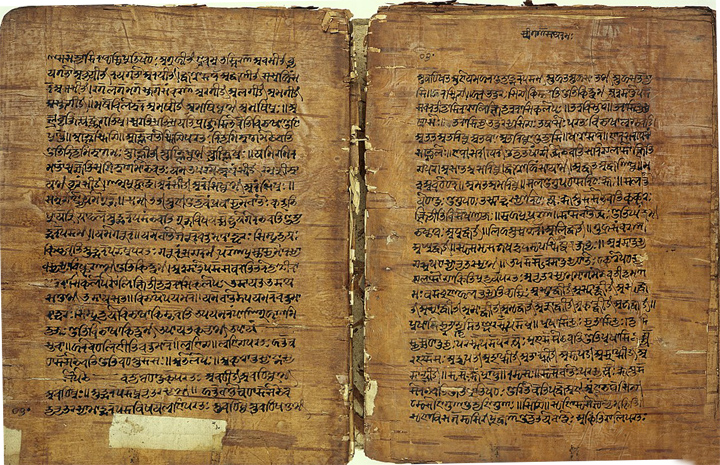
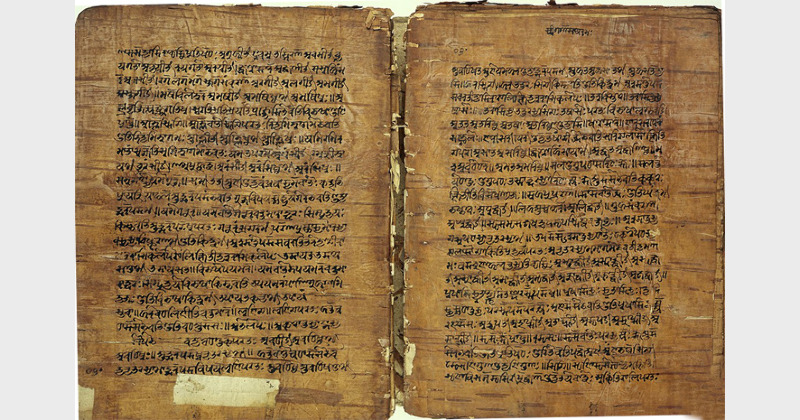
A 17th-century birch bark manuscript of P??ini”s grammar treatise from Kashmir
Three terms are closely connected in all discussions of knowledge —darsana, Gyan and Vidya. Darsana, philosophy is the “system,” the point of view, which yields/leads to Gyan, knowledge. When knowledge gathered about a particular domain is organised and systematised for purposes of, say, reflection and pedagogy, it is called vidya, “discipline.” The entire body of organised knowledge is divided into two sets in the Mundakopanisad —pars vidya and apara vidya (Mundakopanisad, 1.1.4), knowledge of the ultimate principle, Paramatma or Brahman, (that is the metaphysical domain) and knowledge that is secondary to the means by which one grasps aksara- Brahman, (knowledge of the worldly domain). The distinction is accordingly made between Gyan and Vigyan, the knowledge of facts of the perceptible world.
Bharatiya mind has depended more on hypothetico-deductive methodology than on observational inductive methodology
The first kind of knowledge is observational and is gained by the eyes, etc.; the other is experiential and is gained by the inner self as drasta. In one, the whole cognising self is bahirmukhi directed towards and involved in the outer world; in the other, the whole cognising self is antarmukhi, (turned inwards). To acquire the first kind of knowledge, only the sensory apparatus, including the mind, has to be prepared, but to acquire the second kind of knowledge the knower has to go through a process of preparation, sadhana, (for knowledge-acquisition). The Jaina thought also makes a distinction between pratyaksa Gyan which is knowledge present to the self (Atma sapeksha) and paroksa Gyan which is present to the senses and the mind (indriya-mana sapeksha)
Modes of Gyan
In the Bharatiya tradition, knowledge has been constituted, stored and maintained in the framework of the oral culture. According to Bhartrihari, knowledge is constituted in our inner self. There is the antargyanta, constituted by the input of the senses (indriya), processed by the mind {mana) and the intellect (buddhi), and finally constituted knowledge exists as our transformed, alert self, Citta (VakyapadTya, 1.112-14).
Therefore, while both perception and inference are given primacy as epistemologies, Tarka (argumentation) is also accorded an important place; the Indian mind has not relied completely on mind and senses and has accorded the central role in knowledge formation to meditation and deep reflection, cintana and manana. Also, shabda -pramana (verbal testimony) has always enjoyed authority with major systems of thought. Seeing with “mind”s eye” is the typical epistemology of Indian thought. The Jaina thinkers, interestingly, define perception as Atma-pratyaksa — what is present to the inner self and not as what is present to the senses. To put it in contemporary vocabulary, Bharatiya mind has depended more on hypothetico-deductive methodology than on observational inductive methodology.
Just as knowledge is by and large constituted in mind, it is also stored in mind, not outside the mind. This is another requirement of the oral culture. This requirement, we noted earlier, has determined the structure and style of the texts. As oral texts, they are constituted to facilitate memorisation as they have to be held in mind and transmitted orally in the guru-s”isya mode. So even the dictionaries, Amarakosa for example, are metricalised. Other features of speech are also employed both to help memorisation and to communicate meaning — thus, for example, Panini employs pitch variation to mark the change of topic in his grammar Asthdhyayi.
They are highly structured, are necessarily brief and are composed in abbreviated, sutraic, mnemonic style — a highly nominalised style with the language replete with technical vocabulary. This metalanguage, with its other complex devices of abbreviated expressions, such as anuvrtti, reading parts of earlier statements into subsequent statements, adds to the density of the texts.
Structure of Oral Texts
The oral texts, we said, are highly structured. The Bharatiya mind is acutely taxonomic, and the layered structure of the texts reflects the structured analysis of the domain of knowledge. Overt organisers such as adhikarana and prakarana signify the inter-relationships and the order of treatment of subjects. Such embedding may extend up to four layers. This enables the identification of statements through a four-point reference to their location in the over-all text down to the particular sfitra and ksrika as is the case with the Rigveda, Mahabharat and Arthashastra, for example. One notices then that though the texts are oral, they have a high degree of complexity and stability. The complexity of the organisation and the density of statement are the causes of the need to abbreviate them so that they can be held in mind along with other texts of all the contending schools in that domain of knowledge.
A different philosophy of knowledge and cognitive processes informs this mode of orality. Knowledge in this mode is simultaneous, not sequential/ linear — as is the case in the scriptal traditions. It is important to note that oral culture is an alternative culture of knowledge and not a default culture, one that is there because writing systems are unknown as is often alleged.
Nobody could say this of Bharat where there is evidence of the existence of a script in the ancient Mohenjo-Daro civilisation and where Anoka”s inscriptions (fourth century BC) come in three scripts — Brahmi, Kharosthi and proto-Dravid. In the oral culture of knowledge, the scholar has a library in his mind, and the speed of information processing is very high, much higher than in the scriptal mode where the information is first transferred to the mind through senses. In this case the mind-memory is loaded with large bodies of data — remember that the mind has a much larger capacity to store data than the hard disk of a modern computer — and there is direct visualisation of data with the eyes shut. This explains the puzzling requirement in the scholastic tradition for a scholar to be the master of fourteen disciplines, puzzling —because how can one master so many disciplines?
(The writer is a scholar of linguistics and literature and an authority on Bharatiya intellectual traditions)
*Extracts from Indian Knowledge Systems, (Ed.) Kapil Kapoor & Avadhesh Kumar Singh, IIAS, Shimla, pp. 11-15







Comments