Tirtha and ?Crossing Over?
September 6, 2026
  • Read Ecopy
  • Circulation
  • Advertise
  • Careers
  • About Us
  • Contact Us
Android AppiPhone AppArattai
Organiser
  • ‌
  • Bharat
    • Assam
    • Bihar
    • Chhattisgarh
    • Jharkhand
    • Maharashtra
    • View All States
  • World
    • Asia
    • Europe
    • North America
    • South America
    • Africa
    • Australia
  • Editorial
  • International
  • Opinion
  • RSS @ 100
  • More
    • World Hindu Congress 2026
    • Op Sindoor
    • Analysis
    • Sports
    • Defence
    • Politics
    • Business
    • Economy
    • Culture
    • Special Report
    • Sci & Tech
    • Entertainment
    • G20
    • Azadi Ka Amrit Mahotsav
    • Vocal4Local
    • Web Stories
    • Education
    • Employment
    • Books
    • Interviews
    • Travel
    • Law
    • Health
    • Obituary
  • Subscribe
    • Subscribe Print Edition
    • Subscribe Ecopy
    • Read Ecopy
  • ‌
  • Bharat
    • Assam
    • Bihar
    • Chhattisgarh
    • Jharkhand
    • Maharashtra
    • View All States
  • World
    • Asia
    • Europe
    • North America
    • South America
    • Africa
    • Australia
  • Editorial
  • International
  • Opinion
  • RSS @ 100
  • More
    • World Hindu Congress 2026
    • Op Sindoor
    • Analysis
    • Sports
    • Defence
    • Politics
    • Business
    • Economy
    • Culture
    • Special Report
    • Sci & Tech
    • Entertainment
    • G20
    • Azadi Ka Amrit Mahotsav
    • Vocal4Local
    • Web Stories
    • Education
    • Employment
    • Books
    • Interviews
    • Travel
    • Law
    • Health
    • Obituary
  • Subscribe
    • Subscribe Print Edition
    • Subscribe Ecopy
    • Read Ecopy
Organiser
  • Home
  • Bharat
  • World
  • Operation Sindoor
  • Editorial
  • Analysis
  • Opinion
  • Culture
  • Defence
  • International Edition
  • RSS @ 100
  • Magazine
  • Read Ecopy
Home Bharat

Tirtha and ?Crossing Over?

For Hindus, many times, to travel, was to go for Tirtha Yatra. Without bothering about the separation of languages, kingdoms, and societal practices, the yatras continued With the beginning of Shravanaa (July-August) in the Hindu calendar, the whole of Bharat witnesses an exquisite expression of devotion. Clad in bhagwa (saffron) robes and clothes, pilgrims from the length and breadth of the country flok in to worship Mahadeva Shiva on different sites. The pilgrims particularly visit Baidyanath

Archive ManagerArchive Manager
Aug 13, 2018, 04:48 pm IST
inBharat
Follow on Google News
Facebook
Twitter
WhatsAppTelegramEmail
For Hindus, many times, to travel, was to go for Tirtha Yatra. Without bothering about the separation of languages, kingdoms, and societal practices, the yatras continued
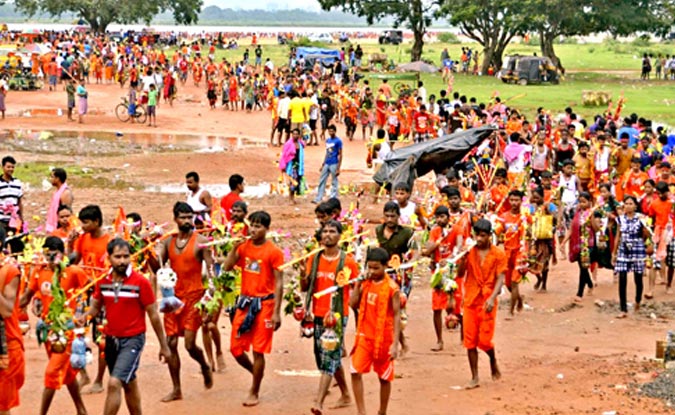
 
With the beginning of Shravanaa (July-August) in the Hindu calendar, the whole of Bharat witnesses an exquisite expression of devotion. Clad in bhagwa (saffron) robes and clothes, pilgrims from the length and breadth of the country flok in to worship Mahadeva Shiva on different sites. The pilgrims particularly visit Baidyanath Jyotirling in Deoghar (Jharkhand) and Kashi Vishwanath in Kashi (Uttar Pradesh).
 
Tamil devotees from far-off Dakshin Bharat can be seen making an appearance in Kashi travelling hundreds of miles. However, this long perennial walk for worshipping not only the deity but the location has been going-on from the days when any mechanical medium of locomotion was still not invented!
 
Why the people of Bharat, i.e. the Hindus, have been taking these pilgrimages or tirthas around the same time in a calendar year? Why most of the tirthasthals have water bodies around them which are considered equally sacred? How the tirthas as locations have been attributed equal significance and sacredness as much as the deity?
 
“Locative” strand of Hindus
One of the oldest strands of the Hindutva tradition is what, Harvard scholar Diana L Eck calls, the “locative” strand of Hindu piety. Its traditions of ritual and veneration are connected primarily to place-to hilltops and rock outcroppings, to the headwaters and confluences of rivers, to the pools and groves of the forests, and to the boundaries of towns and villages.
 
In this locative form of religiousness, the place itself is the primary locus of devotion, and its traditions of ritual and pilgrimage are usually much older than any of the particular myths and deities which attach to it. In the wider Hindutva tradition, these places, particularly those associated with waters, are often called tirthas, and pilgrimage to these tirthas is one of the oldest and still one of the most prominent features of Bharatiya religious life. Tirtha is a spiritual concept in Hinduism, particularly as a “pilgrimage site”, states Axel Michaels, which is a holy junction between “worlds that touch and do not touch each other.”
 
The word Tirtha is found in the oldest layer, which is the Samhita of the Rigveda as well as other Vedas. In the hymns of Rigveda, such as 1.169.6 and 4.29.3, the context suggests that the word means “a way or road”. In other hymns of Rigveda such as 8.47.11, states Kane, the context suggests the term means “a ford in the river”. Yet, in other cases, Tirtha refers to any holy place, such as by the sea, or a place that connects a Yajna to the outside. Later texts use the word Tirtha to refer to any spot, locality or expanse of water where circumstances or presence of great sages or Gurus has made special.
 
According to Diana L Eck, the “crossing over” refers to the “spiritual transition and transformation from this world to the world of Brahman, the Supreme, and the world illumined by the light of knowledge”. The emphasis in the Upanishads, in Tirtha context is on spiritual knowledge, instead of rituals, and this theme appears in the Hindu epics as well.
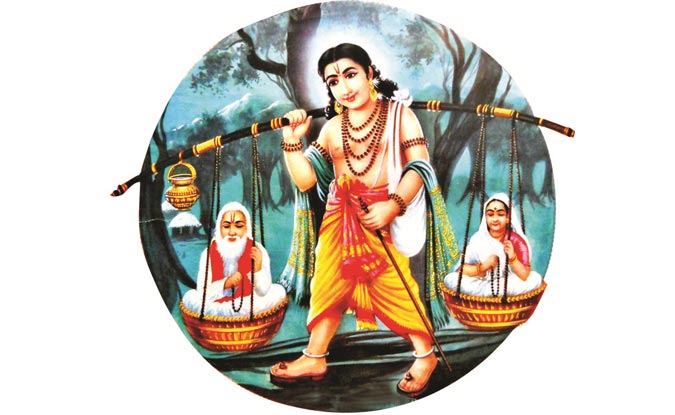
Shravan Kumar taking his divyang parents to Tirtha. For Hindus, doing this has been outlined as a necessary duty
 
Vrata and Prayaschitta
Some pilgrimages are part of a Vrata (vow), which a Hindu may make for a number of reasons. It may mark a special occasion, such as the birth of a baby, or as part of a rite of passage such as a baby”s first haircut, or after healing from a sickness. It may, states Eck, also be the result of prayers answered, or consequent to a vow a person had made if his or her prayer were to come true, such as the well being of a family member, or overcoming poverty or destitution or a challenging situation.
 
Another reason for a Tirtha is the Hindu belief that journeys have rejuvenating potential, to purify the inner state of man, and there is spiritual merit in travel, a theme asserted by the Vedic texts. This reasoning is related to the panacea and atonement. Vishnu Dharmasastra asserts that the type of sin that may be expiated through pilgrimages is referred to as anupatakas (small sin), in contrast to mahapatakas (major sin) that require other penances. An alternate reason for Tirtha, for some Hindus, is to respect wishes or in memory of a beloved person after his or her death. This may include dispersing their cremation ashes in a Tirtha region in a forest, mountain, river or sea to honor the wishes of the dead. The journey to a Tirtha, assert some Hindu texts, helps one overcome the sorrow of the loss.
 
It is still well-observed that the practice of Tirtha continues today. With the development of faster mode of transportation, and quicker access to inaccessible landscape, the frequency of the tirthas may have increased. However, the inherent linkage of many tirth yatras with the calendar cycle has still not changed. While dwelling in the multiple reasoning of doing Tirtha, a Hindu across the landscape of Bharat will agree about its significance, long continuity and the aspect of taking pain in completing it.

Share
Tweet
SendShareSend
✮ Subscribe Organiser YouTube Channel. ✮
✮ Join Organiser's WhatsApp channel for Nationalist views beyond the news. ✮
Previous News

Idea of Bharat: Nationalising Bharatiya Mind

Next News

Jijnasa: The Art of Knowing

Related News

UNGA "Correct the Map" Resolution

UNGA “Correct the Map” Resolution: Real cartographic representation of the world & India’s rising role

Manipur: Security forces defuse 20 kg of IEDs in Jiribam

Manipur: Security forces defuse 20 kg of IEDs in Jiribam; Two wanted mutants neutralised in Churachandpur

We don’t buy narratives, let people speak for themselves: Dr Sudesh Agrawal

Representative Image

The 7.8 per cent GDP growth is real; The outrage is manufactured!

Bilaspur Police detains 23 people from the Sirgitti area.

Chhattisgarh: Crackdown on Bangladeshi infiltrators: 23 detained in Bilaspur, shifted to detention centre

Religious leaders coming together can be counter to political polarisation: Bawa Jain

Load More

Latest News

UNGA "Correct the Map" Resolution

UNGA “Correct the Map” Resolution: Real cartographic representation of the world & India’s rising role

Manipur: Security forces defuse 20 kg of IEDs in Jiribam

Manipur: Security forces defuse 20 kg of IEDs in Jiribam; Two wanted mutants neutralised in Churachandpur

We don’t buy narratives, let people speak for themselves: Dr Sudesh Agrawal

Representative Image

The 7.8 per cent GDP growth is real; The outrage is manufactured!

Bilaspur Police detains 23 people from the Sirgitti area.

Chhattisgarh: Crackdown on Bangladeshi infiltrators: 23 detained in Bilaspur, shifted to detention centre

Religious leaders coming together can be counter to political polarisation: Bawa Jain

Two Bangladeshi prisoners escape police vehicle in Murshidabad

West Bengal: Two Bangladeshi prisoners escape from police vehicle in Murshidabad, one recaptured; Search on for second

Editor of Organiser Prafulla Ketkar and others in a programme in Bhubaneswar

Odisha Literary Festival: Prafulla Ketkar Questions ‘Gen Z’ Label, says Indian youth cannot be defined by algorithms

New Delhi, Sep 06 (ANI): People remove debris during a rescue operation at the site of a building collapse near Satya Niketan in South-West Delhi, in New Delhi on Sunday. (ANI Video Grab)

Building collapse in Delhi: ABVP expresses grief over PG building collapse in Satya Niketan; Rescue operation underway

Arrested accused Manjit Singh Bedi

From US grocery store to FBI wanted list: Who is Manjit Singh Bedi, arrested in Punjab in 600000 dollar fraud case?

Load More
  • Privacy
  • Terms
  • Cookie Policy
  • Refund and Cancellation
  • Delivery and Shipping

© Bharat Prakashan (Delhi) Limited.
Tech-enabled by Ananthapuri Technologies

  • Home
  • Search Organiser
  • Bharat
    • Assam
    • Bihar
    • Chhattisgarh
    • Jharkhand
    • Maharashtra
    • View All States
  • World
    • Asia
    • Africa
    • North America
    • South America
    • Europe
    • Australia
  • Editorial
  • Operation Sindoor
  • Opinion
  • Analysis
  • Defence
  • Culture
  • Sports
  • Business
  • RSS @ 100
  • Entertainment
  • More ..
    • Sci & Tech
    • Vocal4Local
    • Special Report
    • Education
    • Employment
    • Books
    • Interviews
    • Travel
    • Health
    • Politics
    • Law
    • Economy
    • Obituary
  • Subscribe Magazine
  • Read Ecopy
  • Advertise
  • Circulation
  • Careers
  • About Us
  • Contact Us
  • Policies & Terms
    • Privacy Policy
    • Cookie Policy
    • Refund and Cancellation
    • Terms of Use

© Bharat Prakashan (Delhi) Limited.
Tech-enabled by Ananthapuri Technologies