





The tribals and non-tribals have lived in India in close proximity for over centuries leading to much acculturation and even assimilation into the larger Hindu Society
Justice (Retd) YK Sabarwal
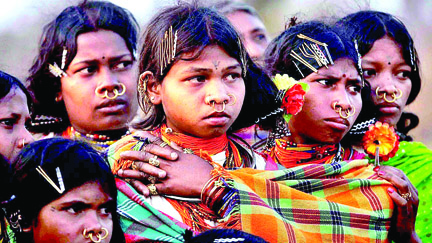
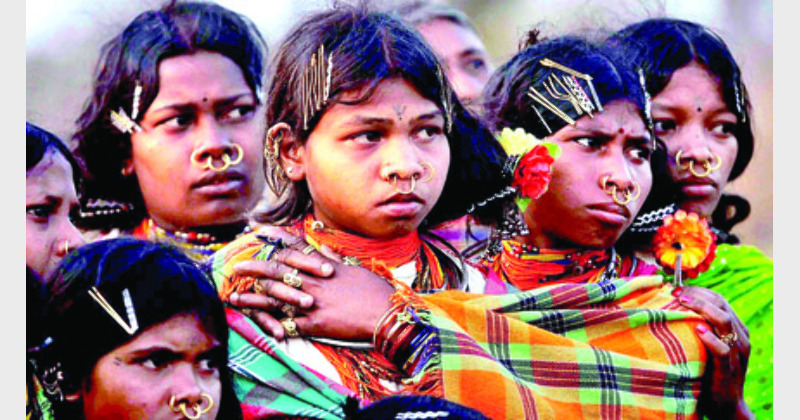
Girls of Indian Dongaria Kondh tribe
The issue of the rights of indigenous peoples raises complex and difficult questions. It is estimated that there are more than 370 million indigenous people spread across 70 countries. They are distinct from the dominant societies in their countries. They have unique traditions, distinct cultures and peculiar approaches towards land, life and religion. They are usually described as descendants of those who inhabited a country at the time when the people of dominant cultures or ethnic groups occupied the country. The dominant groups attained Supremacy through conquest, occupation or settlement.
Who are ‘Indigenous Peoples’?
There is a continuing debate in Bharat about the appropriateness of the use of the phrase ‘indigenous peoples’. Some scholarly work tends to support it while others are skeptical of the use of the term Indigenous peoples in the context of the argument against the use of the term ‘indigenous peoples’ for tribal people in India. I briefly summarise these.
Firstly it is argued that it is not easy to identify indigenous people in India. For there have been continuous movement of populations with different language, race, culture and religion going back centuries and millennia. Tribal communities have been a part of historical process. In the circumstances the question arises as to how far back in history should one go to determine the identity of indigenous peoples? Whatever the nature of determination, it is likely to be extremely arbitrary and controversial
Bharat accepts the existence of different tribes within its larger system again not different from the main culture in terms of the core values
Secondly, tribal and non-tribal peoples have lived in India in close proximity for over centuries leading to, as one author puts it, much acculturation and even assimilation into the larger Hindu Society. Thirdly, in the case of Bharat some tribes are no longer tribes but have become, as the eminent sociologist André Battelle puts it ‘castes or something else. Fourthly, tribal peoples in many cases may have settled in Bharat long after some non-tribal peoples in other parts of Bharat. Finally, attention has been drawn to the serious national sovereignty issues involved revolving around question of “self-determination” and ownership of lands.
It may not be fair to say that the claim of some countries like Bharat about indigenous peoples is not correct. Bharat is indicted unjustifiably through, at time on the ground that it is resisting to accept the existence of the indigenous peoples in the society. When one looks at it from the standpoint of a person other than Bharatiya, it may appear that Bharat’s stand is not correct. But one who is familiar with the Bharatiya scenario may agree with this perception. Bharat has a history of cultural assimilation even while we agree that some communities maintain their distinct identity within the nation. The country always presented unity in diversity and deserves cultural identity is no insignia of the existence of indigenous group.
Indeed, Bharat accepts the existence of different tribes within its larger system again not different from the main culture in terms of the core values. True to its tradition of cultural assimilation and spirit of accommodation the Indian Constitution presents the picture of the larger system of permitting the smaller political systems of tribal population to be part of the system to remain distinct culturally but to be part of the larger system politically with sufficient autonomy whenever necessary and possible. Tribal people of other areas are taken as part of the main society in as much as special constitutional provisions have not been made for them. They are to be assimilated rather than to be made separate entity. Indeed, under the scheme their cultural identity is assured to be maintained.
UNHRC Is now to be replaced by the Human Rights Council. The working group was, as it was in 1995 and its term extended by the commission into the second International Decade of the World’s Indigenous Peoples (2005-2015). The key obstacles in achieving progress have inter alia include clauses relating to “self determination” treaty rights, and lands, territories and resources (see UN 2005, UN 2006). The feeling of many States with regard to these issues is strong as it involves their territorial integrity and political unity. On the other hand, there is an urgent need to correct the historical injustices heaped on the “indigenous peoples” where they exist.
Bharat and Tribal Welfare
Bharat has been successfully experimenting with federalism during the last half a century. And it should be said to the credit of the system that India has succeeded in affording protection of human rights of its citizens including the members of the tribal communities. Apart from administrative authorities including government wings of Department of Tribal Welfare both at Central and State levels and interstate council, India has several independent bodies such as National Human Rights Commission, State Human Rights Commission, Minorities Commissions, Scheduled Caste and Scheduled Tribes Commission, National Commission for Women etc. to safeguard the human rights of peoples who claim to be treated as indigenous peoples.
Administrative efforts incorporating and employing affirmative action under the watchful eyes of vigilant independent judicial and quasi-judicial bodies may ensure the protection and promotion of rights of people who claim to be treated specially among the others. Bharat has the largest concentration of tribal people anywhere in the world except perhaps in Africa. The prominent tribal areas constitute approximately about 15 per cent of the total geographical area of the country. The main concentration of tribal people is the central tribal belt in the middle part of India and in the north-eastern states. However, they have their presence in all states and union territories.
(The writer is former Chief Justice of Bharat. Excerpts from his speech delivered at the Plenary Session of the 72nd Conference of International Law Association in Toronto from June 4 to 8, 2006 on “Rights of Indigenous Peoples”)



Comments