





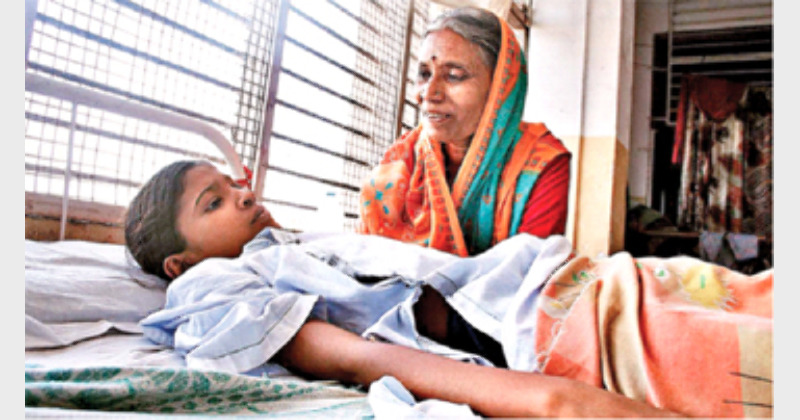
 With Cabinet Nod, Ayushman Bharat Yojana or Modicare will be a giant stride in providing ethical and affordable healthcare
Dr R Kumar
Union Budget 2018 presented by Finance Minister on February 1, saw the unveiling of world’s biggest healthcare project ‘Ayushman Bharat Yojana’. The National Health Protection Scheme (NHPS), which has been dubbed ‘Modicare’ by Arun Jaitley, has the objective of extending healthcare insurance to 100 million families, and raises the insurance ceiling to Rs 5 lakh per family. Under the NHPS, four in ten Indians will be able to avail of secondary and tertiary care in government and private hospitals. Secondary healthcare services include those provided by skilled medical practitioners, for outpatient treatment, or a brief stay at a hospital for serious illness. Tertiary care is for patients who are admitted to hospitals for longer bouts of illness, and require the attention of specialist doctors. NHPS will require an expenditure outlay of over Rs 1 lakh crore ($1,000 billion). “India cannot realise its demographic dividend without its citizens being healthy,” said Jaitley in his budget speech. In addition government plans to set up 1.5 lakh Wellness Centres under this programme. These centres will provide treatment for non-communicable diseases, and disburse primary care to young mothers and children. Free supply of essential medication and diagnostics is also on the anvil. As of now India’s expenditure on health is dismally low around 1 per cent of GDP. Distribution of doctors and hospitals is also uneven e g Chandigarh has the most doctors per capita with 279.9 doctors per lakh of the population. Meghalaya has only 27.5 doctors per lakh of the population. This needs to be corrected.
As a scheme, the NHPS, appears to be an excellent cashless health insurance plan. As a portable family floater policy, it is without any restrictions, and covers almost all secondary care and most of tertiary care procedures. It promises to cover pre-existing diseases right from day one and is a dream come true, especially for the elderly shunned by insurance companies. Besides, it will fully cover both pre and post-hospitalisation expenses. More importantly, the scheme, allows the poor to access world-class healthcare facilities of corporate hospitals, hitherto a privilege of the rich, or the insured. Can it assume a practical shape? Experience tells us that as in the case of many other centrally-sponsored schemes, states will be entrusted to implement the ambitious plan adding its share of matching grants, within a defined time frame. The scheme envisages the Centre bearing 60 per cent of the commitment while the States will have to underwrite the rest. Considering that the financial health of most state governments is precarious, it will add onerous burden on the states to raise funds to meet its share of 40 per cent. Many state governments have already made their intentions known i.e. their inability to implement the scheme.
Health Minister JP Nadda said the scheme would be launched pan-India in one go. The Prime Minister is expected, to announce the launch in his August 15, 2018 speech and implement it soon after. Health Secretary Preeti Sudan said, other than organ transplant; all other treatments will be provided for those eligible. Transfer of funds will be through an escrow account directly, so that funds are transferred in an efficient and timely fashion, was an official statement. We want a strong deterrence mechanism when it comes to fraud. Today, the Insurance Regulatory and Development Authority of India (IRDAI) can haul up insurers and third-party service providers, if there is any wrong-doing on their part, but if a hospital does something in most cases, nothing comes of it. More Government Medical Colleges and Hospitals are planned to be instituted towards the goal of having at least one medical college for every three parliamentary constituencies. However, India does not need more doctors, it needs better doctors. Medical teaching faculty is deficient even in the best of medical colleges at present. When new AIIMS are opened, it becomes hard to get faculty in various specialties. Personnel of low teaching experience/caliber are recruited as professors. Will it not affect the quality of products coming out of such institutions? Raising buildings at huge cost, spending scarce national resources to equip the same, but manning them with sub-normal trained faculty cannot lead to better teaching, research or patient care. GOI needs to improve the existing but decaying institutions like Government Medical College Patiala, once a premier institution of north India, which is now suffering for want of funds. Will the government take the right call?
The success of ‘Modicare’ also depends on a robust infrastructure and efficient institutional mechanism. At present, both are missing from the Indian public healthcare system. It would be a challenge for the government to coax expensive private hospitals to get empanelled under this scheme, abandoning their USP that is exclusivity. Although the poor are expected to be identified from the Socio Economic and Caste Census (SECC) database, doubts have been raised about its accuracy. Besides, the number of poor families is far in excess of 10.74 crore. What would happen to the healthcare of those left out of the scheme?
Similarly, to run the wellness centres, which will be the backbone of preventive and promotive health services for the entire populace, relevant manpower is not available. However, this does not require doctors to treat patients. This requires the services of wellness consultants, who are not doctors to treat patients, who will be responsible for keeping the population healthy. They can be trained in first aid but not in medical treatment. This will offer a new model of healthcare, under which 70-80% of those who now are touted as patients need not go to doctors, thus reducing the load of hospitals. This will improve the quality of services given in the hospitals and save scarce national resources allocated to the healthcare sector. Wellness consultants could be recruited to their job with a B Sc in wellness, which can be introduced in some universities that train in allied health manpower courses. This will not belong to any pathy—it will be universal to all pathies. They will advice and ensure adequate and appropriate use of water, air, sunshine, food, exercise, sleep, mobility etc. They will act as guides in health and friends in disease. This will also create millions of jobs all over the country. Since most people will not fall sick with healthy lifestyle measures, national productivity will increase. India can easily afford this model of healthcare. This will be a giant stride in providing ethical and affordable healthcare.
A word of caution is essential here. For want of inadequate attention to the details it could well turn out to be another well- intentioned failed plan. It is a noble plan that can flounder because of a faulty implementation and poor funding mechanism. Will it be vote-catcher enough so as to generate political will to bring it in practice?
(The writer is President, ‘Society for Promotion of Ethical and Affordable health Care’)






Comments