
Analysis : SC Hammers It Privacy
December 9, 2025
  • Read Ecopy
  • Circulation
  • Advertise
  • Careers
  • About Us
  • Contact Us
Android AppiPhone AppArattai
Organiser
  • ‌
  • Bharat
    • Assam
    • Bihar
    • Chhattisgarh
    • Jharkhand
    • Maharashtra
    • View All States
  • World
    • Asia
    • Europe
    • North America
    • South America
    • Africa
    • Australia
  • Editorial
  • International
  • Opinion
  • RSS @ 100
  • More
    • Op Sindoor
    • Analysis
    • Sports
    • Defence
    • Politics
    • Business
    • Economy
    • Culture
    • Special Report
    • Sci & Tech
    • Entertainment
    • G20
    • Azadi Ka Amrit Mahotsav
    • Vocal4Local
    • Web Stories
    • Education
    • Employment
    • Books
    • Interviews
    • Travel
    • Law
    • Health
    • Obituary
  • Subscribe
    • Subscribe Print Edition
    • Subscribe Ecopy
    • Read Ecopy
  • ‌
  • Bharat
    • Assam
    • Bihar
    • Chhattisgarh
    • Jharkhand
    • Maharashtra
    • View All States
  • World
    • Asia
    • Europe
    • North America
    • South America
    • Africa
    • Australia
  • Editorial
  • International
  • Opinion
  • RSS @ 100
  • More
    • Op Sindoor
    • Analysis
    • Sports
    • Defence
    • Politics
    • Business
    • Economy
    • Culture
    • Special Report
    • Sci & Tech
    • Entertainment
    • G20
    • Azadi Ka Amrit Mahotsav
    • Vocal4Local
    • Web Stories
    • Education
    • Employment
    • Books
    • Interviews
    • Travel
    • Law
    • Health
    • Obituary
  • Subscribe
    • Subscribe Print Edition
    • Subscribe Ecopy
    • Read Ecopy
Organiser
  • Home
  • Bharat
  • World
  • Operation Sindoor
  • Editorial
  • Analysis
  • Opinion
  • Culture
  • Defence
  • International Edition
  • RSS @ 100
  • Magazine
  • Read Ecopy
Home Bharat

Analysis : SC Hammers It Privacy

The nation is on the move and in the right direction too, going by the recent judgments of the Hon?ble Supreme Court of India. The Apex Court has scored a hat trick with three successive decisions making a national impact. These decisions have stirred nationwide debates on the extent to which they impact the lives of citizens.

Archive ManagerArchive Manager
Sep 11, 2017, 04:15 pm IST
in Bharat
Follow on Google News
FacebookTwitterWhatsAppTelegramEmail


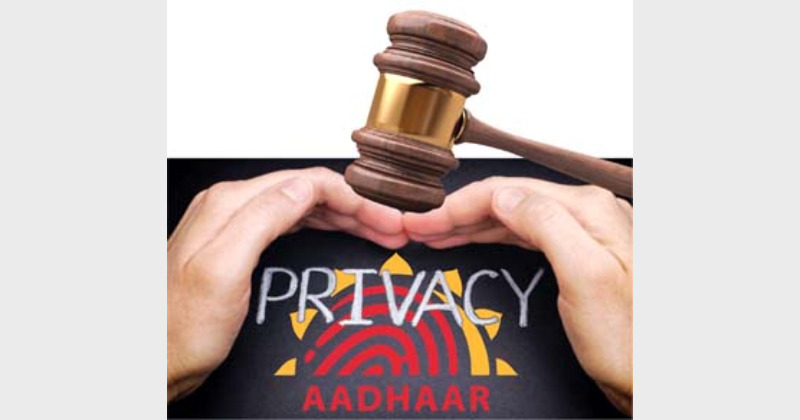
The SC has yet again put the nation on a progressive path. It will be interesting to see how the Right to Privacy unfolds

Choodie Shivaram

The nation is on the move and in the right direction too, going by the recent judgments of the Hon’ble Supreme Court of India.  The Apex Court has scored a hat trick with three successive decisions making a national impact. These decisions have stirred nationwide debates on the extent to which they impact the lives of citizens.
On  August 22, the Supreme Court granted bail to Lt.Col. Purohit, after nine years of internment in a Maharashtra jail, raising animated discussions on the role of governments and politicians in implicating and wrongfully confining an officer who was performing his duty. The next day it pronounced a
historic judgment striking down ‘triple talaq’, paving the way for Muslim women’s security and empowerment.
On  August 24,  the nine judge Constitution bench of the Supreme Court was unanimous in declaring that the Right to Privacy is a fundamental right under the Constitution, thus rewriting the deep-seated narrative on citizen’s rights.  The fact that the Constitution bench was unanimous in its decision, a rare occurrence, reveals the judiciary’s concern over civil rights and the compelling need for reforms.
Former Karnataka HC judge, KS Puttaswamy, now 91, had filed the PIL in 2012 challenging the Aadhaar scheme, saying it violates fundamental rights to privacy and equality. The Apex court linked all the 20 plus Aadhaar related cases to this case. The petitioners included activists Bezwada Wilson, Aruna Roy and Nikhil Dey.  It is interesting that a former High Court judge petitioned the Apex court.
Right to privacy is an inherent fundamental right embedded in part-III of the Constitution of India and it is located in the golden trinity of Articles 14, 19, and 21 (Equality, right to liberty and protection of life).   Privacy is the bulwark of other rights. This right is protected as an intrinsic part of the freedom guaranteed by the Constitution.
The UN Declaration of Human Rights recognises the right to privacy as a fundamental right saying  “no one shall be subjected to arbitrary interference with his privacy, family, home or correspondence, nor to attacks upon his honour and reputation. Everyone has the right to the protection of the law against such interference or attacks”.
The Indian Parliament enacted the Protection of Human Rights Act, 1993 which recognises the importance of human rights to bring accountability and transparency.  In reality, India is yet to get there, Lt. Col Purohit being a strong case in question.
Privacy is an inherent right, not given or granted.  Jurists world over consider William Pitt the Elder’s (British statesman who led the government of Great Britain twice in the 18th century) path breaking opinion on privacy in 1763 as a way ahead of its time and rely on it even to this day as a benchmark.  Quoting Pitt in his judgment Justice R.F. Nariman, J. writes, “the poorest man may in his cottage bid defiance to all the forces of the Crown. It may be frail, its roof may shake, the wind may blow through it, the storm may enter, but the King of England cannot enter; all his force dare not cross the threshold of the ruined tenement!”
The Apex court has drawn reference from several cases that dealt with the Right to Privacy including the case of M.P. Sharma v. Satish Chandra (1954) and Kharak Singh v. State of U.P.  The former is the earliest case in India to deal with “privacy” in the context of Articles 19 and 20 of the Constitution. M.P Sharma’s company was accused of attempt to embezzle its funds, fraudulent transactions, and falsified records. Search warrants were issued and records were seized. Sharma challenged that the searches violated fundamental rights. An eight-judge bench ruled that there was no right to privacy under a specific Article.
In Kharak Singh’s case (1962) a six-judge bench ruled that the right to privacy is not a guaranteed right under our Constitution.
The extent of the impact of the Apex Court’s judgment is yet to unfurl.    It is an established principle that no right can be a carte blanche or absolute in nature; as Justice Chelameswar writes in his judgment “…, even a fundamental right to privacy has limitations. The limitations are to be identified on a case to case basis”. What will be of impact and concern are issues of National Security and processes adopted by investigating agencies.  Justice Sanjay Kishan Kaul writes in the judgment, “the security environment, not only in our country but throughout the world makes the safety of persons and the State a matter to be balanced against this right to privacy”.
American law is eloquent on the Right to privacy.  In Asia the
concept of privacy has been community-based, in contrast to the West. With globalisation this is fast changing. Within a week, the Supreme Court’s landmark judgment echoed in the Delhi High Court on August 30. When the bench of the Acting Chief Justice Gita Mittal and Justice C.Hari Shankar heard arguments on petitions seeking criminalisation of marital rape, Senior counsel, Colin Gonsalves cited how the Apex Court’s judgment covers marital rape and referred to portions of the judgment dealing with physical integrity, sexual autonomy, and reproductive choice. In the 547-page judgment, the Constitution bench of the apex court debated exhaustively over the issue of Privacy traversing through numerous cases in India and other countries.
The judgment draws references ranging from the Bhagavad Gita, the American Constitution, and European Case Laws to opinions and decisions of eminent jurists world over.  The Apex court has yet again put the nation on a progressive path.  The responsibility of preventing misuse of this fundamental right and upholding the trust of the Constitution bench lies with the state machinery, the citizenry, and institutions vested with powers to enable peaceful existence. The coming months and years will prove to be interesting on how this right to privacy will take shape and be interpreted in courts of law.
(The writer is a journalist and a researcher)

ShareTweetSendShareSend
✮ Subscribe Organiser YouTube Channel. ✮
✮ Join Organiser's WhatsApp channel for Nationalist views beyond the news. ✮
Previous News

Demonetisation/Opinion : Delivering Silent Gains

Next News

Golden Jublee of Nana Palkar Smruti Samiti : True Tribute to a Karmayogi

Related News

Pakistan to divide its provines?

Pakistan decides to disintegrate the country; For administrative gain or to consolidate the iron fist?

This young girl arrived in Jodhpur four years ago, fleeing Sindh, Pakistan, where her family had faced repeated attacks due to their Hindu identity

International Human Rights Day: The neglected chapter

Russian President Vladimir Putin and Prime Minister Narendra Modi

India-Russia Summit 2025: A time-tested partnership in a turbulent world

Martyrs’ Memorial Project

Assam Swahid Divas 2025: Congress can never wash away stigma of betraying indigenous people and killing 860 youth: BJP

A representative image

Updated consumption survey data helps revise global poverty estimates of Bharat: Government

RSS Sarkaryavah Dattatreya Hosabale addresses a seminar in Jammu

Swayamsevaks have been contributing selflessly in various spheres of social life: Dattatreya Hosabale

Load More

Comments

The comments posted here/below/in the given space are not on behalf of Organiser. The person posting the comment will be in sole ownership of its responsibility. According to the central government's IT rules, obscene or offensive statement made against a person, religion, community or nation is a punishable offense, and legal action would be taken against people who indulge in such activities.

Latest News

Pakistan to divide its provines?

Pakistan decides to disintegrate the country; For administrative gain or to consolidate the iron fist?

This young girl arrived in Jodhpur four years ago, fleeing Sindh, Pakistan, where her family had faced repeated attacks due to their Hindu identity

International Human Rights Day: The neglected chapter

Russian President Vladimir Putin and Prime Minister Narendra Modi

India-Russia Summit 2025: A time-tested partnership in a turbulent world

Martyrs’ Memorial Project

Assam Swahid Divas 2025: Congress can never wash away stigma of betraying indigenous people and killing 860 youth: BJP

A representative image

Updated consumption survey data helps revise global poverty estimates of Bharat: Government

RSS Sarkaryavah Dattatreya Hosabale addresses a seminar in Jammu

Swayamsevaks have been contributing selflessly in various spheres of social life: Dattatreya Hosabale

2nd WHO Global summit on traditional medicine

Bharat begins countdown to 2nd WHO Global summit on traditional medicine; 100+ nations to join Meet

A representative image

Govt accelerates National Gas Grid Expansion to boost clean energy access, affordability and industrial growth

Know when RSS founder Dr Hedgewar defied British by chanting Vande Mataram in school

Vande Mataram at 150: Know when RSS founder Dr Hedgewar defied British by chanting Vande Mataram in school

History details RSS role in freedom struggle & Vande Mataram celebrations: Kharge’s claim falls flat

Load More
  • Privacy
  • Terms
  • Cookie Policy
  • Refund and Cancellation
  • Delivery and Shipping

© Bharat Prakashan (Delhi) Limited.
Tech-enabled by Ananthapuri Technologies

  • Home
  • Search Organiser
  • Bharat
    • Assam
    • Bihar
    • Chhattisgarh
    • Jharkhand
    • Maharashtra
    • View All States
  • World
    • Asia
    • Africa
    • North America
    • South America
    • Europe
    • Australia
  • Editorial
  • Operation Sindoor
  • Opinion
  • Analysis
  • Defence
  • Culture
  • Sports
  • Business
  • RSS @ 100
  • Entertainment
  • More ..
    • Sci & Tech
    • Vocal4Local
    • Special Report
    • Education
    • Employment
    • Books
    • Interviews
    • Travel
    • Health
    • Politics
    • Law
    • Economy
    • Obituary
  • Subscribe Magazine
  • Read Ecopy
  • Advertise
  • Circulation
  • Careers
  • About Us
  • Contact Us
  • Policies & Terms
    • Privacy Policy
    • Cookie Policy
    • Refund and Cancellation
    • Terms of Use

© Bharat Prakashan (Delhi) Limited.
Tech-enabled by Ananthapuri Technologies