






Invoking Cultural Consciousness
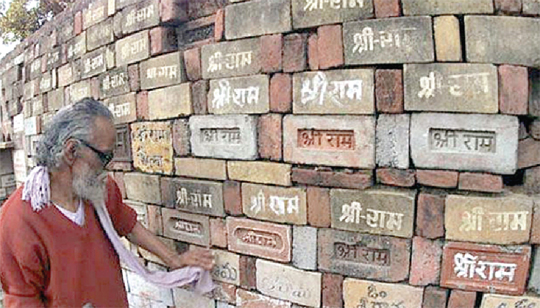 Shri Ram Janmabhoomi Movement is an example that the energy generated in the Sangh powerhouse is used for betterment of the society and finding solution to the social problems
 The struggle to reclaim Shri Ram Janmabhoomi in Ayodhya has beengoing on ceaselessly since 1528 AD. Out of 75 battles, fought for this purpose, described and recorded in the books of history, the battle of 1934 AD is well known and documented. The seizing of the place by the youth in 1949 feels like yesterday and many of those youths are alive even today. The world believes that the Vishwa Hindu Parishad (VHP) fought for the liberation of Shri Ram Janmabhoomi, and that the battle was led by Shri Ashok Singhal Ji, but, as Ashok Ji had said, that ‘the VHP is nothing without the Rashtriya Swayamsevak Sangh (RSS). The strength of the RSS is the backbone of Vishwa Hindu Parishad (VHP). Devoid of the RSS, we all are like body left inert after the soul has departed from it’. The Sangh is dedicated to the welfare of the Hindu society, to the development of the individual and the nation. In other words, the Sangh is like a powerhouse, which generates energy, which is used for the benefit, and finding solutions to the problems of the society. The contribution of swayamsevaks in awakening the masses through Shri Ram Janmabhoomi Movement is a living example of true leadership.
Making of the idea
A Hindu Sammelan was organised by the RSS swayamsevaks in Muzaffarnagar on March 23, 1983. Mananiya Rajju Bhaiya was also present on the dais, besides a couple of saints and, as I can recall, the late Jagdish Muni also. The Hindus of Muzaffarnagar had also gathered there in a large number. Guljari Lal Nanda and Daudayal Khanna were also there on the dais, but none of the workers of the VHP was there, even Ashok Singhal Ji was also not there. There Daudayal Ji had suggested the idea of reclaiming the temples of Ayodhya, Mathura and Kashi. The people who had gathered there were
swayamsevaks and the members of the Hindu Society mobilised by the Sangh. The idea created a wave of enthusiasm. Ashok Ji then went to meet Daudayal Ji, and understood his thought on it. It was the first contribution of swayamsevaks in pushing that campaign.
Opening the Locks
I have read that in 1983, a winter camp was organised in Allahabad, where the then Sarsanghachalak Balasaheb Deoras was also present. After the completion of the camp, a few Pracharaks were sitting together and talking. Balasahebji asked, “I have come to know that locks have been put at the Ram Janmabhoomi in Ayodhya,” The Pracharak of that area stood and affirmed, “Yes, what you are saying is true”. Balasaheb asked, “How long the doors will remain locked?” This was the sowing of the seeds of the movement launched for the liberation of Shri Ram Janmabhoomi by the VHP. It was decided that ‘the birthplace of Shri Ram has been put under locks’ is the message to be spread everywhere, including each and every villages across the country. The people should be informed and hence a Rath Yatra was planned. But who would drive the Rath? Who would arrange for it and who would mobilise people for this? All these tasks were executed by the swayamsevaks. First, one Rath started to move and then the number of Raths reached to six. Mass awareness was spread in Uttar Pradesh, which resulted into opening of the locks later.
I also remember that senior Pracharaks from various Prants were discussing Shri Ram Janmabhoomi issue at a city of Rajasthan. Balasaheb Deoras there said, “Think well. Once this mission is undertaken, there will be no going back from it. We must succeed in the direction of boosting the pride of the Hindu society. ” Ashok Ji was also part of that meeting. If there were over 100 workers sitting there, he was just one of them.
Shri Ram Shila Pujan
Gradually, the movement started gaining momentum. It was decided that a temple should be constructed there and temple architects were also consulted, many formats of the temple were designed. But before the construction of the temple could take place, it was required to inform all the Hindus that this temple will be constructed with the help of crores of Hindus. ‘Shila Pujan’ began in 1989 and took place in 2,75,000 villages, involving over 6 crore people, who contributed one and a quarter rupee each. It was not possible for the VHP to complete this work alone. The swayamsevaks did it in 15 days only.
The foundation stone for the temple was laid on November 9, 1989. To push the movement further, a Hindu Sammelan was held in Haridwar on June 24, 1990. Over 40,000 people attended the Sammelan, and 50,000 food packets were collected from homes across Haridwar. This work could be completed only due to the strength of the swayamsevaks. It was decided that on October 30, 1990, the Hindu society would move to Ayodhya and will start the construction work – kar sewa— with their hands. Police officers visited Delhi and spoke to Ashok Ji at VHP office, “What kind of announcement you have made. You know when the police will start firing, none of the people will stay there.” Ashok Ji replied, “You know nothing about the swayamsevaks of Sangh, if one will die the other one will follow, if the second one will die, the third one will move ahead with the flag.” I don’t think that police officers would have ever met anybody who said things like this.
Big Movement sans Social Disturbance
Due to the police firing, however, the campaign had to be suspended on November 2, 1990. After 1990, an idea emerged to display the strength of the Hindu society in Delhi. The date chosen was April 4, 1991 and the venue was Boat Club, New Delhi. Around 25 lakh people visited Delhi, congregated there and left after their deliberations without creating any commotion. It was decided that the march will once again start on December 6, 1992. Over 3 lakh people from all over the country reached Ayodhya. But none of the shopkeepers could ever complain that any one of them came to his shop and had tea without paying money. In Ayodhya, even today there are over 15 mosques, but the crowd of 3 lakh people did not touch any other place of worship. There are amny Muslims living in Ayodhya, but no untoward incident happened at any one’s house. Muslim shopkeepers too were also not disturbed. Everything was done with a sense of discipline, with no intention of giving pain to anyone and such high ideals are taught only in shakhas of the Sangh.
Massive Signature Campaign
When the disputed structure came down due to the fury of karsevaks, it was decided to start a signature campaign demanding reconstruction of the temple. Once again the task was completed by the Sangh workers. With no intention of getting their pictures clicked, the swayamsevaks left their homes and business to fulfil this mission. Ultimately, over 11 crore signatures were collected and submitted to the then President of India. This is the contribution of the Sangh in Shri Ram Janmabhoomi Movement.
The writer is general secretary of Vishwa Hindu Parishad





Comments