





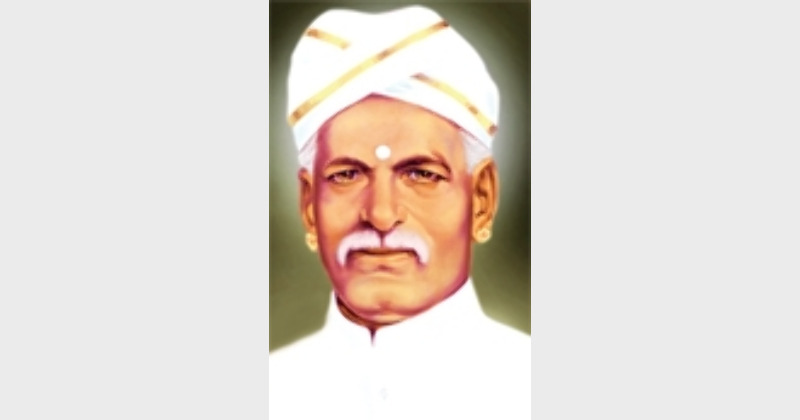
Mahatma Ayyankali is remembered as the indomitable social reformer who paved way
for Dalit empowerment in Kerala
Guru Prakash & Sudarshan Ramabadran
As India celebrates 70 years of Independence, the greatest battle that eludes the nation is the right to dignity for Dalits. From Una to deciphering late Rohit Vemula's caste, the deep undercurrent of not giving the Dalits their rightful place in the public sphere has left deep scars which we as a responsible nation conveniently choose to ignore let alone discuss or debate.
History is witness to several key social
reformers and vital anecdotes which has left an indelible mark in paving way for empowering Dalits. Indian culture is witness to several key social reformers, right from Sage Veda Vyasa, Sage Valmiki, to Sri Ramanujacharya and several others like Sree Narayana Guru who have been instrumental in dedicating their life’s vision and mission to empowering the subaltern community and in ensuring them their denied rights.
It is in this context that we could take key lessons from one of Kerala’s remarkable social reformer, Ayyankali a subaltern hero who is forgotten in the annals of history. Ayyankali was born in Kerala, which in the 19th century, was regarded as a state which witnessed the despicable treatment of the untouchables. So much so, the Dalits in the state were derided as not just untouchables but ‘unseeables’ and ‘unapproachables’. It is in these circumstances that Ayyankali rose to become the Dalit voice in the social milieu of Kerala.
Ayyankali was a rebel but for a cause. He firmly stood rooted in ensuring that Dalits had their share of representation but did not play the role of a disruptor by going against the State. This was perhaps the spirit of all social reformers which this pristine culture was fortunate to have and witness. Be it Sage Valmiki or Ayyankali, they never walked out of the system, they stayed within the system and brought in the essential reforms.
Ayyankali emerged in Kerala when there was no space for Dalits in the public sphere in the state; he brought in revolutionary steps to sow seeds of Dalit-led empowerment. Before one delves into Ayyankali’s vision and mission, it is important to recognise and accept that India of the 19th century suffered from pre-dominant caste discrimination.
In his book My father Baliah, Y B Satyanarayana writes how deep rooted caste divisions were in rural India during those times, this could be discerned through the construction of houses in today’s Telangana where Satyanarayana hailed from. He writes that in a colony the houses of the upper castes appeared in front followed by the houses of the lower castes. The book records that the construction of houses was envisioned in such a way that the wind blew from the houses of upper castes to the lower castes as the opposite was considered inauspicious.
Very similar was the situation in Kerala, where Dalits were not allowed to walk through public roads. Dalits were warned to keep a distance of at least 64 steps away from Nairs, 128 steps away from Namboodiris. It was under these circumstances that Ayyankali chose to do the unthinkable. In his days, persons of Ayankalli's caste that is the Pulayars were not allowed to buy bullock carts or walk through roads reserved for the upper castes, but Ayankalli walked through the public roads in a bullock cart bought of his own. With a single notable act, Ayyankali succeeded in subverting the traditional order by taking on the orthodoxy of Kerala where caste discrimination was predominant.
Thoughts shape actions; Ayyankali’s actions were deeply influenced by Sadanand Swami, a reformist Nair Sannyasi who was against those who put discrimination into practice, so that conversion of Dalits to Christianity could also be kept under check. Ayyankali's thoughts and actions mirrored his contemporary Sree Narayana Guru. In 1907, Ayyankali established the Sadhu Jana Paripala Sangam (SJPS). This institution was formed to unite all the depressed servile people beyond the traditional strongholds of upper castes. This institution also encouraged Dalit women. These women went on to play an integral role in raising funds for the Sangam.
Ayyankali contributed significantly in ensuring justice to Dalits. He was instrumental in establishing community courts, whose local offices functioned in every branch of the SJPS. Some of the appeals of the lower courts were directed to the Supreme Court of Venganur where Ayyankali was the judge.
Ayyankali always advocated Dalits to arm themselves with education. In his words education was a powerful medium to fight discrimination. Ayyankali believed that modern
education was the passport to enter into the public sphere that is dominated by the educated upper caste. Towards this Ayyankali led a number of agitations to ensure that Dalits benefit from
education. He did all this he did to meet his final objective which was to ensure that Dalit children were given the right to education in all the schools in the state. This move of Ayyankali mirrors the essence of the Bhagavad Gita, which states that knowledge
provides a clear vision; Sustain this vision, bring into action and thus achieve perfection.
Today the scenario is such that there is no adequate representation for Dalits in the political realm. In his times, Ayyankali understood that to bring any change political will is necessary, thus he began to work earnestly to see that Dalits were represented in the political realm. P K Govinda Pillai—was
nominated to the Srimoolam Praja Sabha as a representative of the SJPS. In 1911, Ayyankali himself was
nominated to the Srimoolam Praja Sabha. In his speeches at the Sabha, he consistently reiterated the point of including atleast 5 members of the Pulayarcommunity into the Sabha.
Ayyankali was a pragmatic
philosopher and guide, according to him there were 5 pillars of success which he laid down to the subaltern. These pillars were, achieving progress through faith in God, modern dressing, cleanliness, obedience and discipline.
Meena Kandaswamy and M Nisar in their book Ayyankali, A Dalit Leader of Organic Protest which also has a Foreword by Kancha Ilaiah write that Ayyankali also began to work with the Arya Samaj, Hindu Mahasabha, Kerala Hindu Mission and so on to achieve his objective of integrating the subaltern into the mainstream.
Dalit issues ranging from atrocities to representation to empowerment have predominant influences on the political narrative. It is often observed that social issues are turned into misguided missiles under the influence of
passionate rhetoric and emotional
platitudes. In the name of standing up for social justice or for that matter towards the cause of the subaltern,
one-sided reportage and columns are being used against the Central Government. For it is this Central Government that observed and
celebrated the birth anniversary of Ayyankali in 2014.
But it is imperative to see that the problem of caste is more social than political. Yes, the Dalit narrative today is replete with stories of agony,
victimhood and protest but ignoring the positive side of the rise of Dalits by pure effort and merit would be a great
disservice to the Dalit cause. Taking inspiration from the vision and mission of Ayyankali on August 28, his birth anniversary, India can ensure that the battle for the right to dignity is won especially for the Dalits.
(The writers are Research Fellows at the India Foundation)









Comments