





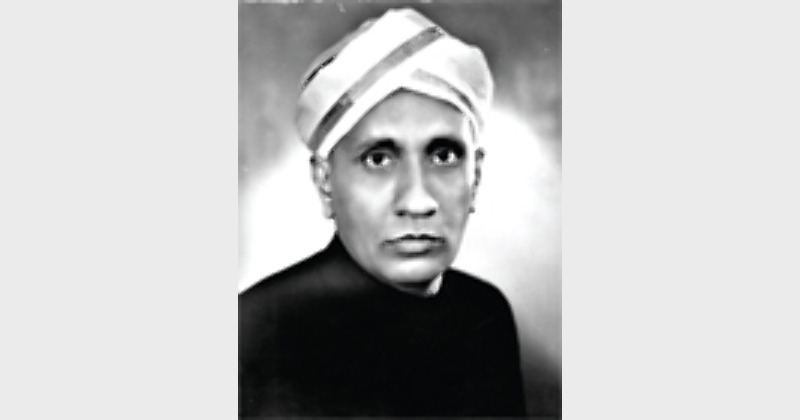
In order to popularise science and also to generate scientific temperament among people, the common men must be exhorted about science. It was with this objective that February 28 is celebrated as National Science Day in Bharat. February 28 marks the
invention of Raman Effect by Sir CV Raman, who was awarded Nobel Prize for it in 1930.
The ‘Raman Effect’ is considered very significant in analysing the molecular structure of chemical compounds. Thanks to the invention of the laser, the ‘Raman Effect’ has proved to be a very useful tool for scientists. According to Raman Effect there is a change in the wavelength of light when a light beam is deflected by molecules. When a beam of light traverses a dust-free, transparent sample of a chemical compound, a small fraction of the light emerges in directions other than that of the incident (incoming) beam. Most of this scattered light is of unchanged wavelength. A small part, however, has wavelengths different from that of the incident light; its presence is a result of the Raman Effect. It is perhaps most easily understandable if the incident light is considered as consisting of particles, or photons (with energy proportional to frequency), that strike the molecules of the sample. Most of the encounters are elastic, and the photons are scattered with unchanged energy and frequency. On some occasions, however, the molecule takes up energy from or gives up energy to the photons, which are thereby scattered with diminished or increased energy, hence with lower or higher frequency. The frequency shifts are thus measures of the amounts of energy involved in the transition between initial and final states of the scattering molecule.
Raman conducted his experiment with the help of the tools which are easily available. Those tools have been preserved at Indian Association for the Cultivation of Science in Kolkata. The results of his experiments were first published in the Nature magazine and then in the Indian Journal of Physics. The publication of the discovery shook the scientific world. Lord Rutherford, the father of nuclear physics, while reacting on this invention in 1930 had said that it would prove highly helpful in understanding the structure of solid, liquid and gases.
The importance of Raman Effect can be understood from the fact that more than 6,000 research papers have been published on it so far. After the invention of laser beams in 1930 the impact area of Raman Effect expanded manifold. It helps in understanding the nuclear structure of various substances. It is now being used in various other areas also.
How high was the confidence level of Raman can be understood from the fact that he, in 1920, wrote to Ghanshyamdas Birla, “If you give me Rs 22,000, I will be able to import an instrument required for my research. I hope I can receive a Noble Prize after this invention.” Birlaji took no time to send the cheque to Raman.
Raman was interested in the study of science since childhood. But in those days the people used to prefer administrative services than making the child a scientist. Therefore, Raman had to leave science subjects in intermediate. But his love for science led him to study science at graduation level and he earned gold medal in physics.
Even at the student age, his research papers were published in Philosophical Magazine of London. After completing education he worked in the Finance Department. Despite being Assistant Accountant General in Kolkata, he was deeply interested in physics. He was so deeply involved in physics that he normally forgot time and place. There is an interesting incident. One day, he was travelling by Tram in Kolkata. Suddenly, he noticed a sign board of the Indian Association for the Cultivation of Science. He became so much restless to reach there that he requested the driver to stop the Tram. When he refused to do so he decided to jump from the moving Tram. At last, the driver had to stop the Tram for him.
Raman used to go to the Science Association office after finishing his duty at the finance department. There he started research in the evening. Even after having limited resources, he wrote 30 original research papers, which were published in various reputed international research journals like Nature, Philosophical Magazine, Phoenix Review, etc. Later, the number of such research papers grew to 475. Apart from it, five monographs were also published.
Finally, relinquishing the job of Finance Department, he joined as Honourary Professor at the Department of Physics in University of Calcutta on request of the then Vice Chancellor Sir Ashutosh Mukherjee in 1917. He was selected as a fellow of Royal Society on May 15, 1924. He was also elected as Secretary of the Indian Association for the Cultivation of Science.
Raman conducted many experiments in University of Calcutta about the light. In 1912, he went by a ship to represent the University of Calcutta at the University Conference of Oxford University. One day while travelling, when he was seriously looking at the sea water he suddenly clicked the idea of conducting an experiment to discover the mystery of the nature of light. That discovery became popular as Raman Effect.
He had to work hard during his research. The work, which then used to be done in 40 hours can now be done in few minutes. Today, about 1,000 research papers are published in the world about the results of various experiments. He founded Raman Institute in Bengaluru and worked there only till end. He was born on November 7, 1888 at Tiruchirapalli in Tamil Nadu. He was awarded Bharat Ratna in 1954 for the discovery of Raman Effect. His work was mainly based on the vibration and sound. He deeply studied various musical instruments like Ektara, Violin, Tambura, Veena, Mridangam, Tabla, etc. He prepared a detailed research article on the basis of his study on violin.
He breathed his last on November
21, 1970.
Dr Manoj Kumar Patairiya (The writer is Director of
DD Kisan Channel)






Comments