





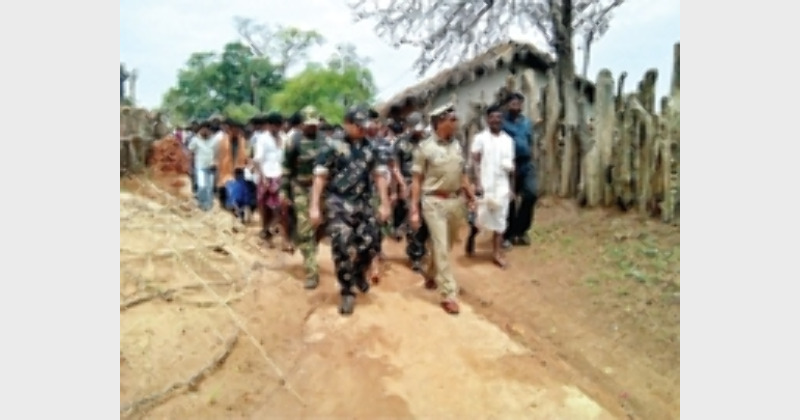
 A combination of the DSR model, led by Rights of the local population, can in the long term wean away the population from Maoist ideology and bring lasting peace to the affected areas
There has been a marked improvement in the security situation in most states affected by Left wing extremism (LWE) in 2015. While this in no way spells the demise of the phenomenon in Bharat, it nevertheless speaks of the ability of the state and its security forces to contain the spread and growth of extremism in Bharat’s heartland. Other than Chhattisgarh and Odisha, all other affected states have shown a marked decline in fatalities due to violence generated by LWE.
What is noticeable is the decline in civilian and security force fatalities over the last two years. In 2015, these fatalities have registered a drop of 25 to 30 per cent over the levels prevailing in 2014 which is a positive sign and needs to be built upon.
The government’s three pronged approach to tackle the growth and spread of LWE is premised on the DSR model, meaning development, security and rights of the people, all three taking place concurrently. More importantly, where political penetration has taken place as seen in West Bengal and Bihar, the incidences of LWE have practically disappeared. This is an indicator of the importance of participatory democracy as a counter to the spread of LWE as people get a voice through various political groupings to air their grievances. This acts as a check to the radical ideology of the Maoists.
Much however remains to be done in implementing the DSR model. It must be appreciated that the Maoist ideology can only be countered by an alternate ideology and that alternate must be the idea of Bharateeya democracy. But for that to happen, democratic structures must be seen to be functional and viable bodies, which the people can trust and turn to. This would require much stronger and robust justice delivery mechanisms than at present existing. Where law enforcement is tardy and where the courts take years to deliver justice, the system inspires little faith amongst the local population. Allied with this is the concept of Rights. Indeed, this must be the core of the campaign against LWE, and should take primacy in the affected states. The governors of the affected states must be held accountable for the implementation of Article 244 of the Constitution, and for other provisions where rights have been guaranteed to the tribal and other people, such as land and forest rights. Simply ensuring the implementation of Constitutional provisions in letter and spirit, will remove a great deal of angst of the local people, which in turn will facilitate initiatives towards development and security. Interventions are also required to sensitise government representatives that come in contact with the local people at the lowest level, such as the police constable and the forest guard to avoid alienating the local population. Unless the behaviour of petty officials at the grass roots level improves, the idea of Bharateeya democracy will not be seen as a viable alternative to what the Maoists have to offer.
The development process has been slow due to a host of factors. However, the process can be speeded up if a long term view on development is taken. As of now, it appears that the focus is on accomplishment of immediate goals, without a view being taken on the end state to be achieved. It would be preferable, if each affected district is asked to draw up a ten year development plan, which should be sent to the state capital for scrutiny and coordination. Thereafter, the plan, duly approved by the state, with yearly timelines for implementation, should be sent back to the districts for implementation, after making due provisions for budgetary and other support. The Centre should fund such projects as approved by the state governments, making development a grass root affair rather than being Delhi led. It must be appreciated that each district will have a different set of concerns and needs and these should be placed at the highest priority, rather than looking at a uniform development model across the board. With such a model, progress can be monitored and the concerned officials made accountable for actions on the ground. In addition, industrial development by the private and public sector must not be at the expense of the local inhabitants. Rather, they must be made partners in the development effort and steps taken to ensure that their rights are not trampled upon.
While the security environment has improved, much still remains to be done. Low casualty figures do not necessarily imply improvement in SF operations. It appears that over the last few years, the Maoists have overreached themselves in their bid to spread their wings to other parts of the country, and in the process, a large number of their senior cadres have either been killed or imprisoned. They are thus in a period of strategic pause, waiting to strike at an opportune moment.
The Security Forces as of now is hampered by weak leadership and inadequate training. The leadership issue can be addressed by deploying complete battalions of the Central Armed Police Forces (CAPFs), along with their commanding officers, who should be especially selected for the job. Officers upto the rank of IG must lead by example and stay in deployment areas in the jungles along with their troops. They need to deploy their forces in grids akin to army deployment in J&K and the Northeast and must have complete charge of operations. Higher control could be exercised by the Chief Minister, Home Minister and the concerned DG Police of the state.
For operations, the troops must learn to operate independently in section groups, by day and by night. Indeed, they must be trained to become masters of the night, so that space for manoeuvre by the Maoists is restricted. Well trained and motivated troops can alter the security situation in a very short time, which in turn can lead to a restoration of public confidence and accelerate the development process. A combination of the DSR model, led by Rights of the local population, can in the long term wean away the population from Maoist ideology and bring lasting peace to the affected areas.
Maj Gen Dhruv C Katoch (The writer is the former Director of CLAWS and is presently the Editor of Salute Magazine)








Comments