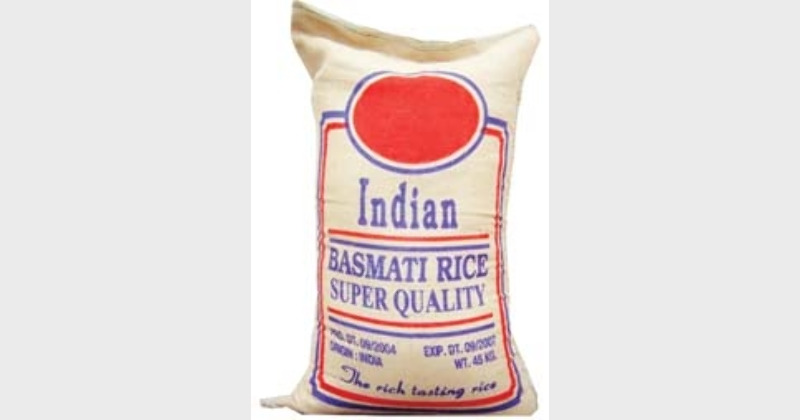
Pakistan opens a new war front against Bharat by raising an illegible claim on Basmati Rice. Even as the two countries are engaged in a bilateral discussion on trade-economic issues, Pakistan’s bid for geographical indication (GI) for basmati rice seems to be one of the unfinished agendas of partition.
In the recent past, Basmati Growers Association (BGA), Lahore, Pakistan has claimed and registered a case that Basmati Rice is owned only by Pakistan but Bharat does not ‘own or have rights’. Basmati rice is one of the testimonies for Bharat’s deep-rooted history, culture and civilisation, where Basmati Rice has relationship with ‘Kuru Vamsa’ of Mahabharat. A Geographical Indication (GI) is the blend of Reputation and Quality. The Reputation is a mixture of history and culture. A detailed legal and cultural history of Basmati Rice is not available. There were number of attempts in the past to ascertain cultural history but legal history of Basmati Rice were not searched. Contrary to the claim of Basmati Growers Association (BGA), Lahore, there are number of facts to prove that Bharat owns (exclusively) Basmati but it never claimed so. A Bharateeya government notification says that Basmati Rice is grown in Indo-Gangetic Plain, which shows magnanimity of Bharat.
The assets to be provided from United Bharat (together Bharat, Pakistan and Bangladesh) to Pakistan were settled during the partition by way of partition proceedings. Indian Independence (Rights, Property and Liabilities) Order 1947 does not have any provision of division of intangible assets in the same. As regards the division of other than physical assets (meaning intangible), the Partition Proceedings: Volume II – Assets and Liabilities (Expert Committee No. II) Captures in Annexure 1 detailed out recommendations as to how each class of these miscellaneous assets should be allocated between Bharat and Pakistan. It recommends that such of the assets as have only a contingent value should be finally settled (or valued) jointly on a basis acceptable to both the States before the March 31, 1948 so that a final adjustment between the two states may be made in respect of these items by that date. The Partition Proceedings never mentions basmati rice to be shared with Pakistan by United Bharat or Bharat. Further, an Agreement between Pakistan and Bharat on Certain Outstanding Financial Issues dated of June 12, 1955 at Karachi does not capture in the list of issues provided by Bharat as well as Pakistan anything relating to sharing of Intellectual Property Rights or Basmati. A financial settlement was attained to build “Unique Establishments” in accordance to the Partition Proceedings: Volume 1: Expert Committee No. 1; Chapter VII including Imperial Agriculture Research Institute (IARI). It underlines the fact that tangible and intangible assets of IARI are not shared with Pakistan and it is only remaining with Bharat, including Basmati.
“Merchandise Mark Act, 1889” of British Raj specifically mentions that it is not necessary to mark the country of origin on any goods imported into Bharat, except where the goods bear some other mark or indication which is held under the regulations to constitute a false trade description with regard to origin, in the absence of any counter-indication of the real country of origin, e.g., Scotch whisky or Jamaica Rum. The awareness about “Indications of Origin” or “Geographical Indications” to British or British Government of Bharat were evident from various policies, rules and regulations such as “Merchandise Mark Act 1889” and “Royal Commission for Scotch Whisky Definition – 1909”. The prior awareness and knowledge about “Indications of Origin” for British and non-inclusion of basmati rice in list of other than physical assets (Partition Proceedings: Volume II – Assets and Liabilities (Expert Committee No. II), Annexure 1) emphasise the fact that the right of GI is exclusively owned by Bharat.
The Royal Commission on Bharateeya Agriculture in 1926 and its subsequent development of Rice Research Stations including Doiwala, Dehradun and Kala Shah Kaku, Pakistan under the charge of Late Sardar Mohammed Khan, who had special training in rice breeding in Madras, provides fact about real geographical origin of basmati rice. The phenomenon of commercial basmati rice production in Pakistan Punjab was merely from the year 1933. Earlier to this timeline, any basmati production in Pakistan Punjab was merely an exception. A lack of history on basmati production in Pakistan Punjab underlines the fact that Basmati Rice Geographical Indication is exclusively owned by Bharat.
During 1957-58, the Pakistan merely grew basmati rice in Gujranwala, Sheikhpura, Lahore and Sialkot of Pakistani Punjab. The Indus Water Treaty enabled construction of two major dams (Mangla and Tarbela) and link canals to transfer inflows from the western rivers to canal commands formerly supplied by the eastern rivers in Pakistan, which significantly irrigates basmati rice growing area. As per the treaty, Bharat uses paltry 20 per cent of water and rest is used by Pakistan. The cultivation of basmati expanded to additionally 9 districts during various point of time due to the availability of water.
In the year 2008, the Bharat and Pakistan Joint Working Group agreed on delimiting of basmati rice growing areas in each country. The areas identified by each side were Pakistan had included 14 districts (Gujrat, Gujranwala, Narowal, Mandi Bahauddin, Hafizabad, Sheikhpura, Nankana Sahib, Lahore, Faisalabad, Jhang, Toba Tek Singh, Khushab, Sargodha) of its Punjab and Bharat had included Punjab, Haryana, Himachal Pradesh, Jammu (Jammu & Kathua), Uttranchal and Western Uttar Pradesh (26 districts). While examining recent production, Pakistan grows Basmati in additional 19 districts [Sialkot, Jehlum, Mianwali, Bhakkar, Chinot, Kasur, Okara, Sahiwal, Pakpattan, Multan, Lodhran, Khanewal, Vehari, Muzzafargargh, Layyah, D G Khan, Bahawalpur, R.Y.Khan and Bahawalnagar], which is a clear deviation from stated position of Bharat and Pakistan Joint Working Group. If Basmati Rice is grown in 13 districts as claimed by Government of Pakistan in the Joint Working Group, it translates to 20 percent of GI Area or GI Ownership to Pakistan in Basmati. If additional 19 districts included by Government of Pakistan, it translates to 42 per cent of GI Area or GI Ownership to Pakistan in Basmati. It appears that Pakistan is arbitrarily endeavoring to expand the basmati growing area without appropriate “definition of basmati growing area” including quality standards or GI legislation.
The battle over certain geographic words has been long and persistent. World War I was fought over Champagne, both literally – as in the bombardment of cathedral at Rheims – and grammatically. Pursuant to the Treaty of Versailles, Germany surrendered to France, the Lands of Alsace – Lorraine and the words “Champagne” and “Cognac”. A land lost or changed, Geographic Word lost!
The legal and historical facts provide ability to register Basmati Rice as an exclusive GI of Bharat. Such exclusive ownership position of Bharat has authority to claim penalty or royalty on infringement of use of word “Basmati Rice” by Pakistan in International Court or WTO, which could run several billion dollars compensation to Bharat. Either USA or Europe, they approach Intellectual Property Rights, Competition Law (Windows or Google) and Environment Law (BP / Deepwater Horizon Rig) in larger economic interests. Bharat has not approached the subject of basmati rice in such larger economic interest, even though it would provide additional economic benefits to millions of farmers in Bharat if appropriate measures were taken. Such tolerant position of Bharat should not be taken as granted by fringe elements like BGA.
S Chandrasekaran (The writer is a trade policy analyst on agriculture and infrastructure industries)