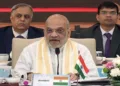





Intro: Prime Minister Narendra Modi will visit China this month and it’s an opportunity for him to create a public opinion conducive for Indian business not only in urban China but also in the provinces away from Beijing.
Narendra Modi’s first visit to China as Prime Minister will be one of the most keenly-watched international visits. Both countries by all standards are cruising ahead to emerge as the most consistent and rewarding lands for economics, finance and investments.
By all standards and to borrow the Indian Chief Economic Advisor’s words but in a different context, the ‘eclipse’ is a happening reality. But it will be the ‘Asian eclipse’ and not solely the Chinese. At least going by the well calibrated symbolism Modi and Chinese President Xi Jinping are engaged in, one can draw the view that the several rounds of negotiations on the boundary dispute notwithstanding, both leaders might have a better chance at achieving breakthroughs in other tracks, namely the economic ties. Since economic progress remains one of the top priorities for both governments, it may help bring down the negativity over broader political questions.
While many analysts believe that Narendra Modi and Xi Jinping are capable of resolving the boundary dispute, it looks challenging against the backdrop of growing nationalistic sentiment in their home countries. Yet, each side has strong incentives – and unique opportunities – to push for the market openness of the other.
Modi’s trip is aimed at keeping the dynamic in the current Sino-Indian relations going further. Given that the bilateral economic relationship has quickly developed over the last decade and a half, the economy is widely regarded as the focus of the PM’s visit. Over the last five years, starting from 2010, India and China had made some progress in normalising their economic relations. But periodically, this process hits a wall as China’s trade regulations regarding Indian products remain highly discriminatory. Irrespective of the high growth rate in trade and investments, the bilateral economic relations still remain very fluid. The nature of Chinese macro-economic policies and its basic economic structure are highly contested among Indians, a strong reason why India remains consistent in introducing cases against China over its lack of compliance with World Trade Organisation (WTO) regulations.
In the past few years, even though India began emerging as a strong economy, the foreign trips of the political leadership fell short in increasing the level and numbers of economic engagements.
As Western economies stagnated, India’s need and options to improve it economic activity in its neighbourhood has intensified. On the one hand, even as India has tried to maintain its share in South Asian countries, it let China become its largest trading partner with a growing bilateral trade deficit. The economic leaders have to find answers to tackle this growing challenge.
In a string of messages on Sina Weibo, the Chinese equivalent of Twitter, the Prime Minister said that he was “certain” that his three day visit to China from May 14 would “strengthen stability, progress and prosperity in Asia”. The Prime Minister opened his Weibo account on May 4, 2015.
The Indian approach to Chinese market has remained traditional. Although Indian diplomatic missions in China have intensified their engagement to set up dialogues with a number of local entities/trade bodies not only in Beijing but at regional level, the results are not promising. The Indian state delegations to China, visits by Chief Ministers and their interactions with the provincial authorities have not been really effective or produced substantial results in terms of actual investments.
The Chinese centrally-owned state enterprises are as confused as they were a decade back over the investment policies and options in India. The state regulatory agencies on both sides are unaware how to deal with issues of dumping and non-tariff barriers. It is a hard fact that Indian exports to China consist mostly of primary and semi-secondary products which are uncompetitive as far as the market share in China is concerned. For example, China is the largest importer of rice in the world and India is the largest exporter, but China has put Indian rice in the restricted list of agricultural products. Besides rice, the other products which China imports from the rest of the world but not from India, include live plants, cashew nuts, mango, fresh and dried grapes, wheat, rice, coconut oil and raw sugar.
The key to breaking into the Chinese market lies at the provincial level. Beijing, the capital city, is not a gateway to Chinese market. Although it is unwise to compare Indian potentials with some of other contenders for the Chinese market, the approach adopted in engaging with the Chinese market has to undergo some basic course correction. For example, the German companies after initial efforts to convince the coastal provinces and setting up some pioneer bases in these regions, moved on to creating more bases or local ‘spring boards’ in China in places far away from Beijing and the coastal regions. To do this they had to look for sub-national synergies and create a situation where the local players believed that such cooperation would benefit them to expand domestically.
As far as India is concerned, the state delegations have yet to attain that state of influence or credibility among Chinese local governments. India is still seen as a weak federal state with a powerful central government. India has to remember that Chinese public memory processes new information slowly and language barriers delay matters further. Moreover, access to information in China is not open which furthers hampers prospects of engagements. This lag of information is not conducive especially at a time when Indian chief ministers and states are taking pro-active measures to lure Chinese business to invest in India. In fact, what is happening at the moment is that Chinese provinces are exploiting market opportunities in India while their Indian counterparts are unable to do so for lack of preparation and knowledge.
To come back to the earlier point that most foreign trips by Indian leaders fell short of their objective to elevate the level of economic engagements, this is particularly visible in the Chinese case. When the subnational opportunities are mushrooming, India is not able to capitalise on the easy options available in Chinese provinces. The provincial governments have to understand the potential in allowing Indian business enter in provincial markets and turn ‘domestic’ as it were, which is the need of hour.
India’s economic relations with China just cannot thrive on investments from China and Prime Minister Modi has to play a decisive role in supporting the initiatives which the Indian sub-national governments have already taken. As a former chief minister of Gujarat who visited China four times, he already has much knowledge of the opportunities and pitfalls. In this backdrop, Prime Minister, Modi can use this visit as an opportunity to create a public opinion conducive for Indian business not only in urban China but also in the provinces away from Beijing. Meanwhile, Indian state governments have to work harder and invest more on developing sound economic understanding of China and to craft their policies accordingly.
Aravind Yelery (The writer is Associate Fellow, Institute of Chinese Studies, Delhi)