





New Impetus to Bilateral Ties?
Intro: Prime Minister Narendra Modi’s Nepal visit has emboldened mutual confidence and trust between India and Nepal and has given new impetus to vital ties.?
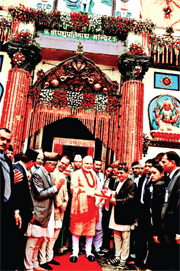
 Pashupatinath and Kashi Vishwanath (of Varanasi) are the same. I am full of emotions and I pray that the blessings of Pashupatinath, which unite Nepal and India, may continue for people of the two countries,” the Prime Minister of India Narendra Modi wrote in the visitor’s book of Sri Pashupatinath Devasthan in Kathmandu after performing the special pooja. The visitor from the abode of Shiva in Varanasi enthralled the residents of the abode of Shiva in the Himalayas, for all the right reasons.
This was the first visit by any Indian Prime Minister to Nepal after 17 years, the last one being former PM IK Gujral’s in 1997. Meanwhile, nine prime ministerial level visits were made to India from Nepal during the past 17 years and Nepal”s heads of state have visited India six times since 1979.
Long before the people of India gave a decisive victory to Narendra Modi-led Bharatiya Janata Party, the people of Nepal gave a resounding victory to the Nepali Congress, totally rejecting the Maoists. The Nepali Congress staged a political come back in the 2013 Constituent Assembly (CA-II) elections with 196 (105 +91) seats and the Communist Party of Nepal (Unified Marxist–Leninist) CPM-UML getting 175 (91+84) seats and the one time rulers Maoists just 80 (26+54) seats. The 2013 CA-II election had produced astounding results. The impressive victory of the Nepali Congress augured well for the renewed goodwill between India and Nepal.
Prime Minister Narendra Modi’s recent visit cemented the goodwill. He promised to catapult the fruits of this mutual relationship to Himalayan heights.
Nepal’s tryst with democracy began as early as 1950 which witnessed the unique phenomenon of democratic forces rallying around a Monarchy to lay the foundations of a new republic, which was then called Hindu Adhirajya. After many governments and turbulences, the Himalayan Kingdom took a decisive turn in 1990 towards another revolution, this time leading to the overthrow of Monarchy and cestablishing a secular republic.
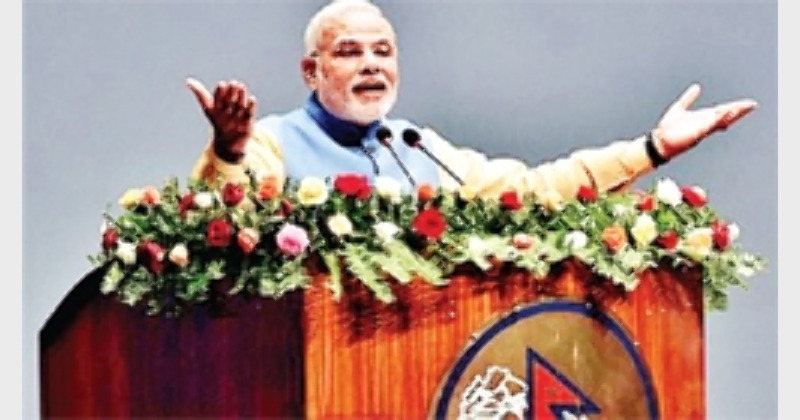
 After experiencing Monarchy and not so good performance of the Nepal’s First Constiuent Assembly, the new 2013 Constituent Assembly (CA) has a specific task cut out for it as Nepal now needs a new Constitution, political stability, progress and prosperity. In his 50 minute historic address to the CA as the first ever Indian PM, Narendra Modi urged the members to set aside all political differences and come out with the much needed Constitution. Calling the process sacred, Narendra Modi told Nepal’s highest law making body “You are writing a treatise just like the rishis in the past wrote the Vedas and Upanishads.”
Political parties in Nepal set aside all their rivalries and inhibitions about India and rallied around the Indian Prime Minister who set the tone for future relations saying “My work is neither to give directive nor to interfere with your work in Nepal, because Nepal itself is a sovereign nation.”
Modi gave a very clear indication that India is ready to treat Nepal as an equal partner in its quest for peace in the region and tap Nepal’s resources for regional growth and prosperity. Little wonder that a deeply fragmented political dispensation in Kathmandu united under Modi, thus paving the way for a new direction for India-Nepal bilateral engagement.
Deprived of political stability and therefore development, Nepal’s political parties thrived on creating mistrust and a negative perception of India. But in an atmosphere of remarkable consensus during Modi’s visit, Nepal accepted Indian developmental assistance to tap hydropower and tourism prospects.
The 1996 Mahakali Treaty to develop Pancheshwor project was fiercely opposed by the Left parties and anti-dam groups. But this time there is a great deal of enthusiasm and acceptance, and a marked difference in perception about a strong India under a decisive leader. Modi’s 4 Cs-Cooperation, Connectivity, Culture and Constitution – has clearly become a hit in Nepal.
Continuing his quest for cooperation, Modi announced 1 billion dollar line of credit to Nepal. It was also decided that the Pancheswor Development Authority (PDA) will be set up and a Detailed Project Report (DPR) will be finalised within a year. The two countries also agreed to conclude a Power Trade Agreement – a framework pact for the commerce and power sector within 45 days. For this the concerned authorities on both sides have been directed to conclude negotiations within 45 days on the Project Development Agreement for the development of Upper Karnali hydropower project.
Nepal has a huge network of rivers and natural waterfalls that is conducive for tapping hydro energy. Sitting over nearly sixty five thousand Megawatt of power, Nepal today produces just 1% (yes, just one percent) of power in a year, which roughly equals to one day power consumption of Delhi city.
In spite of deep cultural bonds, high geographical proximity and perfect demand-supply situation, India and Nepal never came anywhere close to working together on energy cooperation. Thus India lost precious strategic and economic space to China.
Beijing is already funding a 60-megawatt power plant on Nepal’s Trishuli river, already under construction; and, a 1.6 billion dollor, 750-megawatt joint venture on the Seti river-an important tributary of the Karnali system that drains western Nepal, due to be completed by December 2019. The first Indian project, if begun on time, will be completed only by 2021.
In a strategic move PM Modi announced India’s willingness to consider any proposal by Nepal on the 1950 Indo-Nepal Friendship and peace treaty. What began as a road map for friendship ended up as contentious document, with both sides picking holes in what both acclaimed as legacy worth preserving for centuries. In less than fifty years the 1950 Treaty became the favourite whipping boy of all the political parties in Nepal.
With the 1950 Treaty that was expected to guide relations between the two countries becoming a major source of controversy, it was long felt that the Treaty needs to be re-drafted, re-worded or totally re-drawn. Nepal was unwilling to take India into confidence before setting its security parameters, mandated by the treaty, while India considered it her right to oversee, and rightly so, the security architecture of the Himalayan region, given India’s experience in 1962. Decades of fractured mandate and as a result of the intransigence of some of Nepal’s political parties, the treaty became a stumbling block for the two sides to work together. In a deft move, Modi has extended an olive branch to Nepal by accepting to walk more than half the way to meet the expectations of the Nepalese side on the treaty.
During the run up to elections, Modi had recognised the fact that foreign policy formulations all over the world and especially in Asia are increasingly being influenced by economic considerations.
On the day of his taking oath, Modi invited the heads of state of SAARC countries and got a resounding support from the neighbourhood. He boldly set about to unveil a new and strong India making confident strides towards creating a new regional balance.
The successful Nepal visit is another feather in Modi’s cap, and many more are yet to come.
-Seshadri Chari? (The writer is an ideologue and former Editor of Organiser)
?





Comments