Interview:Raising Quality of Parliamentary Debatesis the Biggest Challenge— Sumitra Mahajan
— Sumitra Mahajan
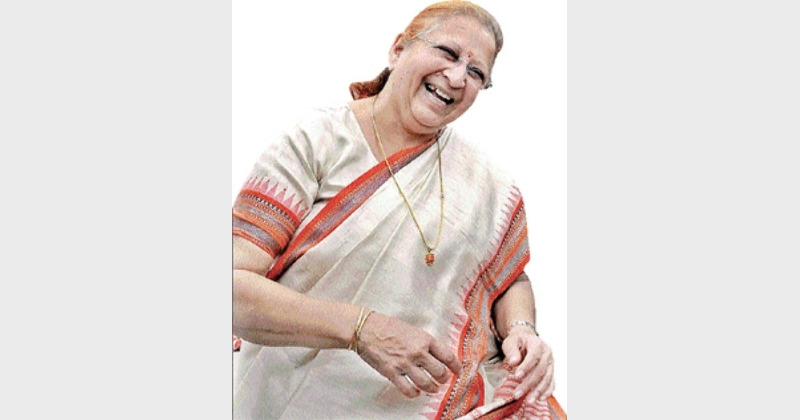
In the first session of the 16th Lok Sabha, Smt Sumitra Mahajan was elected unopposed as the speaker of the House. She has already displayed her acumen and stewardship in handling the functioning of the Lower House. From her personal political journey to numerous issues of priorities and challenges as a speaker, she spoke to Prafulla Ketkar, Editor, Organiser and Hitesh Shankar, Sampadak, Panchjanya in her first exclusive interview after getting elected as a speaker. According to her restoring the faith of the masses in democratic institutions by raising
the echelon and content of debates in the parliament is the biggest challenge for her.
• Hearty Congratulations for getting elected as a speaker of Lok Sabha unopposed. Though you have a long political career, by and large, your personal life is unknown. Do you have a family background of politics?
Frankly speaking, absolutely not. Neither my parents nor my in laws had any background in politics. But since my father was the Sanghchalak at Chiplun in Konkan region of Maharashtra and my mother an active member of Rashtra Sevika Samiti, I was raised in RSS sanskars. Even in the Mahajan family (at my in laws place) in Indore, there was an environment for social work. That is why the basic instinct for doing something for society, for nation has been a part of my life. Another important aspect of my personality is that I have the ‘habit of reading’. From childhood, it has been my natural inclination of not throwing even a single piece of paper without reading. It has helped grasp many things from all aspects of life.
• Who have been your inspirations to join active politics?
There are two people from extreme political spectrum who brought me in politics. Mrs. Indira Gandhi by imposing emergency in 1975 had led to an outrage against the anti-democratic excesses; it brought me in public life. I was assigned the responsibility of coordinating with the families of political prisoners and provide them support. When the 1977 elections were announced, many opposition leaders were still in jail and people were afraid to talk openly in the public meetings. I was advised to conduct some meetings. This was my first encounter in actual politics. My involvement got me introduced to leader like Late Shri Kushabhau Thakre, who was instrumental in bringing me in active politics. He introduced me to Rajmata Vijayaraje Scindia and systematically groomed me for political career. That’s how Thakare Ji and Indira Ji brought me in politics.
• There is a general feeling that a class of notorious students has got a ‘right Principal’, what is your reaction? Do you think your image of a gentle and generous ‘Tai’ would be a hurdle in being a speaker?
These can be perceptions but the reality is that the people who were making noises were senior people. They are well aware of the rules and regulations of the house. If they don’t follow the rules then it will set wrong example for the newly elected MPs. In this case, it is my duty to make them aware of rules and their roles.
As far my image is concerned, people who know me well are aware that I don’t compromise with rules and regulations. Even a mother does not do that with her kids. So everybody should be treated equally, according rules but in a gentle way.
• When you came to know about the new responsibility, did you make any special efforts for this role?
Sincerely speaking I did not get a chance to do much. Otherwise also, as a MP I have been observing the proceedings for a long time. I have also been member of the panel of the Chair for a long time, so I am well aware about the rules and regulations of the House. Irrespective of party and politics, I use to feel sad about non-functioning or misbehavior of the members. I spoke to some senior people on certain issues. I also studied previous speakers and their role in the parliament. For upholding the role of speaker, I personally think it is a matter of experience and sensitivity.
• Though all members are equal in front of the chair, women MPs must be having more expectations from you? Many a time’s female voices are curbed in the male dominated legislatures. Will this change?
As a parliamentarian, I always say that I am a representative of all the people from my constituency, so I will speak on behalf of all of them. I will definitely try to address the genuine concerns of women. I also feel that women should come out, study on certain issues and then make their impact in the legislatures. Women have to learn to be assertive without being aggressive. They also have to prepare for certain subjects. I consciously did that by asking for time to talk on finance bill for which I had to spend lot of time on studying taxation.
• It is often discussed that there are more than 300 new (first time elected) members in this Lok Sabha, what do you expect from them? Is there any provision for their training?
Though some are first timers, we need to know that most of them have been representatives in state assemblies, and may have eperience in local governments. Rules and procedures may be different but general applications and expectations are the same. While being in the chair I will try to categorise members on the basis of their experience and then deal with them. There is a provision for training of Lok Sabha members; I will try to make it more interactive and innovative. Improvisations in the parliament library is the other agenda in my mind- It is one of the richest libraries; and, all the members need to be made aware of this valuable resource.
• In Indian Parliamentary system, certain things are just ornamental. Many are blind imitations of the foreign traditions. Do you foresee any change in this?
Certain ornamental things are also important. They have to be preserved. Our constitution also evolved with inputs from many other constitutions. We should remember that the founding fathers of the Constitution had our rich tradition in mind that is why Shlokas and Richas from Vedas are carved out in the parliament. We are not “Secular” in the sense of ‘non-religious’ or ‘anti-religions’. It is perfectly in tune with truly ‘Dharmik’. We and many members of the parliament are not aware of that. I was the one who suggested once to preserve ‘Vedas’ in the parliament as they reflect our ancient collective wisdom. It is a slow and nurturing process. As and when required necessary changes will be made but there is no need for any drastic departure from traditions.
• As a Lok Sabha speaker what will be your priorities and challenges?
When there is an absolute majority on the one hand and the opposition is divided, following the parliamentary traditions above party lines and giving everyone an equal chance is the biggest challenge.
Restoring the faith of the common people about the functionality and effectiveness of legislative procedures is another challenge.
Media will also have to play a balancing role in this. There use to be a special coverage of the parliamentary debates which is reduced now. Rather than shouting and arguing members, the one who are making meaningful contribution in the parliament should get more time and coverage. Installing positive thought process is the last challenge.
Maximum work, inter party coordination and qualitative functioning of the parliament are my priorities, and they will go hand in hand with the challenges.