






Over 2,300 educated youth in Maharashtra and Gujarat join development process in their respective villages giving new dimension to rural development?
New Drivers of Development?
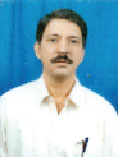 The biggest drawback with the present model of development is that it has failed to ensure public participation in planning and execution of development projects. This is the reason majority of the projects fail to cater to the needs of the target audience. In order to change the situation and also to bring Bharatiya model of development in reality with active participation of people, Pune based YOJAK Centre for Research and Strategic Planning for Sustainable Development has come out with a unique idea, which can really reshape the destiny of villagers. With the help of some voluntary organisations in Central India’s Maharashtra and Gujarat regions it has created a band of educated youth who instead of migrating to cities for jobs owned the responsibility of developing their respective villages. During the last three years, YOJAK and its associated voluntary organisations have mobilised over 2,300 youth, mostly Vanvasis, to take up this challenge. The man leading this silent revolution is Dr Gajanan Dange, national president of YOJAK.
| Majority of the people in our country have the mentality that development is the sole responsibility of government and they can do nothing if the government fails to discharge its responsibility. Assuming it as their fate they continue to languish since decades and are not ready even today to join any initiative which tell them to reshape their destiny on their own. Setting a new precedent in village development, over 2,300 educated youth in Vanvasi regions of Maharashtra and Gujarat have decided to take up developmental activities while staying in their villages only. The step may prove to be a landmark in the days to come, writes Pramod Kumar. ? |
The Vanvasi region of Central India, beginning from Southern Gujarat to West Bengal, is among the highly underdeveloped regions. About three years back, YOJAK started a project, Madhya Bharat Vananchal Samriddhi Yojna, to change the development scenario in this region. Mobilising and empowering some voluntary organisations, it started studying the existed methods of development including their impact on natural resources. The second aspect of the study was how to take corrective steps that can meet the local needs. Third was implementation of the new sustainable approach. Following the ideals of Pandit Deendayalji, who said development should be based on janchetana (local conscience) and the government’s role should be of just a guide, motivator and supporter, YOJAK emphasised on this Bharatiya concept of development purely focusing on the needs and aspirations of the people of this region.
The model is being implemented with the help of voluntary organisations working on ground by mobilising local youth through Yuva Chetna Jagran Programmes. Before organising such programmes, the organisations” activists met local youth and motivated them to join the programme. During discussions they also tried to know what corrective steps they want in their areas. During the study it was found that majority of the educated youth want to stay in their respective villages, if provided better knowhow and help to live a meaningfullife. In order to help the selected youth understand the whole concept, the first Yuva Chetna Jagran Programme was organised at Krishi Vigyan Kendra Nandurbar, Maharashtra, on October 1, 2013. The programme was held with the help of five organisations—Dr Hedgewar Sewa Samiti, Deendayal Vanvasi Sewa Sanstha, Eklavya Adivasi Sewa Sanstha, Bahuddeshiya Birsa Munda Adivasi Sewa Sanstha and Vanvasi Utkarsh Samiti. Prior to the programme, all these organisations had deeply studied Nandurbar region for several months. A total of 1,500 youth had expressed their desire in writing to stay in their villages and sought guidance for taking up activities. Finally, 1,003 youth turned to the programme on their own expenses. They were first apprised of the work being done by the associated voluntary organisations. Then they were told that the problems which they find are basically the problems of all 6 lakh villages. In the third session they were apprised of the successful projects of rural development going on in their regions. They were also told about the availability of technology for resolving their problems. At a session they were administered an oath for taking up developmental activity in their villages. In the last session, their responsibility towards their villages and family was reintegrated through “Kartavya Bodh”. The participants returned home with renewed vigour and hope.
Another similar function was held in Songarh in Tapi district of Southern Gujarat on March 13, 2014. Hosted by Dr Ambedkar Vanvasi Kalyan Trust, Surat, the function was supported by Dang Vikas Parishad, Sarvamangal Trust and Manasi Vikas Sanstha also. It was attended by 1,300 youth.
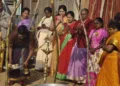
At both the events, an exhibition was organised highlighting the local knowhow. Basically, the instruments which can reduce the drudgery in farming activities were prominently displayed. The exhibition also displayed how the indigenous seeds can be preserved and used.
Both these events were also attended by some achievers who have done wonderful work for rural development. In Nandurbar, the villagers who stopped a river at 18 places and changed the farming system in the entire area were invited. Similarly, in Songarh a community representative who is managing forest based livelihood programme was invited. Many similar successful experiments were displayed before them.
After analysing the information provided by the youth during the events, YOJAK started work on providing them technological support through local partners. Every individual case is being studied by experts. If somebody is involved in cotton production, he has to be helped in that way. “Since the Kharif season is beginning from June we have started imparting them training as to how they can increase production. The work has begun at rapid pace,” points out Dr Dange.
“An army of 2,300 youth has already started fighting against the faulty model of development. They are serious to take it to new heights. They are visiting the projects already going on in their regions to have first hand and practical knowledge. In Nandurbar, the youth were apprised of the work being done in Baripada Village where the villagers preserved a forest of 1,100 acre. Now youth from eight villages have visited that village to see and study the work. This shows the post programme enthusiasm among these youth.
When asked how the idea of starting this experiment clicked, Dr Dange says: “While visiting village to village in central India during the last several years we realised that participation of people in present process of development is very less. It is due to the lack of ownership spirit among local people that the impact of majority projects is minimal. We met many officials who too are worried over it. Our overall objective is to increase the people”s participation in development process.”
The experiment has given a new dimension to rural development process, where the people think they should not continue to depend upon the government agencies for resolving their issues rather they have to be drivers in development. This can go a long way in curbing migration from rural areas to cities in search of jobs.





Comments