Kid's Org: Veer Savarkar - A Legend
December 8, 2025
  • Read Ecopy
  • Circulation
  • Advertise
  • Careers
  • About Us
  • Contact Us
Android AppiPhone AppArattai
Organiser
  • ‌
  • Bharat
    • Assam
    • Bihar
    • Chhattisgarh
    • Jharkhand
    • Maharashtra
    • View All States
  • World
    • Asia
    • Europe
    • North America
    • South America
    • Africa
    • Australia
  • Editorial
  • International
  • Opinion
  • RSS @ 100
  • More
    • Op Sindoor
    • Analysis
    • Sports
    • Defence
    • Politics
    • Business
    • Economy
    • Culture
    • Special Report
    • Sci & Tech
    • Entertainment
    • G20
    • Azadi Ka Amrit Mahotsav
    • Vocal4Local
    • Web Stories
    • Education
    • Employment
    • Books
    • Interviews
    • Travel
    • Law
    • Health
    • Obituary
  • Subscribe
    • Subscribe Print Edition
    • Subscribe Ecopy
    • Read Ecopy
  • ‌
  • Bharat
    • Assam
    • Bihar
    • Chhattisgarh
    • Jharkhand
    • Maharashtra
    • View All States
  • World
    • Asia
    • Europe
    • North America
    • South America
    • Africa
    • Australia
  • Editorial
  • International
  • Opinion
  • RSS @ 100
  • More
    • Op Sindoor
    • Analysis
    • Sports
    • Defence
    • Politics
    • Business
    • Economy
    • Culture
    • Special Report
    • Sci & Tech
    • Entertainment
    • G20
    • Azadi Ka Amrit Mahotsav
    • Vocal4Local
    • Web Stories
    • Education
    • Employment
    • Books
    • Interviews
    • Travel
    • Law
    • Health
    • Obituary
  • Subscribe
    • Subscribe Print Edition
    • Subscribe Ecopy
    • Read Ecopy
Organiser
  • Home
  • Bharat
  • World
  • Operation Sindoor
  • Editorial
  • Analysis
  • Opinion
  • Culture
  • Defence
  • International Edition
  • RSS @ 100
  • Magazine
  • Read Ecopy
Home Bharat

Kid’s Org: Veer Savarkar – A Legend

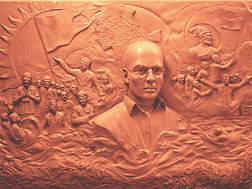
A fearless freedom fighter, social reformer, writer, dramatist, historian, political leader and philosopher, Veer Savarkar was a revolutionary who propounded the philosophy of Hindutva and spent many years in prison in the Andamans fighting for the Independence of Bharatmata
Archive ManagerArchive Manager
May 26, 2014, 11:49 am IST
in Bharat
Follow on Google News
FacebookTwitterWhatsAppTelegramEmail

Intro: A fearless freedom fighter, social reformer, writer, dramatist, historian, political leader and philosopher, Veer Savarkar was a revolutionary who propounded the philosophy of Hindutva and spent many years in prison in the Andamans fighting for the Independence of Bharatmata

$img_title

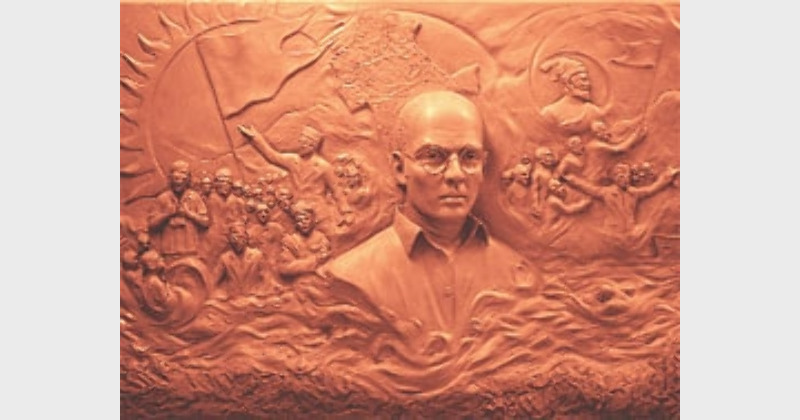
Swatantryaveer Vinayak Damodar Savarkar (May 28, 1883 to February 26, 1966) was a fearless freedom fighter, social reformer, writer, dramatist, historian, political leader and philosopher. Savarkar’s thoughts touch upon virtually every aspect of nation-building and are relevant even today.Veer Savarkar was a revolutionary who propounded the philosophy of Hindutva and spent many years in prison in the Andamans fighting for the Independece of Bharatmata.

  •  The first political leader to set Absolute Political Independence as India”s goal (1900).
  • The first Indian political leader to perform a bonfire of foreign (English) clothes (1905).
  • The first Indian to organise a revolutionary movement for India”s Independence on an international level (1906).
  • The first Indian law student who was not called to the English Bar despite having passed his examination and observed the necessary formalities, for his activities to seek India”s freedom from the British (1909).
  •  The only Indian leader whose arrest in London caused legal difficulties for British Courts and whose case is still referred to in the interpretations of the Fugitive Offenders Act and the Habeas Corpus(Rex Vs Governor of Brixton Prison, ex-parte Savarkar)
  •  The first Indian historian whose book on the 1857 War of Independence was proscribed by British Authorities in India even before its publication. The Governor General had asked the Postmaster General to confiscate copies of the book six months before the book was officially banned (1909).
  • The first political prisoner whose daring escape and arrest on French soil became a cause celebre in the International Court of Justice at The Hague. This case was mentioned in many International Treaties at that time (1910).
  •  The first graduate whose degree was withdrawn by an Indian University for striving for India”s freedom (1911).
  • The first poet in the world who, deprived of pen and paper, composed his poems and then wrote them on the prison walls with thorns and nails, memorized ten thousand lines of his poetry for years and later transmitted them to India through his fellow-prisoners who also memorised these lines.
  • The first revolutionary leader who within less than 10 years gave a death-blow to the practice of untouchability in the remote district of Ratnagiri while being interned there.
  • The first Indian leader who successfully started –
  1. A Ganeshotsava open to all Hindus including untouchables (1930).
  2.  Interdining ceremonies of all Hindus including untouchables (1931).
  3. “Patitpavan Mandir”, open to all Hindus including untouchables (22 February 1931).
  4. A cafe open to all Hindus including untouchables (01 May 1933).
  •  The first political prisoner in the world who was sentenced to Transportation for Life twice, a sentence unparalleled in the history of the British Empire.
  • The first political leader to embrace death voluntarily by way of Atma Samarpan in the highest tradition of Yoga (1966). ?


Vinayak Damodar Savarkar was born on May 28, 1883 into a family of jagirdars (landlords) in the village of Bhagpur near Nasik. Vinayak was one of four children others being, Ganesh (Babarao), Mainabai and Narayan, born to Damodarpant Savarkar and Radhabai. He was looked after by elder brother Ganesh since his parents died when he was very young. Right from his childhood he used to like reading. Invariably found in libraries, he used to read the news papers like Kesari, Kal etc. He read Short History of the World in childhood. He studied History of India from Vedic times. He thoroughly read Sanskrit as well as English literature. Amongst other books, he was impressed by the biographies of Mazini, Garibaldi, Napoleon, Lenin and Trotsky etc. He read Bible, and Holy Koran. He also read the works of philosophers like Spencer, Mill, Darwin, Huxlay , Emerson etc. He knew by heart half of Rabindranath Tagore”s literature.

In 1898, the British hanged the Chapekar brothers in Pune for killing a British officer. This made a deep impact on the teenaged Savarkar, who decided to take up armed struggle against the British. Savarkar”s patriotic spirit found an outlet through an organisation called the “Mitra Mela” that he formed. He inducted young patriotic men like himself into the Mela. He encouraged the members of the Mela to strive for “absolute political independence for India”. Savarkar renamed the “Mitra Mela” as “Abhinav Bharat” and declared that “India must be independent; India must be united; India must be a republic; India must have a common language and common script.”

In March 1901, Savarkar was married to Yamunabai, daughter of Ramchandra Triambak Chiplunkar, who agreed to help Savarkar in his university education. After his matriculation examination, Savarkar got enrolled in Fergusson College in Poona in 1902.

In 1905, a huge Dussehra bonfire of foreign goods was lit in Poona by Savarkar and his friends to express resentment toward the Partition of Bengal. He left for London to study law in June 1906 on receiving a scholarship. Savarkar stayed at the India House in London, which was established by Pandit Shyamji, a patriot, scholar and social reformer. Savarkar founded the Free India Society which held weekly meetings and celebrated Indian festivals and anniversaries of important figures.

In Britain, Savarkar organised students and advocated an armed struggle to throw the British out of India. He also wrote his book on the 1857 Sepoy Mutiny, which he called India”s First War of Independence, a terminology the Indian government accepted after Independence. Since there was no question of printing the book in Britain, it was printed in Holland and copies of it were smuggled into India. The book was a huge success, giving Indians a strong sense of pride, providing a fresh perspective on a war that was till then merely seen as the outcome of disgruntled Indian soldiers in the service of the British.In Britain, he also created a network of like-minded individuals. Seeing his anti-British activities, he was arrested in London on March 13, 1910 and sent to India to face trial.

While he was coming to India by a ship,the ship in which he was being taken to India berthed at Marseilles, France, on July 8, 1910. Savarkar wriggled out of the porthole and swam a great distance in the cold water to reach the shore. He had earlier told his friends, including Madam Bhikaji Cama, to meet him at Marseilles, but they arrived late and the British recaptured him. He was tried, and on December 24, 1910, sentenced to 50 years in prison. On July 4, 1911, he was sent to Port Blair”s Cellular Jail. Savarkar was sentenced to rigorous imprisonment and was placed in solitary confinement

In 1920, Vithalbhai Patel — Vallabhbhai Patel”s elder brother — demanded Savarkar”s release, a demand also backed by Gandhi and Nehru. On May 2, 1921, Savarkar was shifted from the Cellular Jail, first to the Alipore Jail in Bengal and then to Ratnagiri Jail in western Maharashtra. While in Ratnagiri Jail, Savarkar wrote Hindutva which was smuggled out and published under the pen-name “Maharatta.” On his release, Savarkar founded the Ratnagiri Hindu Sabha on January 23, 1924 which aimed to preserve India”s ancient culture and work for social welfare.

He was released on January 6, 1924 on the condition that he would not leave Ratnagiri district. He became active in the Hindu Mahasabha, founded in 1915, which sought to protect the interests of Hindus. Veer Savarkar founded the Ratnagiri Hindu Sabha on January 23, 1924 that aimed to preserve India”s ancient culture and work for social welfare. In 1937, he became president of the Hindu Mahasabha, and remained in the post till 1943. On August 15, 1947, Savarkar proudly unfurled the national flag along with the saffron flag of the Mahasabha. Savarkar agreed to join hands with the Congress in support of Gandhiji”s Quit India movement as long as the Congress did not compromise the unity of the nation to the Muslim League. “The Quit India Movement must not end in a Split India Movement!” he thundered on a BBC broadcast of his speech.

Veer Savarkar died on February 26, 1966 at the age of 83.

-Aniket Raja

?
ShareTweetSendShareSend
✮ Subscribe Organiser YouTube Channel. ✮
✮ Join Organiser's WhatsApp channel for Nationalist views beyond the news. ✮
Previous News

World This Week: Petition to safeguard Hindus in B?desh

Next News

Cover Story : Next Generation Economy & Trade Reforms

Related News

Representative Image

Pakistan slipping into authoritarian rule, warns the lawyers of the country

Representative Image

China-Japan face-off escalates across Indo-Pacific: An emerging threat to the peace & security of the maritime domain

Defence Minister Rajnath Singh(File Photo)

Defence Minister unveils Galwan War Memorial; Hails border connectivity as key to success in Operation Sindoor

UMEED Portal

UMEED Portal deadline ends: Logs 5.17 lakh Waqf properties, with 2.16 lakh approved, 2.13 lakh pending, 10,869 rejected

R. Sreelekha IPS (Retd.)

Kerala: Interview with R. Sreelekha IPS (Retd.) — BJP’s Thiruvananthapuram Municipal Corporation Candidate

How Nehru Torpedoed Vande Mataram: The Untold Story

Load More

Comments

The comments posted here/below/in the given space are not on behalf of Organiser. The person posting the comment will be in sole ownership of its responsibility. According to the central government's IT rules, obscene or offensive statement made against a person, religion, community or nation is a punishable offense, and legal action would be taken against people who indulge in such activities.

Latest News

Representative Image

Pakistan slipping into authoritarian rule, warns the lawyers of the country

Representative Image

China-Japan face-off escalates across Indo-Pacific: An emerging threat to the peace & security of the maritime domain

Defence Minister Rajnath Singh(File Photo)

Defence Minister unveils Galwan War Memorial; Hails border connectivity as key to success in Operation Sindoor

UMEED Portal

UMEED Portal deadline ends: Logs 5.17 lakh Waqf properties, with 2.16 lakh approved, 2.13 lakh pending, 10,869 rejected

R. Sreelekha IPS (Retd.)

Kerala: Interview with R. Sreelekha IPS (Retd.) — BJP’s Thiruvananthapuram Municipal Corporation Candidate

How Nehru Torpedoed Vande Mataram: The Untold Story

Bangladeshi army officer and senior BNP leader Col Abdul Haque

A former Bangladeshi army officer & BNP leader urges youth to get army training to sever Northeast from India

PM Narendra Modi on Vande Bharat

“Removal of significant verses in Vande Mataram sowed seeds of partition”: PM Modi

West Bengal: Sanatan Sanskriti Sansad’s Gita Path Sees 6.5 Lakh Hindus Recite the Gita in Kolkata

(L) Panakkad Munavarali Shihab Thangal (R) Fathima Nargese

Kerala: Muslim League leader’s 16 years old daughter Fathima Nargese backs women entry into Mosques, father disputes

Load More
  • Privacy
  • Terms
  • Cookie Policy
  • Refund and Cancellation
  • Delivery and Shipping

© Bharat Prakashan (Delhi) Limited.
Tech-enabled by Ananthapuri Technologies

  • Home
  • Search Organiser
  • Bharat
    • Assam
    • Bihar
    • Chhattisgarh
    • Jharkhand
    • Maharashtra
    • View All States
  • World
    • Asia
    • Africa
    • North America
    • South America
    • Europe
    • Australia
  • Editorial
  • Operation Sindoor
  • Opinion
  • Analysis
  • Defence
  • Culture
  • Sports
  • Business
  • RSS @ 100
  • Entertainment
  • More ..
    • Sci & Tech
    • Vocal4Local
    • Special Report
    • Education
    • Employment
    • Books
    • Interviews
    • Travel
    • Health
    • Politics
    • Law
    • Economy
    • Obituary
  • Subscribe Magazine
  • Read Ecopy
  • Advertise
  • Circulation
  • Careers
  • About Us
  • Contact Us
  • Policies & Terms
    • Privacy Policy
    • Cookie Policy
    • Refund and Cancellation
    • Terms of Use

© Bharat Prakashan (Delhi) Limited.
Tech-enabled by Ananthapuri Technologies