





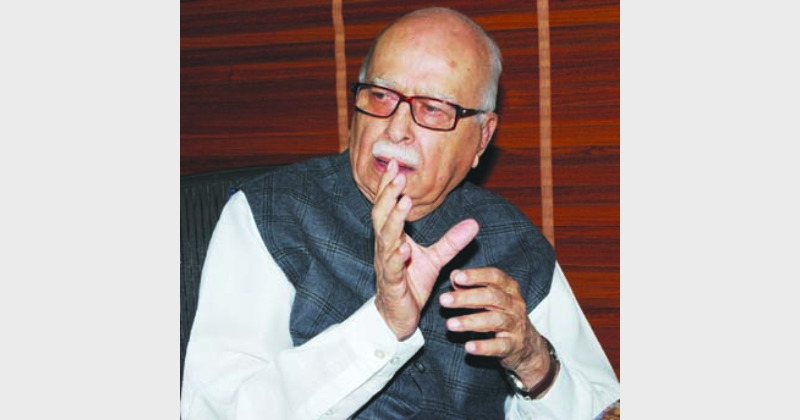
 Veteran BJP leader and former Deputy Prime Minister of India Shri LK Advani has been watching both Bollywood and Hollywood movies since his school days. Howsoever busy he is, he still finds time to watch new movies. While working in Organiser around 1961 he even started an exclusive column ‘Cine-Notes by Netra’ on films, which was very popular. Organiser editor Prafulla Ketkar and Sr. Correspondent Pramod Kumar spoke to him in New Delhi to know about his love for films, changing nature of cinema and his views on 100 years journey of Indian cinema. “The biggest contribution that the Indian Cinema has made towards the country’s integration is the manner in which it became the principal instrument of making Hindi the lingua franca of the country,” he feels. Excerpts:
Your column in Organiser on films during sixties was a big hit. How did you think of starting such a column in the ideological newspaper?
When I was working in Organiser, one day Malkaniji, the then editor, said our journal has become too political. If its content is made variegated, it would be better. He said since you have been an avid film-goer right from your early years, why can’t you do a column on films. I said I can try. It was only then that I started writing on films under the column ‘Cine-Notes by Netra’.
Was the column on general films or some particular films focusing on social, political issues?
No, general films on this and that topic. It is true that I used to watch movies regularly in school days at Karachi. Shortly after doing my high school, in fact before going to college in Hyderabad (Sindh) I became a Sangh swayamsevak and then gradually my interest in Sangh work grew so much that for the next 15 years, from 1942 to 1957, I did not watch even a single movie. During that period, for 10 years I was a Pracharak (RSS whole timer) in Rajasthan. In 1957, I went to Bombay, where I stayed with my uncle, whom we called Sunder Mama. One day Sunder Mama said, “Lal, can we go to see a film?” I said, “I have not seen any film for the last 15 years.” I remember the next morning I saw a news item in a newspaper that a viewer at Strand Cinema, where he had gone to see a 3D horror film, House of Wax, had a heart attack and had collapsed there itself. After reading the news, I suggested: Mama, Let’s see this movie. This is how the break came once again.
Was there any problem in integrating ideological journalism with the movies?
No. If there was any film with patriotic element we highlighted that aspect.
From early days till today the Indian movies have retained certain kind of Indianness. How do you identify the typical aspects that the Indian movies have become distinctive?
Distinctiveness to Indian movies is given by the importance that music has in the film. That has made it really distinctive.
My wife’s brother, Manek Premchand, has specialised on this topic. In his excellent, well-researched book, Romancing the Song: Hindi Cinema’s Lyrical Journey, Manek has unfolded the changes that have been taking place in the poetry of Hindi films in the last one hundred years. Paying rich encomiums to the book, Gulzar, a leading lyricist of Hindi cinema, has in his foreword described the book as ‘fabulous’.
Besides music, in terms of content, dance, etc…?
In terms of content, I feel before Partition, the film makers were extremely hesitant to touch patriotic themes lest there be anything even indirectly against the Britishers. Whenever there used to be some patriotic content, it used to be in a veiled manner. But the biggest contribution that the Indian Cinema has made towards the country’s integration is the manner in which it became the principal instrument of making Hindi the lingua franca of the country. Personally, until the age of 20, I was familiar with only two languages— English and Sindhi. I could not read and write Hindi at all. So much so that as I did my first, second and third year OTCs (RSS Training Camps) before Independence, and went to Nagpur in 1946 for my third year OTC, I did not know how to read and write Hindi. I could understand Hindi only because of cinema. Of course I spoke broken Hindi. The fluency came later on after I came to Rajasthan. During that period, I consciously studied and learnt Devanagri. My fondness of books proved a big asset for me.
In early years of Independence, movie makers tried to connect the films with dramatic traditions and they adopted some patriotic content also. Comment.
The good thing that has been in Indian cinema is the importance given to family. I recently saw a book written by Jayaprakash Chowksey titled Mahatma Gandhi and Cinema. Chowksey was a professor of English in Indore, but later on he took to film script writing and production. There are some very striking details in the very first chapter of the book. He writes that the world’s first ever film screened by Lumiere Brothers was at Indian Saloon, Grand Café, in Paris. What a co-incidence that the venue for screening of the pioneering cinema event in the world has an oblique Indian connection! After all, India is the country in the world today, which produces the largest number of films.
The second striking fact mentioned is that while Gandhiji was born in 1869, the pioneer of Indian cinema Dada Saheb Phalke was born just one year later, in 1870. It was Phalke who released the first Indian movie, Raja Harishchandra in a Mumbai theatre on May 3, 1913. Gandhiji had seen a play based on the life of Harishchandra in his childhood. This play had a deep impact on him.
Do you think the movies have changed political, social situations in the country?
Movies do influence society considerably.
It’s a curious mix of cinema, cricket and politics that India talks today?
Yes, that is very true. Generally speaking, there is a tendency to show that good always triumphs. This, as well as the emphasis on family bonds is a positive attribute.
What type of movies did you see from school days to till date?
In school days, I saw both Hindi and Hollywood movies. When I joined the Central Government for the first time after Emergency in 1977, the then PM Morarji Desai asked me whether I had any particular portfolio in my mind. I said since I have been a journalist; and considering what has happened to the media during Emergency, the kind of restrictions that were imposed on it, I would be happy if I am able to dismantle all those curbs on the media. Therefore, I asked for the I&B ministry. Apart from that I had been pleading for making All India Radio autonomous.
Cinema came incidentally. My concern at that time was print media and broadcasting, as censorship was on them. Cinema was also censored. I remember a small incident of 1972-73. I was fond of theater in those days. There was a play, Hatya Ek Aakar Ki, at Fine Arts Theater of Delhi. It was a play relating to the assassination of Mahatma Gandhi. It was a very good play. The core of the story was that a conspiracy is hatched to assassinate Mahatma Gandhi. Those who are part of the conspiracy suddenly start having second thoughts whether what they were doing was right or wrong. But the person who had been assigned the main responsibility was firm. So a mock trial is held in which he is put on trial. He is accused by others who found serious flaws in the plan and argued that it was unethical and against the Indian traditions. In his response the would be assassin uses the arguments given by Godse during his actual trial. Shortly after this play, a film was made on it. I did not see that film. I just heard in the papers that Vimal Ahuja made a film based on that play, both in Hindi and English. In English, it was titled as Five Past Five. At that time, IK Gujral was the I&B Minister. The film was banned.
There was some criticism of Sholay also?
That was a different matter. It was about violence. As I&B Minister, when I went to Calcutta, I spoke to Satyajit Ray and sought his opinion on it. He said technically he regards Sholay as the best film produced in India. He said if violence is the ground of criticism then no film or serial can be made on Mahabharata.
During 1950s the movies generally focused on national reconstruction and in seventies the focus was on social unrest. How do you see this change, whether the movies were responding to the change—the emergence of angry young men about social evils or losing faith in the system?
It was the actual life responsible for it and not the films. Films in a way, in a climate where ethics are compromised very easily, do try to emphasise on the victory of good over evil. There is nothing wrong in this. Films become ugly when only for the sake of box office, certain compromises are made.
There are allegations that films in India promoted vulgarity and westernisation also. What do you feel?
Westernisation came as an impact of British rule on us. In fact, when I first went to Nagpur, the Central Railways at that time used to be known as Great Indian Peninsular (GIP) Railways. The first thing that I noticed in the train was that on every single removable item in the compartments, whether it was taps, or the mirror in the toilet, or cushions on the benches, on all these items the inscription was ‘Stolen from the GIP’.
I used to quote this many times especially when the people said British rule was quite good. The GIP Railway example reflected the attitude of the British. I would give this example and say: they thought all Indians are thieves who would pick whatever is handy and take it home.
How do you evaluate the 100 years of Indian cinema?
Technologically, it has seen great improvement in Indian cinema. Content wise, there have been different phases. By and large Indianness is there. Though, for the sake of commercial success, there are many compromises. But so far as the family values are concerned, they are generally strengthened. Also, tendency that good must succeed over evil is a positive trait.
The major compromise made in the films is seen in the music. The melody part is missing today. What do you think?
When you have proliferation of numbers, the decline in standards naturally comes. In terms of lyric writers we have very few names like Prasun Joshi, Gulzar, Javed Akhtar. The music does not have as much importance in the West as it has in India. There may hardly be any film here without a song. In India, music is itself an industry. There are separate events for music launch.
Could you name five good movies you have watched?
In my school days, I was fond of war films, of course then of Hollywood. The best film I liked was the Bridge on the River Kwai. Hindi films relating to war came much later. It was Chetan Anand who produced Haqeeqat in 1964 on Indo-China war. Then many other movies like the LOC, etc followed.
Were you with Organiser in those days?
I was with Organiser in the early sixties. As representative of Organiser, I went to Ladakh after the Chinese war was over, as part of a journalist group, comprising of five foreigners, five Indians. It was this trip that made me acutely conscious of how gravely neglected had been India’s Defence Ministry in those early years under Pandit Nehru and Krishna Menon.
In the context of this interview I would like to add something about my family. In school, I was a diligent student and scored well all through. My non-curricular interests were two: cinema and cricket. My two children have inherited these interests, one each. Jayant, my son, is an authority on cricket. He is also friendly with quite a few prominent cricketers of these days. Similarly, my daughter Pratibha, who runs a Television company, is a storehouse of knowledge about films.
Pratibha has now started producing some interesting documentaries, in which she picks a particular theme like Tiranga. It is about our country’s flag, the tricolour. But apart from educating the viewers how the tricolour evolved, her style is of using Hindi films and making the documentary not merely educative, but entertaining also. On the same basis, she has made Rama, Krishna, Vandemataram, Ganesha, Holi, Maa Ganga etc. In fact, I have told her that it would be very useful if they are subtitled in English and shown to the children of NRIs living overseas.
A Tailpiece
For many years, I used to be film critic, having filed dozens of reviews that saw the light of day. In fact, I continues to be a film enthusiast even now.
I recall the pain of a day, way back around 1958, when our party lost in a Delhi corporation election. To help forget our sorrow, Atalji and I went and saw a movie at a theatre close to our party office, in Paharganj. That theatre was imperial and the film we saw was the Raj Kapoor-Mala Sinha starrer Phir Subha Hogi, based on Dostoevsky’s Crime And Punishment. The lyrics of the film were excellently written by Sahir Ludhianvi, and the words of one uplifting song went thus:
Wo subah kabhi to ayege…
Jab dukh ke baadal pighlenge, jab such ka saagar chhalkega
Jab ambar jhoomke naachega, jab dharti naghme gaayegi
Wo subah kabhi to ayegi
Forty year later, in 1998, when Vijpayeeji became our Prime Minister, I recalled our poll defeat and affirmed, “Wo subah aayi hai, aur humhi usey laaye hain”.
Later still, sharing a stage with India’s nightingale Lata Mangeshkar, I requested her to sing her exceptional song Jyoti kalash chhalke. This happened twice, and she obliged both times, even if she had no music to back her up at these events. This song never fails to move me. Its touching lyrics were created by the legendary Pt. Narendra Sharma, and the amazing Sudhir Phadkeji had made the tune for this cosmic wonder of a song. I can think of many songs that are close to my heart, mainly for the thoughts that are offered in their melodies. These include Main zindagi ka saath nibhaata chala gaya from Hum Dono, and Nadi naare na jao Shyam paiyaan padoon from Mujhe Jeene Do.
(From the foreword of the Book Romancing the Song: Hindi Cinema”s Lyrical Journey)








Comments