






MV Kamath
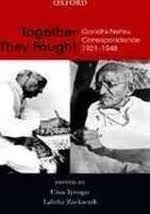
Together They Fought: Gandhi-Nehru Correspondence 1921-’48; Uma Iyengar, Lalitha Zackariah (Eds); Oxford University Press, Delhi; Pp 558
MOHANDAS Karamchand Gandhi and Jawaharlal Nehru; freedom fighters, both, one a guru, the other a shishya. One a Baniya, another a Brahmin; one a true Hindu, the other sceptical of Rama Rajya; one an ardent advocate of non-violence, another not averse to take to arms against an invading enemy. No two were more divided by age, custom, tradition, faith and belief. No two could have been in their political career, more in conflict in their views. And yet, in the end, it was Jawaharlal that Gandhi ‘nominated’ as his heir.
The first time the two met was in December 1916. It took time – some five years – for them to get down to sustained correspondence. The first letter recorded in this book is dated May 9, 1921. It is from Nehru to Gandhi. The last recorded letter is dated January 20, 1948. Ten days later Gandhi was assassinated for Nehru to open his heart. In the earliest letters Jawaharlal signs as ‘Nehru’ and the Mahatma signs up as ‘Yours sincerely, MK Gandhi’. As their relationship matures, Nehru is addressed as ‘My Dear Jawaharlal’ and still later as ‘Chi. Jawaharlal.’ In 1924 Nehru addressed a letter to “Respected Bapuji” and signs up as “Yours obediently, Jawaharlal”. Later letters are addressed to “Dear Bapu” and “My dear Bapu”; there is no consistency. The two differ widely and don’t hide their feelings and Jawahar is often ticked off brutally.
Once Gandhi wrote to Jawahar (as he was addressed): “Resist me always when my suggestion does not appeal to your head or heart. I shall not love you the less for that resistance”. Jawahar had no job, no personal income and was dependent on his father and wanted to stand on his own feet. To him Gandhi wrote: “Shall I try to arrange for some money for you? Why may you not take up some remunerative work? Will you be correspondent to some newspaper? Or will you take up a professorship?” But when Gandhi got angry he didn’t hide his anger. In a letter (April 15, 1942) he wrote to Jawaharlal, “Whereas we have always had difference of opinion, it appears to me that now we also differ in practice….the more I think of it, the more I think you are making a mistake…. It is my duty to caution you”. Once when he was out of jail on parole, Jawahar wrote a letter to Gandhi (August 13, 1934) running to over 3,500 words, towards the end of which he said: “Perhaps some parts of this letter might pain you. But you would not have me hide my heart from you”.
In a couple of letters Jawaharlal’s anger against Gandhi pours through every sentence – it is almost unbelievable. Wrote Jawaharlal: “You chastise us like an angry schoolmaster….only pointing out from time to time the errors of our ways… you only criticise and no helpful lead comes from you”. Once Gandhi himself wrote (June 7, 1947): “The oftener we met the more convinced I am becoming that the gulf between us in the thought world is deeper than I had feared”. On an earlier occasion Jawaharlal wrote to his guru: “I am a pagan at heart, not a moralist like you”. Often the letters deal not with politics but matters purely personal, like the illness of Jawaharlal’s wife Kamala, the growing pangs of his daughter Indira, his travels abroad and the people he met and what he thought about them. Very few people in India would know – probably none – that Kamala gave birth to a male child which, however did not survive even a week. In a very brief letter (November 28, 1924) Gandhi expressed his sadness, saying: “Sorry about baby’s death, God’s will be done”. One wonders what the future would have been had the baby survived.
Those of us who have lived through the 30s and 40s of the 20th century have always wondered what were the issues that divided Jawaharlal and Gandhi, what they separately felt about other leaders like Vallabhbhai Patel, Subhas Chandra Bose, Rajendra Prasad, C Rajagopalachari and so many others and in many ways this correspondence bares them all. In a letter dayed October 5, 1945, Gandhi wondered whether he should write in English or in Hindustani. He wrote in Hindustani, saying. “I take first the sharp difference of opinion that has arisen between us. If such a difference really exists, people should also know about it, for the work of Swaraj will suffer if they are kept in the dark….”
About the Congress support to Britain following the beginning of the second world war, which later changed, not much is clear as to how that change came about. Nor is there much information or correspondence on how and why the quit India resolution came to be passed which did grave damage to the country. Either there wasn’t much correspondence between the two on the subject of Congress support to the British or, if there was, it has not been possible for the editors to acquire it. At one point in time Gandhi wrote to Jawaharlal (October 3, 1935): “Your letters come in with clockwork regularity and they are such a blessing”.
Reading this collection of Gandhi-Jawaharlal correspondence one comes to know both in much better ways. Why, one wonders, for all their major – and painful – differences, Gandhi wanted Jawaharlal to succeed him. The right man would have been Vallabhbhai Patel. (Towards the end there is a touching letter Jawaharlal wrote to Vallabhbhai worth reading). In it, he said: “I have been greatly distressed by the persistence of whispers and rumours about you and me, magnifying out of all proportion any differences we may have. This has spread to foreign ambassadors and foreign correspondents; mischief makers take advantage of this and add to it…. This is bad. We must put an end to this mischief”).
The differences between Gandhi and Jawaharlal were not that obvious, though many knew they existed. Each bared his innermost thoughts to the other, as when Jawahar wrote: “Religion is not familiar ground for me and as I have grown older, I have definitely drifted away from it.” Seldom do they show any sense of humour, except, perhaps, once and that was when Jawaharlal got arrested and jailed before Gandhi himself was. Triumphantly Jawaharlal wrote to his preceptor: “I have stolen a march over you.”
The correspondence between them deal with so many issues that to read their letters is not only to get a political picture of the times in which they strode the political scene, but of how the struggle for freedom progressed step by nuanced step. It is like re-living another time and era. Strangely, there is very little reference to Mohammad Ali Jinnah or to General Wavell or Mountbatten and the editors owe us readers an explanation. One suspects the editors have been over careful in the choice of letters. Surely there must be much more than has met with their approval.
(Oxford University Press,Ist floor, YMCA Library Building, 1, Jai Singh Road, New Delhi 110 001)








Comments