





BOOKMARK-7-8-9
Manju Gupta
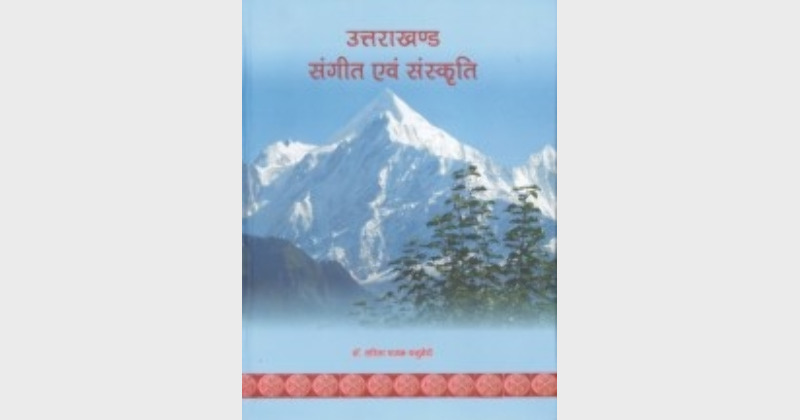
Uttarakhand: Sangeet evam Sanskriti (Hindi), Dr Sarita Pathak Yajurvedi, Brahaspati Publications, Pp 368, Rs 1100.00
The Indian culture with its ancient tradition formed out of amalgamation of diverse cultural streams today occupies an important place in the cultural map of the world. The author describes it as a flowing and pure stream in which innumerable rives and nallahs merged to get lost and make it into a large stream while adding flavour in the people’s lives.
This study of song and dance under the cultural tradition of Uttarakhand, which was once a part of Uttar Pradesh, has been presented to include the folk songs, folk instruments and their types and dance-songs.
The position of this region in the northwest, its area and boundaries, its mountainous peaks, rivers, forest wealth, minerals, water resources, farming, etc are described in detail. The history of the region reveals that different tribes of Vanvasis used to live here and among whom Kirats, Yaksha, Nagas, Gandharvas, Knnar, etc. were the prime ones. Some say that Khasos also lived here and they were conquered by the Aryans in the 3rd to the 4th century. Then came the Katyuri rulers who ruled for 200 years and were followed by Parmars in Garhwal and the Chand in Kumaon. In 1790, they were defeated by the Gurkhas who were ruled over by the British after 1815 and till Independence in 1947.
The book highlights the social life of Uttarakhand where the varna system prevailed. This chapter says that the hill women are more hardworking than their men and considers them as the prime reason for preserving the state’s culture and economy. Education and its current position is also described apart from the state’s economic and religious situation, language and dress style.
The prime instruments described are ektara musical (one-string instrument), sarangi, morchung, huduk which is a small drum, nagada (large drum), dafli or tambourine, dholak (a drum beaten on both sides with the palms), etc. There is a large treasure house of folk dances where groups of men and women dance together. The Kshatriya women dance with men on fasts and festivals while the Brahmin men and women dance separately. Here there is a particular tribe which is known exclusively for its music and is called Hudukya who go and dance from house-to-house on festive occasions. The Saron dance is performed by groups in front of the groom’s party during wedding processions.
The book throws light on the musical aspects of folk songs and notations of songs are given along with their accompanying beats as they are based on classical ragas.
(Brahaspati Publications, Sahitya Sangeet Sargam, D-4-C DDA Flats, Munirka, New Delhi – 110 067; brahaspatipublications@yahoo.co.in)
Life and times of Fauja Singh, the Marathon runner
Manju Gupta
 Turbaned Tornado: The Oldest Marathon Runner Fauja Singh, Khushwant Singh, Rupa Publications India Pvt Ltd, Pp 128 (PB), Rs 250
This book is the result of the efforts of the author who spent endless hours with the runner Fauja Singh, his family, coach and others who have been influenced by Fauja’s life. This true story traces the runner’s roots and tries to capture life’s journey and understand the impact of Fauja on the world around him.
Born in Bias, Pind, then a nondescript village in Punjab on the present Jalandhar-Pathankot Road, Fauja was the youngest of four children to his poor parents who were farmers. It was ‘April Fool’ day, that is, 1 April 1911 when Fauja Singh took birth to his parents Mehar Singh and his wife Bhago Kaur, who did not know even in their wildest dreams that 1 April was a fool’s day. But if the soothsayer would have told the farmer that his newborn son “with spindly legs would be running long distance races at the age of ninety-nine, they would have surely kicked out the soothsayer from their home, calling him a fraud who was trying to fool them for extra money.”
This shows that Fauja, much to the dismay of his parents was not a blessed child. He was rather a non-starter, given that he started walking only at the age of five. Given his health condition, no one in the family gave him much chance at athletics. So frail was he in health that he could barely walk a mile at the age of 15. He was well known in his village for running “from one place to another,” say the old-timers in his village. To quote Fauja Singh himself, “Children of my age would play the cycle tyre game (running the tyre with a stick on the non-metalled village lanes), whereas I would sit like a cripple, watching them play.”
The death of his son Kuldip and earlier of his wife forced him to search for a worthwhile alternative in life. At the of 89 years, he took seriously to running and ended up in international marathon events like the one in London, Glasgow, Toronto.
(Rupa Publications India Pvt Ltd, 7/16 Ansari Road, Daryaganj, New Delhi -110002; www.rupapublications.com)
A primer on Buddha
 The Spirit of the Buddha, Martine Batchelor, Amaryllis, Pp 176 (PB), Rs 250
Meant for both non-practitioners and scholars of Buddhism, this book by a former Buddhist nun, teacher and author explores the spirit of the Buddha, who is the source of Buddhism and who, in his time, did not know he was creating Buddhism or that his teachings would survive for 2,500 years. It also tries to answer questions like who was he? What did he teach? What were his personal traits? How did he create this new religious current?
It needs to be remembered that the Buddha was born in a certain cultural and religious milieu. Often he had to define himself and his teachings in competition with or in opposition to the other religious currents. There was a great tradition in his time for religious seekers to test each other and engage in philosophical debates.
The first chapter of the book explores the life and awakening of the Buddha and shows that from a young age he was a thoughtful, young man with a high degree of empathy. He could visualise things from different perspectives and get a wide-angle vision. He had the ability to take from the other traditions the ideas which were familiar to his audience and transform them into something that fitted the direction his teaching was taking.
On reading this book one feels that the Buddha was as relevant to his time as he is even today because human nature has not changed much in terms of the three poisons – greed, hatred and delusion and in the remedies that can be applied to deal with these powerful negative forces. Buddha displayed a pragmatic and multi-perspective approach, showing that he could have been “the first deconstructivist and also the first cognitive therapist.”
(Amaryllis, J-39 Ground Floor, Jor Bagh Lane, New Delhi-110003; www.amaryllis.co.in)
—MG









Comments