





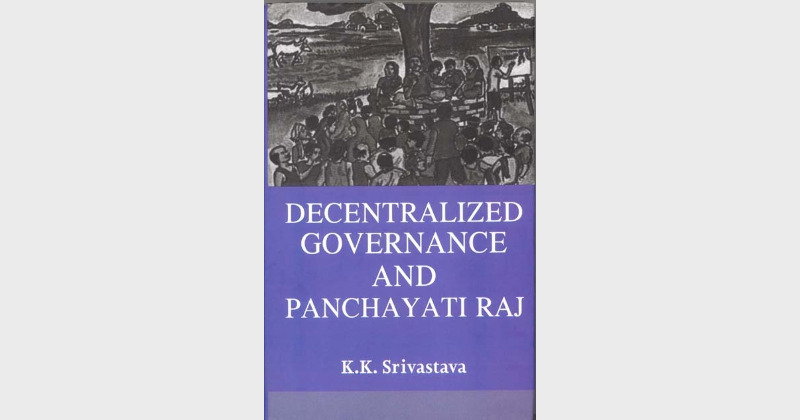
A valuable study of Panchayati Raj?
By Manju Gupta?
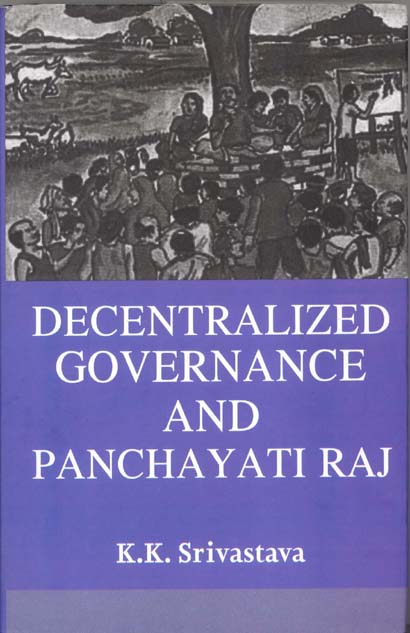 Decentralised Governance and Panchayati Raj, K.K. Srivastava, Kalpaz Publications, Pp 280, Rs 750.00?
Decentralisation is considered as an instrument for meeting the aspirations of local people all over the world. Prior to Independence of India, it was Lord Mayo who had thought of the concept and incorporated the decentralisation formula during the British Raj. Since 1957, following Independence, many experiments have been carried out for decentralisation of governance but it was found that people’s participation was limited. They did not identify themselves with these institutions and neither did the panchayats make any attempt to ensure their involvement in the decision-making process. Many panchayats were superseded and elections were not held for years. Rather the whole process of development through panchayats gave the opportunity to the rural elites to emerge as centres of power and work with government functionaries at local level. Apart from this, panchayats did not get enough funds for development and without elections, women, Scheduled Castes and Tribes did not find any representation.
It was the 73rd and subsequently the 74th Constitutional Amendments in 1992-93 that ushered in the present phase of panchayats which are described as institutions of local self-government and are expected to chalk out plans for economic development and social justice. The 73rd amendment has been considered as a major landmark in the history of local self-government and some of its salient features are grant of constitutional status to Panchayati Raj institutions, reservation of one-third seats for women in panchayat bodies, holding of elections to panchayats after every five years under the direct supervision of the Chief Electoral Office and setting up of Finance Commission to review the financial position of the panchayats.
In the context of reservation for women in Panchayati Raj institutions, it becomes pertinent to analyse their socio-economic status along with political accountability as entrusted under the constitution to them. This book presents a study of decentralised governance and problems of elected women representatives in Panchayati Raj to explore the findings and take remedial measures.
The author carried out a field study and its analysis to come to the conclusion that neither from the point of view of people’s participation, nor from the perspective of capacity of Panchayati Raj institutions to deliver in the rural areas does the Act prove to be effective. Thus he feels that given the state of socio-economy and political disparities and the poor capacity of the panchayats to deliver, reforms are critically required for reducing inequalities, making basic services available to people and enhancing their access to opportunities. Reforms have to be focused on fundamentals like mobilising people, responsiveness to the aspirations of the weaker sections of the society and providing them with a good quality of life. He calls for implementation of various legislations at different levels along with required socio-economic and institutional reforms through people’s participation in democratic and developmental processes and through improved efficiency of panchayats to deliver.
(Kalpaz Publications, C-30 Satyawati Nagar, Delhi – 110052; www.kalpaz.hotmail.com)
Know your North-east?
By Manju Gupta?
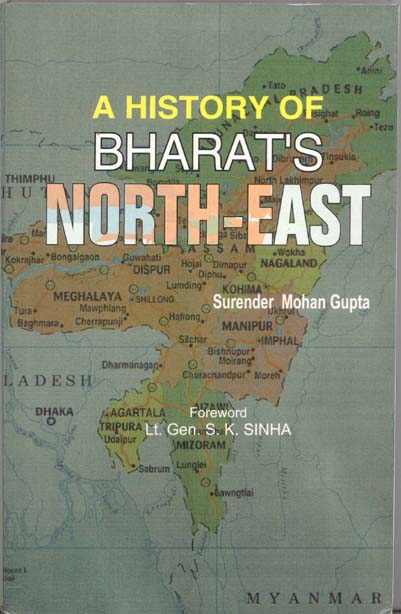 A History of Bharat’s North-east, Surender Mohan Gupta, DAV Publications Division, Pp 284, Rs 125.00?
North-east has been an integral part of India since the epic ages but the tribes have not been fully assimilated with the Indian civilisation and culture, partly because of Indian people’s ignorance about the strategic importance of the region and its people in preserving the cultural unity of India. Assam had a glorious past and its history is history of the Brahmaputra valley. The Ahoms, who came from ‘Syamadesa’ in AD 1226, conquered the whole of Bahmaputra valley. They could not contain the Burmese invasion that followed till the British rule was established over the whole of Assam. The north-east, comprising Assam, Arunachal Pradesh, Manipur, Meghalaya, Mizoram, Nagaland and Tripura, along with Sikkim which was included in 1998, has been isolated from the rest of the country since the British left.
Assam is the sentinel of the north-east as it is strategically situated. The author talks of the colonisation of Assam by settlers from East Bengal in the second decade of the 20th century, the Muslims of Bengali descent and the political refugees coming in hordes during the 1970-71 Bangladesh war.
After 1947, following the country’s Independence from British rule, Assam was divided into five states and this gave rise to militant sub-nationalism which tapped their sense of injury and powerlessness. The breakup of Assam was due to a complex set of factors. The politics of resistance to immigration reinforced the Assamese desire for cultural policies and the Bengali influence in Assam gave rise to ‘language riots’. The re-organisation of states and the outbreak of language riots in 1972 helped in making the Muslims of Bengali descent as the “unexpected beneficiaries”, while the Bengali Hindus and ethnic Assamese fought out their cultural wars. The influx of Bengali Muslims into Assam led to a six-year long anti-immigration stir followed by two insurgencies. This continued till an accord was reached between the Government of India and the state government.
Apart from Assam, the other six states are also described but not in so much detail as Assam, possibly because Assam is the largest and the most developed state in the region.
A very valid point raised in this book is while most history books in India talk of the Indus Valley and Ganges Valley civilisations, no mention is made of the Brahmaputra Valley civilisation; also while Maharana Pratap and Shivaji are eulogised, no mention is made of Lachit Borphukan, the great military hero of Assam; hence why grudge the Assamese their feelings of anger and alienation?
(DAV Publications Division, Arya Samaj Building, 40 Block, Pitampura, Delhi-110034; davpubdiv@msn.com)
A Hindu way of Life?
By Manju Gupta
 Mangal Bhawan Amangalhari (Hindi), Parivar Pradeepika, Pp 366, Rs 120.00?
This is the Hindi translation of the Kannada book titled Maneye Mangalya and presents as many as 800 questions and answers related to the Hindu way of life, right from the time of waking up at beak of dawn till falling asleep.
While describing the kutumba (family), the book explains the duties of a householder towards his wife and children, whose upbringing and marriage are also his responsibility. But his duties do not end here because he has now to take care of his grandchildren too if not directly, then by assisting his children to bring them up. Thus a kutumba may mean three generations staying together to constitute a joint family. It can also happen that at times, a member of the family may go out of station or abroad to live and start his family there. This does not amount to partition of the family but is considered an extension.
The book is presented in question-answer form and is divided into three sections, where the first section concentrates on daily life, fasting, food, bathing, prayers, physical exercise, patriotic songs, chanting of mantras, importance of mother tongue, domestic games, puzzles, homework, CDs and music, afternoon siesta, wealth, philanthropy, etc.; the second section discusses cleanliness, decoration of home, drinks and vegetables, food, flowers, how to cook and serve food, care of skin, radio programmes, obeisance to elders behaviour towards elders and youngsters, economic situation, value of time, importance of working together, welcoming guests, care of pets, footwear and behaviour; and the third section is devoted to society and social setup, to God, temples, family deity, Vedas, superstitions, distribution of food, donation of blood and eyes, marriage, service to humanity, care of orphans and widows, observance of rites and rituals like naming ceremonies, death, etc., nurturing of plants and trees, culture, elections, dressing up, ashramas, pilgrimage, Hindutva and adverse influence of Western culture.
(Parivar Pradeepika, Sec. 75-76 ‘Gyangiri’, IV Cross, Second Main, Saudamini Layout, Konankunte Main Road, Bangalore-560062.)




Comments