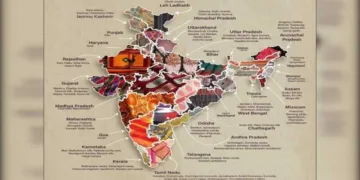
New Delhi: India’s textile heritage is as diverse as its landscapes, languages and traditions. Every region has developed its own distinctive fabrics, weaving techniques, embroidery styles and patterns, shaped by local history, climate, communities and cultural practices. From the intricate Kalamkari of Andhra Pradesh and Telangana to the luxurious Kanchipuram silk of Tamil Nadu, these textiles are not merely clothing; they are living expressions of India’s cultural identity. Tamil Nadu – Kanchipuram Silk Kanchipuram silk sarees are among India’s most celebrated traditional textiles. Woven in and around Kanchipuram, these sarees are known for their rich silk, vibrant colours and distinctive zari work. Traditional designs often feature temple borders, peacocks, paisleys, flowers and geometric patterns. A notable feature of Kanchipuram sarees is the use of contrasting borders and pallus, which give them a distinctive appearance. Traditionally associated with weddings, festivals and religious ceremonies, these sarees are often preserved as family heirlooms and passed from one generation to another. The weaving tradition has also adapted to contemporary tastes, with designers introducing lighter fabrics, modern colour combinations and new motifs while retaining the traditional craftsmanship. Andhra Pradesh and Telangana – Kalamkari Kalamkari is a traditional textile art involving hand-drawn or block-printed designs on cotton or silk. The word comes from kalam, meaning pen, and kari, meaning work. The art traditionally depicts floral motifs, mythological stories, temple scenes and figures from Indian epics. The Srikalahasti style is particularly associated with freehand drawing using a bamboo or date-palm pen, while the Machilipatnam tradition is known for block printing. Natural dyes have traditionally been an important part of the process, with colours derived from sources such as plants, minerals and other natural materials. Kalamkari has also moved beyond traditional sarees and textiles and is now widely used for dupattas, dress materials, home furnishings and contemporary fashion. Kerala – Kasavu Kerala’s iconic Kasavu saree is characterised by its simple white, cream or off-white body and distinctive golden border. Traditionally worn during festivals such as Onam and Vishu, Kasavu represents Kerala’s understated elegance. The golden border, traditionally created using zari, provides a striking contrast against the plain fabric. The simplicity of the design makes the saree suitable for both ceremonial occasions and cultural celebrations. Today, the Kasavu tradition has expanded beyond the traditional saree and is reflected in set mundu, blouses, dresses, skirts, dupattas and other contemporary garments. It remains particularly prominent during Onam celebrations. Karnataka – Mysore Silk and Ilkal Mysore silk is renowned for its smooth texture, lustrous appearance and elegant simplicity. Produced in Karnataka, it is traditionally associated with high-quality silk and distinctive zari borders. Ilkal sarees, traditionally woven in northern Karnataka, are recognised for their characteristic borders and pallu designs. A traditional feature is the Tope Teni technique, which helps connect the body of the saree with the pallu. Karnataka’s textile traditions demonstrate the variety of weaving cultures found within a single state. While Mysore silk is associated with refined silk sarees, Ilkal represents the rich handloom traditions of Karnataka’s weaving communities. Gujarat – Bandhani and Patola Bandhani, or tie-and-dye, is one of Gujarat’s most recognisable textile traditions. Small portions of fabric are tightly tied before dyeing, creating intricate patterns of dots and colourful designs. The process requires considerable precision because the tiny knots must be tied carefully to create the desired pattern. Traditional Bandhani is particularly associated with festive occasions, weddings and other celebrations. Patola, particularly the double-ikat Patola of Patan, represents a highly sophisticated weaving tradition. Both the warp and weft are resist-dyed before being woven together, producing remarkably precise patterns. Traditional motifs include geometric forms, flowers, parrots, elephants and other culturally significant designs. Rajasthan – Bandhej and Leheriya Rajasthan is famous for vibrant textiles that reflect its desert landscape and colourful cultural traditions. Bandhej uses tie-and-dye techniques to create dotted and patterned designs, while Leheriya produces distinctive wave-like patterns. Leheriya is traditionally created by rolling and tying the fabric diagonally before dyeing it, resulting in flowing lines resembling waves. The technique is particularly associated with Rajasthan’s colourful festive clothing. Bright reds, yellows, pinks, greens and blues are commonly associated with Rajasthani textiles. These fabrics are widely used in sarees, odhnis, turbans, dupattas and other traditional garments. Maharashtra – Paithani The Paithani saree, traditionally associated with Paithan, is one of Maharashtra’s finest handwoven textiles. It is known for its silk base, zari work and distinctive motifs, especially peacocks, parrots, flowers and traditional geometric patterns. The pallu is often the centrepiece of a Paithani saree, featuring elaborate motifs woven using coloured silk and zari. The peacock design is particularly iconic and is strongly associated with the textile. Paithani sarees are traditionally worn during weddings, festivals and important family occasions. Their intricate craftsmanship and time-intensive weaving have helped establish them as prized heirlooms. West Bengal – Tant, Jamdani and Baluchari West Bengal has a rich handloom heritage. Tant sarees are lightweight cotton sarees suited to the region’s warm and humid climate. Their breathable fabric and simple elegance have made them a popular part of everyday and festive clothing. Baluchari sarees are known for elaborate woven scenes, often inspired by mythology, history and everyday life. The pallu and borders may feature detailed figures and narrative motifs, effectively turning the saree into a woven storytelling canvas. The region is also associated with Jamdani, an intricate weaving tradition in which decorative motifs are created directly on the loom. Floral and geometric patterns are commonly incorporated into the fabric, requiring considerable skill and patience from the weaver. Odisha – Sambalpuri and Bomkai Sambalpuri sarees are among Odisha’s best-known textiles. They use the traditional ikat technique, in which threads are tie-dyed before weaving. This creates distinctive patterns that appear integrated into the fabric rather than simply printed on its surface. Common motifs include the shankha (conch), chakra (wheel), flowers, animals and traditional geometric patterns. These motifs often have cultural and symbolic significance. Bomkai sarees, also known as Sonepuri sarees in some contexts, combine intricate motifs with traditional weaving techniques. Their detailed borders and pallus make them popular for … Continue reading From Kanchipuram to Kalamkari: Exploring India’s rich traditional textiles and regional clothing heritage
