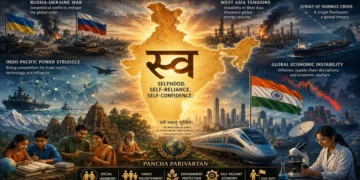
The world today stands at one of the most uncertain geopolitical moments since the end of the Cold War. From the prolonged Russia-Ukraine war to the Israel-Iran tensions in West Asia, from the Indo-Pacific power struggle to economic warfare between global superpowers, international politics has entered a phase of instability. Supply chains are breaking, energy prices are fluctuating, food insecurity is rising, and ideological polarisation is deepening across societies. In this atmosphere of global conflict and civilisational anxiety, India faces a fundamental question: should it continue depending excessively on external systems and borrowed frameworks, or should it rediscover its own civilisational strength rooted in the idea of “Swa”? The concept of “Swa,” long emphasised by the Rashtriya Swayamsevak Sangh, becomes profoundly relevant in this age of global crisis. Swa is not merely “self” in the narrow personal sense. It refers to civilisational selfhood — a nation’s awareness of its identity, values, cultural continuity, intellectual independence, and strategic confidence. The RSS has repeatedly argued that political independence alone is insufficient if a society remains mentally, economically, and culturally dependent upon external powers. This distinction is reflected in its emphasis on the difference between “Swadhinata” and “Swatantrata.” Swadhinata means political independence — liberation from colonial rule. India achieved that in 1947. But Swatantrata signifies a deeper freedom: intellectual autonomy, cultural confidence, economic resilience, and civilisational self-awareness. In today’s global order, this distinction has become more important than ever before. In recent years, the RSS has repeatedly spoken of “Panch Parivartan” — five transformative dimensions necessary for national reconstruction — within which ‘Swa’ occupies a central place. The ongoing Russia-Ukraine war is perhaps the clearest example of how geopolitical conflicts can reshape the global economy overnight. Europe’s dependence on Russian gas created a severe energy crisis after sanctions and supply disruptions began. Nations that once preached the inevitability of global integration suddenly turned inward, prioritising domestic security and national interests. Inflation surged globally, food exports were disrupted, and developing countries suffered the consequences of a conflict far beyond their borders. The lesson for India is clear: excessive dependence on external powers for critical sectors can become a strategic vulnerability. Similarly, the growing tensions in West Asia have exposed the fragility of global energy networks. The recent concerns surrounding the Strait of Hormuz crisis demonstrate how a single geopolitical flashpoint can affect the entire world economy. Nearly one-fifth of global oil trade passes through the Strait of Hormuz. Any escalation involving Iran, Gulf nations, or Western military powers threatens global shipping routes and energy security. For a country like India, which imports a large portion of its energy requirements, instability in Hormuz directly impacts fuel prices, inflation, transportation costs, and economic growth. This is precisely why the idea of Swa becomes strategically essential. A nation that lacks self-reliance in critical sectors remains vulnerable to external shocks. Energy diversification, indigenous manufacturing, domestic technological capacity, and food security are not merely economic policies; they are expressions of national selfhood. The spirit of “Atmanirbhar Bharat” emerges from this very understanding. In a fractured global order, self-capacity is no longer optional; it is necessary for national survival. The crisis is not only economic but also civilisational. Modern global politics increasingly reflects conflicts of identity, ideology, and cultural insecurity. Across many Western societies, social fragmentation, loneliness, declining family structures, and ideological extremism have created deep internal crises. Technological advancement has brought material prosperity, yet many societies continue to struggle with spiritual emptiness and social alienation. In such a world, India’s civilisational worldview offers an alternative rooted in balance, harmony, and collective responsibility. The Bharatiya idea of society has historically prioritised duties alongside rights, community alongside individuality, and spiritual wellbeing alongside material growth. Concepts such as “Vasudhaiva Kutumbakam”, the world as one family, are not merely slogans but reflections of a civilisational ethos that sees humanity through the lens of coexistence rather than domination. However, India can contribute this worldview to the world only when it remains rooted in its own ‘Swa’. As the second Sarsanghchalak of the RSS, Shri Guruji once observed, “The ideal of human unity, of a world free from all traces of conflict and misery has stirred our hearts since times immemorial. Our one constant prayer all through the ages has been: sarve bhavantu sukhinaḥ, sarve santu nirāmayāḥ (Let everyone be happy, let everyone be free from all ills.)” The emerging geopolitical contest between the United States and China further highlights the need for civilisational and strategic self-confidence. The Indo-Pacific region is increasingly becoming the centre of global power competition. Trade routes, semiconductor technologies, maritime dominance, artificial intelligence, and military alliances are shaping a new global order. In such a scenario, India cannot afford to become merely a passive participant dependent upon either Western or Chinese systems. Strategic autonomy requires intellectual autonomy. A nation unsure of its own identity often becomes susceptible to external ideological and economic influence. This is why the RSS’s emphasis on Swa is not simply cultural rhetoric; it has geopolitical significance. A self-aware civilisation is capable of engaging globally without losing itself. India must modernise, innovate, and participate actively in global affairs, but from a position of rooted confidence rather than imitation. The challenge before India is not choosing between tradition and modernity, but harmonising both. The COVID-19 pandemic further exposed the dangers of overdependence on global systems. Even powerful countries struggled to secure medical supplies, vaccines, and essential equipment. Globalisation, once celebrated as the guarantee of uninterrupted interconnectedness, suddenly revealed its vulnerabilities. India’s domestic vaccine production capacity, digital infrastructure, and local manufacturing capabilities became major strengths during the crisis. The pandemic reminded the world that national resilience matters more than abstract global dependency. Yet, ‘Swa’ is not isolationism. India’s civilisational philosophy has never promoted withdrawal from the world. Historically, Bharat engaged deeply with global trade, intellectual exchanges, and cultural interactions while retaining its own civilisational core. The strength of Indian civilisation lay in its ability to absorb influences without surrendering its identity. Thus, ‘Swa’ does not reject globalisation; it seeks balanced … Continue reading The Geopolitics of Selfhood: Why the idea of ‘Swa’ is emerging as Bharat’s strategic compass in a turbulent world
