Aizawl: It has taken four decades, four rounds of negotiations, and a continuous government process and on April 30, Mizoram finally closed the last chapter of its long and painful insurgency story.
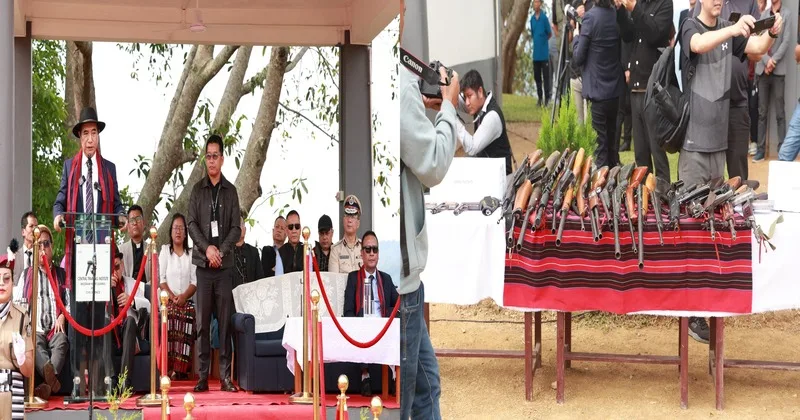
Cadres of the Hmar Peoples’ Convention (Democratic) — Lalhmingthanga Sanate Faction — formally surrendered their weapons at the Central Training Institute Parade Ground in Sesawng, stepping out of the shadows of underground existence and back into the mainstream. With that single act, Mizoram became the first state in the entire Northeast region to be completely free of active insurgent groups.
The moment had been building since April 14, when the Government of Mizoram and the HPC (D) Lalhmingthanga Sanate Faction signed a formal peace agreement at Sakawrdaia. Thursday’s ceremony was the physical, visible fulfilment of that promise — arms handed over, oaths taken, and a chapter that began in the turbulent aftermath of 1986 finally, definitively, closed.
A long road ahead
To understand what the event meant, you need to go back to 1986 — the year Mizoram signed its landmark Peace Accord, ending the major MNF insurgency that had consumed the state for two decades. It was supposed to be a clean resolution. For much of Mizoram, it was. But among sections of the Hmar community, the feeling persisted that their specific aspirations had been left unaddressed, their concerns brushed aside in the broader settlement.
Out of that frustration came the Hmar Peoples’ Convention. In 1994, another agreement led to the formation of the Sinlung Hills Development Council — a concession, but not a complete one. A faction broke away, forming the HPC (D) under Lalhmingthanga Sanate, continuing the armed struggle even as political options were being explored.
One faction, led by Pu H. Lalsangbera, had already made peace with the government back in April 2018. The Sanate faction held out longer. Talks resumed in 2024 and went through four painstaking rounds before landing on an agreement both sides could live with. On Thursday, that agreement became reality.
‘True bravery’: CM said
Chief Minister Lalduhoma presided over the Home Coming and Arms Laying Ceremony alongside Speaker Lalbiakzama, Home Minister K. Sapdanga, members of parliament, ministers, and MLAs — a gathering that reflected how seriously the government regarded the occasion.
In his address, the Chief Minister was both reflective and firm. He acknowledged that discussions on peace in Mizoram have, for years, been inseparable from the question of HPC (D). He credited Home Minister Sapdanga and his team for the relentless behind-the-scenes work that made the breakthrough possible.
But his most striking words were reserved for the cadres themselves. He called their decision to lay down arms an act of “true bravery” — a framing that deliberately recast surrender not as defeat, but as courage. He urged all citizens to guard what had been achieved. “Let us collectively distance ourselves from anything that can incite violence and conflict,” he said, in a line that felt less like a political statement and more like a personal appeal. He was equally emphatic on unity — there are no divisions within the Mizo community, he asserted. All are Mizo. Any attempt to drive a wedge through that identity, he warned, would fail.
Home Minister Sapdanga, for his part, described it as a historic day and welcomed the cadres warmly into the mainstream, attributing the success to the Chief Minister’s personal commitment to seeing Mizoram at peace.
The cadres formally handed over their arms to IGP (Headquarters) H. Ramthlengliana in a moment that was both symbolic and utterly concrete — weapons that had once been pointed at the state, now in the state’s hands. An oath-taking ceremony followed, in which the cadres pledged to renounce violence — words spoken aloud, in public, before witnesses, binding themselves to the peace they had chosen.
Mizoram has now achieved something no other state in the Northeast has managed: a complete exit from organised ethnic insurgency. In a region that has seen decades of armed movements — some resolved, many still simmering — that is not a small thing.
Chief Minister Lalduhoma said it simply: Mizoram can now confidently be described as a truly peaceful state. After forty years, it is a sentence worth saying out loud.