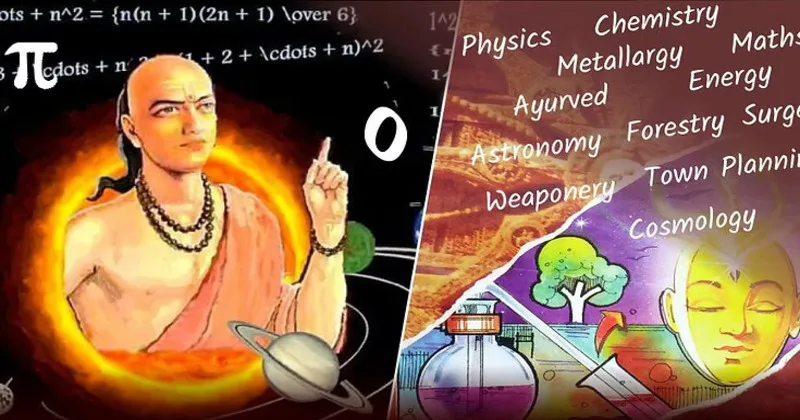
One of the most persistent misconceptions in modern intellectual discourse is the supposed conflict between science and religion. This narrative, deeply rooted in Western historical experience, portrays science and faith as opposing forces, reason versus belief, experiment versus scripture. However, this framework is not universal. When we turn to the Indian intellectual tradition, we encounter a radically different vision, one in which science and spirituality are not adversaries but complementary pathways in the pursuit of truth.
The western divide
In medieval Europe, the institutional authority of the Church dominated the intellectual life. Knowledge was often interpreted through theological doctrine and questioning religious authority could invite severe consequences. The well known cases of Galileo Galilei and Nicolaus Copernicus exemplify this tension. Their heliocentric models challenged prevailing Church doctrines, leading to conflict and eventually, a perceived separation between scientific inquiry and religious belief.
This divide was further reinforced during the enlightenment, when thinkers such as Voltaire and Rene Descartes championed reason, skepticism and empirical methods, often distancing themselves from religious dogma. Over time, this historical trajectory solidified the notion that science and religion occupy mutually exclusive domains, science explaining the material world and religion confined to faith and metaphysics.
The Indian perspective
In contrast, Indian thought never subscribed to such a dichotomy. Knowledge (vidya) was understood as a unified enterprise, encompassing both empirical and transcendental dimensions. The Rig Veda expresses this beautifully, “एकं सद् विप्रा बहुधा वदन्ति” (Truth is one, the wise express it in many ways). This foundational idea reflects a worldview where multiple approaches, observation, reasoning, meditation and scriptural study converge toward a single truth (satya). Disciplines such as astronomy (jyotisa), medicine (ayurveda), grammar (vyakarana) and logic (nyaya) were all considered integral parts of a comprehensive knowledge system.
The Mundaka Upanishad further distinguishes between two forms of knowledge, द्वे विद्ये वेदितव्ये इति ह स्म यद्ब्रह्मविदो वदन्ति । परा चैवापरा च ॥ (There are two kinds of knowledge to be known, the higher and the lower). Here, the ‘lower’ (apara vidya) includes sciences, arts and worldly knowledge, while the ‘higher’ (para vidya) leads to ultimate realization. Crucially, both are valued and seen as complementary, not contradictory.
Nyaya: Logic and the scientific spirit
A powerful demonstration of the scientific spirit in ancient India is found in the Nyaya school of philosophy, founded by Gautama. The term Nyaya itself means ‘method’ or ‘rule’ and the system is fundamentally concerned with valid reasoning and the acquisition of true knowledge.
The Nyaya school of philosophy presents a highly structured and systematic approach to knowledge, identifying four primary means (pramana) through which valid understanding is attained, Pratyaksa (perception or direct observation), Anumana (inference), Upamana (comparison or analogy) and Sabda (reliable testimony). This framework bears a remarkable resemblance to the modern scientific method, which similarly depends on observation, hypothesis formation, analogy and peer-reviewed validation.
Beyond epistemology, Nyaya also developed a refined logical structure for reasoning, articulated in a five-step syllogism, Pratijna (proposition), Hetu (reason), Udaharana (example), Upanaya (application) and Nigamana (conclusion). This method not only demonstrates logical rigor, but also reflects a disciplined approach to argumentation and proof, comparable to formal reasoning in contemporary science and mathematics. For example, “There is fire on the hill, because there is smoke, wherever there is smoke, there is fire, the hill has smoke; therefore, the hill has fire.”This systematic reasoning reflects a highly structured and analytical approach, comparable and in some ways more elaborate than Aristotelian logic.
The Mahabharata underscores the importance of reasoning, तर्कोऽप्रतिष्ठाः श्रुतयो विभिन्ना
नैको ऋषिर्यस्य मतं प्रमाणम्। धर्मस्य तत्त्वं निहितं गुहायां महाजनॊ येन गतः स पन्थाः॥ (Logic has no fixed end, scriptures differ, reason must guide the seeker toward truth). This statement reveals a profound intellectual openness, scriptures are not beyond questioning, and reason plays a central role in validating knowledge.
Empiricism and error correction
Indian epistemology also recognized the limitations of human perception. The classic example of mistaking a rope for a snake illustrates that sensory knowledge can be flawed, but such errors can be corrected through further observation and reasoning. This reflects a scientific mindset that acknowledges uncertainty and emphasizes verification. In practical fields like medicine, texts such as the Susruta Saṃhita combined observational rigor with systematic procedures. Similarly, astronomical works like the Aryabhatiya provided precise calculations of planetary motion, eclipses, and mathematical constants, all grounded in empirical observation.
Integration across disciplines
What distinguishes the Indian approach is not merely the presence of scientific reasoning, but its seamless integration with philosophical and spiritual inquiry. The same intellectual tradition that explored atomic theory in the Vaisheshika Sutra also investigated consciousness in the Upanishads. Rather than fragmenting knowledge into isolated domains, Indian thinkers pursued a holistic understanding of reality. This integrative approach is evident in practices such as Yoga and Ayurveda, which combine physical, mental and spiritual dimensions. Temples, too, were not only places of worship but centers of architecture, acoustics and astronomy. The Sun Temple at Konark, functioning as a giant sundial, exemplifies this synthesis of science and spirituality.
Countering the ‘unscientific’ label
Critics who label Indian traditions as ‘unscientific’ often conflate spirituality with irrationality. However, the presence of metaphysical elements does not negate scientific content. On the contrary, Indian texts demonstrate a layered approach, where empirical investigation coexists with philosophical reflection.
The rigorous analysis of knowledge sources, the emphasis on debate and the systematic development of logic all point to a deeply scientific culture. Schools such as Nyaya, Mimamsa and Buddhist logic engaged in intense intellectual debates, refining their theories through critique and counter argument, much like modern academic discourse.
Toward a unified vision of knowledge
The idea of ‘science versus religion’ is thus a historically contingent narrative, not a universal truth. While the Western experience led to a separation between the two, the Indian tradition offers an alternative paradigm, one of integration and harmony. In India, science and spirituality were never seen as competing domains but as complementary paths leading to the same ultimate reality. Science sought to understand the external world, while spirituality explored the inner dimensions of consciousness. Together, they formed a unified quest for truth.
As we move into an era of interdisciplinary research and holistic thinking, this integrative vision holds renewed relevance. The future of knowledge may well lie not in dividing disciplines, but in reconnecting them, bringing together empirical rigor and philosophical depth. In this sense, the Indian Knowledge Tradition remind us that true wisdom is not about choosing between science and religion, but about transcending the divide and embracing a more complete understanding of reality.