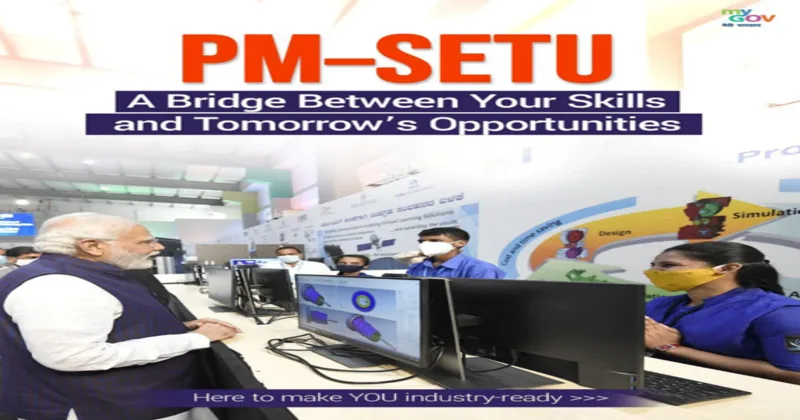
Bharat is at an interesting juncture where it has to translate its demographic strength into economic strength. Bharat adds almost 12 million young people to its workforce every single year, the problem is creation of employability to everyone. Recognising this, the government led by Prime Minister Shri Narendra Modi has launched the Pradhan Mantri Skilling and Employability Transformation through Upgraded ITI(PM-SETU) scheme on October 4, 2025. This scheme has an investment of ₹60,000 crore and represents a complete overhaul of Bharat’s vocational education and training space.
The PM-SETU scheme aims at completely transforming traditional Industrial Training Institutes(ITIs). The scheme goes beyond traditional skill development initiatives and aims at linking skill development with employability. The scheme targets sectors such as Artificial Intelligence, Electric Vehicles, Green Energy, etc. will define Bharat’s future of work.
For millions of youths, especially those from rural and semi-urban background, this initiative promises to provide an opportunity for upward movement in the Indian social ladder. A youth from Bihar, who comes under this program, undertakes training as an electric vehicle technician. It will not only increase the earning capacity of the youth but also helps in integrating the youth into the formal sector of the economy. This is what PM-SETU promises to deliver where aspirations turned into opportunities.
Strong financial backbone driving change
The magnitude of the initiative that PM-SETU promises to deliver is also evident in the financial structure that it has put in place. The entire amount of ₹60,000 crores, which PM-SETU plans to spend is shared across various stakeholders, ensuring that they not only participate in the initiative but also remain accountable for the amount they contribute. The Centre would be contributing ₹30,000 crores the state governments would be contributing ₹20,000 crores and the industry would be contributing the remaining ₹10,000 crores.
This financial model is further supported by global institutional backing as well. It was approved in February 2026 when the World Bank approved a loan amount of $830 million i.e., around ₹7,000 crores, with a maturity period of 19.5 years. The Asian Development Bank has also joined the initiative, helping mobilize an additional amount of $680 million in the form of private capital. It is also an indicator of the high amount of trust that the global institutions have in the skilling strategy adopted by Bharat.
What makes the PM-SETU model special is the focus on sustainability, as the establishment of Special Purpose Vehicles (SPVs) with the involvement of the industry also ensures that the training centers are not dependent on government funding alone. These SPVs would also be able to generate revenue through various means, including training, consultancy and production activities.
Reinventing ITIs for the future
The network of over 15,000 ITIs has historically played an important role in vocational training. Many of them were in need of modernization in accordance with the changing industry requirements. PM-SETU seeks to bridge this gap with the modernization of 1,000 government ITIs using the hub and spoke model. In this model 200 ITIs are created as advanced hubs with modern lab facilities, smart classrooms and digital infrastructure. These advanced hubs are centres of excellence and provide guidance support to 800 other ITIs. This is a blend of centralized excellence and decentralization.
The states have also welcomed the hub and spoke model. In Karnataka, hubs are being created in Bengaluru and Kalburgi. In Bihar, hubs have already been initiated in Patna and Darbhanga. These are examples of how PM-SETU is adapting to local requirements and providing a unified national framework. The curriculum has been redone accordingly, keeping the industry needs in mind. Courses like electric vehicles, artificial intelligence, green technologies, etc., are being introduced, which will ensure that the trainees are equipped with the right skills that are needed in the future as well. The scheme has also been designed in a way that 25 per cent of the trainees will comprise women, thus promoting gender inclusivity.
Five National Skill Training Institutes, situated in Bhubaneswar, Chennai, Hyderabad, Kanpur and Ludhiana, are being upgraded to Centres of Excellence. These Centres of Excellence are focused on training the trainers, which is done in association with international organizations as well, thus ensuring the quality of training.
Bridging the employability gap
The biggest problem faced by Bharat is the employability gap, which is the gap between education and employability. Earlier, only 42–55 per cent of the students were considered employable, but with the introduction of this scheme, the employability gap is going to be bridged as the courses are designed accordingly.
The scheme follows an outcome-based approach, aiming for a placement rate of over 70 per cent in sectors with a high demand for skilled personnel. According to various studies vocational training has been found to improve employability by 20-30 per cent as compared to general education. By incorporating the concept of placement, PM-SETU ensures that skill development leads to actual employment.
The magnitude of the scheme is also noteworthy, as it targets a skilled workforce of over 1 million youth every year, thus ensuring a continuous supply of skilled professionals in sectors such as manufacturing, green energy, and technology. While the immediate benefits are for the urban youth, the concept of the hub and spoke ensures that rural youth are also integrated into this growth story. This not only solves the problem of unemployment but also leads to the formalisation of the workforce, as the youth are able to access better-paying jobs in the formal sector, thus improving productivity in the economy.
Rapid execution and national momentum
The speed of implementation is one of the significant features of the PM-SETU scheme. After the Cabinet approval in May 2025, the scheme was launched in October 2025 and received rapid traction across the country. By January 2026, all 32 States and Union Territories had formed State Steering Committees with the Chief Secretaries. 15 States have already floated Requests for Proposals(RFPs) to engage with the industry. States like Maharashtra have conducted extensive consultations with the industry to ensure effective participation. At the national level, the absence of pending proposals in the National Steering Committee is also indicative of the streamlined system.
The global partnership has also fast-tracked the implementation of the scheme. The inclusion of global institutions like the World Bank and the Asian Development Bank not only provides financial support but also brings global best practices. Early implementation efforts are also evident in the States like Bihar, which demonstrates the success of the scheme itself.
Long-term impact: Building a skilled Bharat
The long-term vision of PM-SETU is in line with Bharat’s vision of becoming a developed nation by 2047. This scheme directly contributes to the growth of the economy and the development of industries. The projected outcomes indicate the magnitude of the transformation that is expected in the economy. By 2026, it is expected that more than 5 lakh youth will be trained, with a placement rate of over 60 per cent. By 2027 it is expected that the numbers will rise to over 10 lakh youth, with a placement rate of over 70 per cent. By 2030, it is expected that the cumulative effect will be 1 crore youth.
Another strength of PM-SETU is that it is sectorally aligned. The electric vehicle sector is expected to require 30 lakh workers by 2030. This ensures that Bharat is able to deliver on such demands without relying on external expertise. This scheme is also ensuring inclusivity. 25 per cent of the beneficiaries are expected to be women, ensuring that the economy grows in an inclusive manner. The inclusion of SPVs ensures sustainability.
Defining step towards Viksit Bharat
PM-SETU is, a paradigm shift in the approach of Bharat towards skill development, as it attempts to go beyond the conventional training methods and create an entire ecosystem that includes funding, infrastructure, curriculum and employment. By linking skill development initiatives with the needs of the industry and the global environment, the PM-SETU addresses the major challenge facing Bharat with utmost clarity and precision.
For the youth of Bharat, PM-SETU is not just an opportunity, but it is the way to achieve dignity, stability and growth in life. It helps the youth of Bharat to be an integral part of the journey of the nation’s growth and development. It is the way to create a platform for the growth of the nation.
As Bharat continues its journey to create a Viksit Bharat by 2047, the initiatives such as PM-SETU would be the stepping stone to create an inclusive, sustainable and futuristic growth path for the nation. The transformation has begun not in isolated areas, but across the nation, as millions of youth of Bharat are getting ready to shape the future with skill, confidence and purpose.